


Monitored alarm systems are a serious upgrade for Australians who want more than a siren on the wall. From my experience working with security content and installation-focused topics, the main reason people choose monitoring is simple: when an alarm activates, someone can assess the signal, follow a response process, and contact the right people.
In Australia, that matters because homes, retail sites, offices, warehouses, and strata buildings all face different risks. A café owner may worry about after-hours break-ins. A family may want support while travelling. A warehouse may need staff duress, opening reports, and after-hours escalation.
This guide explains how monitored alarm systems work, what to compare, and how to choose a setup that suits your property without relying on hype or fear.
What Are Monitored Alarm Systems?
Monitored alarm systems connect your alarm panel, sensors, and communication device to a monitoring centre or app-based response pathway. When the system detects an event, alerts are sent for review and escalation, such as notifying keyholders, security patrols, emergency contacts, or other nominated responders.
Table of Contents
- Why monitored alarm systems matter in Australia
- How monitored alarm systems work
- Main components of a monitored alarm system
- Professional monitoring vs self-monitoring
- Onshore vs offshore alarm monitoring
- Residential monitored alarm systems
- Business monitored alarm systems
- Costs and value factors
- Compliance and administrative considerations
- Numbered checklist: onboarding steps
- Common mistakes to avoid
- People Also Ask
- Expert Q&A
- Conclusion
Why Monitored Alarm Systems Matter in Australia
A basic alarm can make noise. However, monitored alarm systems are designed to create a response pathway. That difference is important.
According to the Australian Bureau of Statistics, 1.8% of Australian households experienced a break-in during the 2024–25 financial year, which represented about 196,600 households. You can review the national figures in the ABS release on crime victimisation in Australia.
Although most people will never need an alarm response, the value of monitoring is often clearest during stressful moments. For example, you may be asleep, overseas, in a meeting, or unable to check your phone. In those cases, an unmanaged alert can be missed.
Monitored alarm systems are especially useful when:
- The property is empty for long periods.
- Staff work early, late, or alone.
- Stock, tools, cash, or equipment are kept onsite.
- Insurance, lease, or internal policy requirements apply.
- The owner wants event records and accountability.
- The site has multiple users, entry points, or risk zones.
However, monitoring is not magic. It does not guarantee police attendance, stop every break-in, or replace good locks, lighting, access control, CCTV, and sensible procedures. Instead, it improves the chance that an alarm event is noticed and handled through a planned process.
How Monitored Alarm Systems Work
Monitored alarm systems use sensors, a control panel, communication paths, and response rules.
First, sensors detect activity. These sensors may include door contacts, motion detectors, reed switches, glass-break detectors, panic buttons, smoke-linked devices, or duress inputs. Then, the alarm panel processes the event. If the system is armed and the event matches a programmed alarm condition, it sends a signal.
Next, the signal travels through a communication path. Modern systems may use IP, 4G, 5G, or dual-path communication. Older systems may have used 3G devices or landline diallers. Because Australia’s 3G networks have now been switched off, many older communicators need review or replacement. The Australian Government explains this transition in its guidance on the 3G network switch-off.
After the signal is received, the response depends on the monitoring type. A professional monitoring centre may follow an agreed action plan. This may include calling keyholders, checking event types, dispatching a patrol, or escalating based on your instructions. Alternatively, self-monitoring sends alerts to your phone through an app, SMS, push notification, or email.
The “best” option depends on risk, budget, site type, and how reliably someone can respond.
Main Components of a Monitored Alarm System
A strong monitored alarm system is not just a box on the wall. It is a set of connected parts that must work together.
Alarm Control Panel
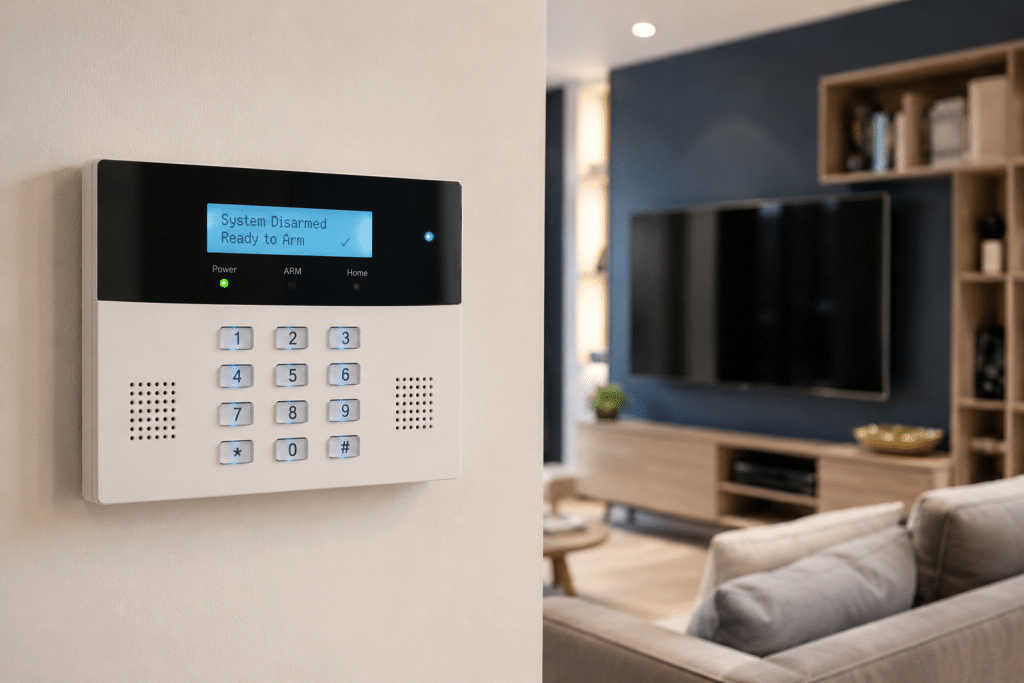
The alarm control panel is the brain of the system. It receives signals from sensors, checks whether the system is armed, and sends alarm messages. It also stores user codes, schedules, zones, and communication settings.
For homes, a compact panel may be enough. For commercial sites, the panel may need more zones, partitions, user permissions, reports, and integration options.
Sensors and Detection Devices
Sensors detect specific events. For example, a door contact detects opening. A PIR motion detector senses movement. A glass-break detector listens for patterns linked to breaking glass.
In my experience, sensor placement often matters more than the brand name. A high-quality detector installed in the wrong spot can cause false alarms. Therefore, installers usually consider sunlight, pets, air movement, ceiling height, entry paths, and business operations before choosing device locations.
Keypads, Tags, and App Control
Users need a safe way to arm and disarm the system. This may involve a keypad, fob, proximity tag, remote control, or mobile app.
For businesses, user management is important. For example, each staff member should have a unique code where practical. This helps managers see who opened or closed the premises. It also avoids the common problem of shared codes continuing after staff leave.
Communication Path
The communication path connects the alarm system to the monitoring destination. Common options include internet, cellular, or dual-path signalling.
Dual-path communication is usually stronger because it provides a backup path. For example, if the internet fails, cellular communication may still send a signal. However, signal strength, device compatibility, network coverage, and power backup still need review.
Backup Battery
A backup battery keeps the system running during a power outage. However, batteries degrade over time. Therefore, scheduled maintenance is important. A weak battery may create trouble signals or fail when it is needed most.
Monitoring Centre or App Destination
This is where the alarm event goes. In professional monitoring, the destination is a monitoring centre. In self-monitoring, it is usually one or more nominated users.
ASIAL, the Australian Security Industry Association Limited, operates a monitoring centre grading and certification scheme. Its information on monitoring centre grading is useful when comparing professional monitoring arrangements.
Professional Monitoring vs Self-Monitoring
Monitored alarm systems can be managed in different ways. The two main models are professional monitoring and self-monitoring.
Professional monitoring means alarm signals are handled by a monitoring centre. Self-monitoring means alerts go directly to the owner, manager, tenant, or nominated users.
Both options can be useful. However, they suit different expectations.
Professional Monitoring
Professional monitoring is best for people who want a structured response process. It is common for businesses, higher-risk homes, warehouses, medical rooms, retail stores, childcare centres, and properties with insurance or operational requirements.
The main benefit is consistency. A monitoring centre can follow instructions even when you are busy, asleep, travelling, or unreachable. Also, professional monitoring can help create records of events, openings, closings, faults, and alarm activations.
However, it comes with ongoing fees. It also requires accurate contact details and clear escalation rules.
Self-Monitoring
Self-monitoring is popular for lower-risk homes and small properties where the owner wants simple alerts. It can be cost-effective, especially when paired with cameras, smart locks, and good physical security.
However, it depends on human availability. If your phone is off, out of range, muted, flat, or ignored, the alert may not lead to action. In addition, app alerts can become noisy if the system is poorly configured.
For this reason, self-monitoring works best when users are disciplined, contact lists are updated, and false alarms are rare.
Onshore vs Offshore Alarm Monitoring
Some Australians ask whether monitoring should be handled onshore or offshore. The answer depends on service model, response quality, data handling, cost, and comfort level.
| Factor | Onshore monitoring | Offshore monitoring |
| Local context | Usually stronger understanding of Australian suburbs, time zones, and response expectations | May need tighter scripts and clearer instructions |
| Communication | Easier for Australian accents, place names, and local terminology | Can still work well with strong procedures |
| Cost | Often higher | Often lower |
| Data handling | May be easier to assess under local business expectations | Requires careful review of provider policies |
| Response pathways | Often aligned with Australian keyholder and patrol processes | Depends heavily on provider setup |
| Best suited for | Businesses, higher-risk sites, and owners wanting local support | Lower-risk sites where cost is a major factor |
This table does not mean offshore monitoring is automatically poor. It also does not mean onshore monitoring is automatically excellent. Instead, the main point is to check procedures, training, redundancy, reporting, and escalation rules before deciding.
Residential Monitored Alarm Systems
Residential monitored alarm systems help protect houses, apartments, duplexes, and holiday homes. They are especially useful when families travel, live in larger properties, or want alerts reviewed while they are unavailable.
For homes, the best setup is usually simple and reliable. It may include:
- Door contacts on main entry points.
- Motion detectors in key internal areas.
- A siren and strobe.
- App control for daily use.
- Cellular or dual-path monitoring.
- Smoke or panic integration where suitable.
- Clear keyholder contacts.
Pet-friendly detection may also be needed. However, “pet-friendly” does not mean “false-alarm proof.” Pets can climb furniture, move near detectors, or trigger sensors in unexpected ways. Therefore, detector selection and placement are important.
Apartments may need a different approach. For example, an apartment may have fewer entry points but shared building access. In that case, the alarm system should focus on the unit’s door, balcony access, storage cage, and internal movement.
Holiday homes need extra care because nobody may be nearby. Therefore, owners should nominate reliable local contacts or arrange patrol response where available.
Business Monitored Alarm Systems
Business monitored alarm systems usually need more planning than home systems. A retail store, warehouse, office, clinic, workshop, and hospitality venue all have different operating patterns.
For businesses, monitoring may support:
- After-hours intrusion alerts.
- Opening and closing reports.
- Staff duress buttons.
- Restricted area alerts.
- Plant room or server room protection.
- Fault and low-battery notifications.
- Multiple user codes.
- Integration with CCTV or access control.
From my experience, the most useful business alarm designs start with workflow. For example, who opens the site? Who closes it? Which doors are used after hours? Where is stock stored? Which staff need access? What happens if the manager is overseas?
These questions shape the design.
A warehouse may need roller door contacts, beam sensors, internal motion detection, and staged arming. A medical practice may need duress buttons at reception. A retail store may need stockroom protection and after-hours escalation. An office may need separate partitions for different tenancies or floors.
Good design reduces false alarms. It also makes the system easier for staff to use.
Costs and Value Factors
The cost of monitored alarm systems in Australia can vary widely. It depends on property size, equipment quality, monitoring type, communication method, installation complexity, and service level.
As a broad estimate, a basic professionally installed home alarm may cost less than a larger business system with many zones, dual-path signalling, and monitoring. Ongoing monitoring fees may be charged monthly, quarterly, or annually. Patrol response, maintenance, call-outs, and extra reports may cost more.
Because pricing changes across providers and regions, treat any online estimate as a starting point only. A proper quote should consider the site.
Key cost factors include:
- Number of sensors and zones.
- Wired vs wireless installation.
- Communication hardware.
- Monitoring centre plan.
- App access or cloud service fees.
- Backup battery and maintenance.
- Patrol or guard response options.
- Integration with CCTV or access control.
- Site access difficulty.
- After-hours installation needs.
The cheapest system is not always the best value. For example, a cheap setup that creates false alarms may waste time and reduce trust. On the other hand, an expensive system with unnecessary features may be overkill.
A balanced system should match the actual risk.
Compliance and Administrative Considerations
Compliance can sound intimidating, but most property owners mainly need to understand the administrative side. This section is general information, not legal advice.
In Australia, alarm monitoring may involve standards, insurance requirements, licensing rules, council noise rules, building procedures, and internal business policies. A licensed security provider can help review what applies to your site.
Administrative tasks may include:
- Confirming keyholder names and phone numbers.
- Recording escalation instructions.
- Updating user codes when staff change.
- Checking insurance requirements.
- Keeping maintenance records.
- Testing communication paths.
- Reviewing monitoring reports.
- Confirming patrol access instructions.
- Updating site maps or entry notes.
- Recording false alarm causes.
For strata buildings, owners may also need approval before installing visible devices, drilling into common property, or using shared communication infrastructure. For commercial leases, tenants may need landlord approval before altering walls, doors, cabling, or signage.
These steps are not just paperwork. They help responders understand what to do during an alarm event.
Numbered Checklist: Onboarding Steps
Use this checklist when planning monitored alarm systems for a home or business.
- Define the risk.
List what you want to protect, such as people, stock, tools, rooms, vehicles, or entry points. - Map the property.
Identify doors, windows, corridors, roller shutters, storage areas, and blind spots. - Choose the monitoring model.
Decide between professional monitoring, self-monitoring, or a hybrid approach. - Confirm communication options.
Check internet reliability, mobile coverage, and whether dual-path signalling is needed. - Review old equipment.
Replace outdated communicators, weak batteries, damaged sensors, and unsupported devices. - Set user permissions.
Give unique codes to regular users. Remove old users promptly. - Create escalation rules.
Decide who is called first, second, and third. Include patrol instructions if relevant. - Test the system.
Test sensors, sirens, app alerts, monitoring signals, and backup battery status. - Train users.
Teach staff or family members how to arm, disarm, cancel false alarms, and report faults. - Schedule maintenance.
Review batteries, sensors, communication paths, contact lists, and reports at set intervals.
Common Mistakes to Avoid
Even good monitored alarm systems can perform poorly when they are badly planned or neglected.
Mistake 1: Using Shared Codes
Shared codes are common, but they reduce accountability. If everyone uses the same code, it becomes hard to know who armed or disarmed the system. Therefore, businesses should use unique codes where practical.
Mistake 2: Ignoring False Alarms
False alarms are not just annoying. They train people to ignore alerts. They may also create extra costs or delays. Common causes include poor sensor placement, loose contacts, pets, insects, user error, and weak batteries.
Mistake 3: Forgetting Contact Updates
Monitoring only works if the contact list is current. When staff leave, managers change, or phone numbers are updated, the monitoring centre should be told.
Mistake 4: Relying Only on Wi-Fi
Wi-Fi can fail, be unplugged, or lose power. For higher-risk sites, consider cellular backup or dual-path signalling.
Mistake 5: Treating Monitoring as a Complete Security Plan
Alarm monitoring is one layer. It should work with locks, lighting, CCTV, access control, staff procedures, and maintenance.
People Also Ask
Are monitored alarm systems worth it in Australia?
Yes, monitored alarm systems can be worth it when you want alerts reviewed and escalated through a clear process. They are especially useful for businesses, vacant homes, holiday properties, and sites where someone may not always be available to check an app.
Do monitored alarm systems call the police automatically?
Usually, no. Response depends on the monitoring plan, event type, verification steps, local rules, and your agreed instructions. In many cases, keyholders or patrols are contacted before any further escalation.
What is the difference between monitored and unmonitored alarms?
A monitored alarm sends alerts to a monitoring centre or nominated response pathway. An unmonitored alarm may only sound a siren or send basic local alerts, which means action depends on someone nearby noticing it.
Can I monitor my alarm system from my phone?
Yes, many modern alarm systems support app alerts and remote control. However, phone-based self-monitoring depends on your availability, internet access, battery life, notification settings, and willingness to respond.
How often should monitored alarm systems be serviced?
Many systems should be checked at least annually, although higher-risk sites may need more frequent servicing. Batteries, sensors, sirens, communication paths, and monitoring signals should be tested as part of routine maintenance.
Expert Q&A
1. What type of property benefits most from professional alarm monitoring?
Professional monitoring is most useful for sites where missed alerts could create serious disruption. This includes warehouses, retail stores, medical practices, offices with valuable equipment, holiday homes, and homes where residents travel often.
2. What information does a monitoring centre need?
A monitoring centre usually needs your site address, keyholder list, escalation rules, alarm zone details, passwords or verification instructions, patrol notes, and any special access information. These details should be reviewed regularly.
3. Can monitored alarm systems reduce insurance costs?
Some insurers may consider security measures when assessing risk, but discounts are not guaranteed. Ask your insurer directly and keep records of installation, monitoring, and maintenance.
4. Should I choose wired or wireless sensors?
Wired sensors are often preferred in new builds, renovations, and commercial sites where cabling is practical. Wireless sensors can be useful for existing homes, apartments, and heritage-style buildings where running cable is difficult. The best choice depends on layout, reliability needs, and budget.
5. What happens if the power goes out?
A properly maintained alarm system should use a backup battery during a power outage. However, the battery has a limited runtime, so it should be tested and replaced when needed. Communication equipment should also be considered because modems and routers may fail without backup power.
Conclusion
Monitored alarm systems give Australian homes and businesses a clearer response pathway when something goes wrong. They do not replace good locks, lighting, CCTV, access control, or practical procedures. However, they do make alarm events harder to miss.
The best system is not always the most expensive one. Instead, it is the one that matches your property, risk level, communication options, users, and response expectations.
For homes, that may mean simple professional monitoring with app access and reliable keyholders. For businesses, it may mean user codes, opening reports, duress buttons, dual-path signalling, and documented escalation rules.
If you are comparing monitored alarm systems for a home, retail store, office, warehouse, or strata property, speak with a qualified security provider who can assess the site properly. To explore practical security options for Australian properties, visit Eclipse Security’s tailored security solutions.