


Introduction
Alarm monitoring is one of the most practical ways Australian homes, businesses, schools, warehouses, offices and commercial sites can improve the way they respond to security events. From my experience reviewing security system needs for Australian properties, the biggest issue is not just whether an alarm sounds. The real question is who receives the signal, what they do next, and how quickly the right response is arranged.
A local siren may scare off an intruder, but it does not guarantee action. In contrast, a monitored alarm sends signals to a monitoring centre or nominated response pathway. Therefore, the system can help alert keyholders, mobile patrols, emergency contacts or other agreed responders.
For many Australian businesses, alarm monitoring also supports better after-hours control. It can help identify late openings, unauthorised access, duress events, communication failures and low battery issues. However, not every monitoring setup is the same. The quality depends on the equipment, communication path, monitoring centre, response plan, maintenance process and the accuracy of your site information.
This guide explains alarm monitoring in clear language for Australian readers. It covers how it works, what terms mean, what to check before signing up, and how to choose a service without relying on exaggerated claims.
What Is Alarm Monitoring?
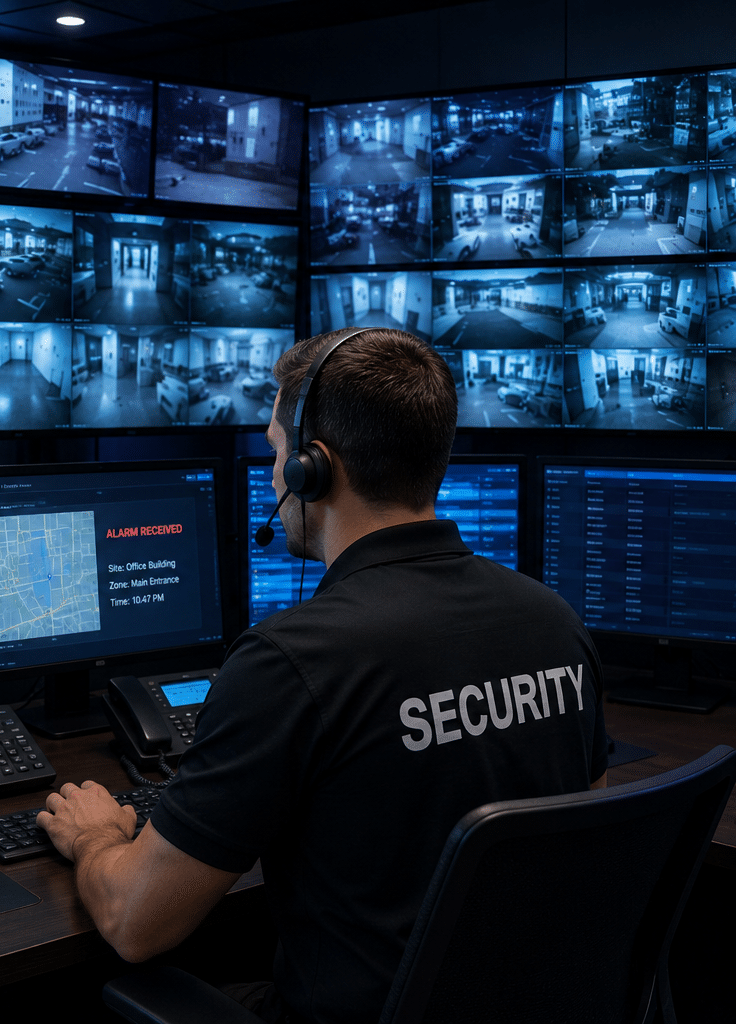
Alarm monitoring is a service where your alarm system sends signals to a monitoring centre or response platform when an event occurs. In Australia, this may include intruder alarms, duress alerts, tamper signals, low battery warnings or communication faults, followed by an agreed response process.
Table of Contents
- How Alarm Monitoring Works in Australia
- Why Alarm Monitoring Matters
- Common Alarm Monitoring Signals
- Australian Standards and Monitoring Centre Grading
- Onshore vs Offshore Alarm Monitoring
- Alarm Monitoring Communication Paths
- Residential vs Commercial Alarm Monitoring
- Alarm Monitoring Onboarding Checklist
- False Alarms and How to Reduce Them
- What to Ask Before Choosing a Provider
- People Also Ask
- Expert Q&A About Alarm Monitoring
- Conclusion
How Alarm Monitoring Works in Australia
Alarm monitoring begins with a security system installed at your property. This may include motion detectors, reed switches, glass break sensors, duress buttons, smoke interfaces, access control inputs, CCTV verification or other connected devices.
When the system detects an event, the alarm panel sends a signal through a communication path. This path may use IP, mobile 4G or 5G, dual-path signalling, radio, or older phone-line style connections where still present. Then, the monitoring centre or response platform receives the event and follows your agreed action plan.
For example, if a warehouse alarm activates at 2:00 am, the monitoring operator may check the event type, zone description and site instructions. After that, they may call nominated contacts, dispatch a patrol, escalate to emergency services where appropriate, or record the incident for reporting.
In simple terms, alarm monitoring turns an alarm from a local noise into a managed response process.
The Basic Alarm Monitoring Flow
A typical alarm monitoring process looks like this:
- A sensor or alarm input is triggered.
- The alarm panel creates an event signal.
- The signal travels through an approved communication path.
- The monitoring centre receives and logs the event.
- Operators follow the site’s response instructions.
- Keyholders, patrols or other responders are contacted.
- The event is recorded for audit, reporting and future review.
This process sounds simple. However, every step matters. If the communication path fails, the signal may not arrive. If the contact list is outdated, the operator may not reach the right person. Also, if the zone descriptions are unclear, responders may not know where to start.
Therefore, good alarm monitoring is both a technical service and an administrative discipline.
Why Alarm Monitoring Matters
Alarm monitoring matters because it closes the gap between detection and response. A siren can alert people nearby, but many Australian properties are empty after hours. As a result, a loud alarm may ring without anyone taking useful action.
For businesses, this is especially important. Retail stores, construction sites, medical clinics, offices and warehouses often hold stock, tools, records, keys, equipment or sensitive areas. Therefore, after-hours alarm response needs to be planned, not improvised.
For homes, monitored alarms can also add peace of mind. If you are away, asleep, travelling or unable to answer a phone notification, a monitoring service may still follow the response steps you have approved.
From my experience, the most valuable part of alarm monitoring is not only the emergency response. It is the daily visibility. A good setup can help you notice repeated false alarms, staff opening outside approved hours, power issues, communication faults and forgotten arming routines.
Practical Benefits of Alarm Monitoring
Alarm monitoring can support:
- Faster awareness of after-hours events.
- Better response coordination.
- Clearer incident records.
- Support for lone workers or duress alerts.
- Lower reliance on neighbours hearing a siren.
- Better management of commercial opening and closing times.
- Visibility over faults, low batteries and communication failures.
- More structured keyholder notification.
However, alarm monitoring does not guarantee that crime will be prevented. It should be seen as one layer in a broader security strategy. Good lighting, locks, CCTV, access control, staff training and regular maintenance still matter.
Common Alarm Monitoring Signals
Alarm monitoring is not only about burglary events. Modern monitored systems can send many different signals. Understanding these signal types helps property owners make better decisions.
Intruder Alarm Signals
An intruder alarm signal is usually created when a motion sensor, door contact or other intrusion device detects activity while the system is armed. The monitoring centre may receive the zone number, zone name and event type.
For example, a signal may show “Warehouse Roller Door” or “Front Office PIR”. Clear zone naming is important because it helps the operator and responder understand the possible entry point.
Duress and Hold-Up Signals
Duress signals are often used in retail, medical, education, hospitality and high-risk workplaces. A duress button may be fixed under a counter, worn as a pendant or integrated into another device.
Because duress events can involve personal safety, the response plan must be clear. It should define who is contacted, what words or codes are used, and when escalation occurs.
Tamper Signals
Tamper signals may occur when a detector cover is opened, a siren box is interfered with, or an alarm panel is disturbed. These signals are important because they may show attempted sabotage or poor maintenance.
Power Failure and Low Battery Signals
A monitored alarm can report mains power failure, low backup battery or restored power. This is useful because alarm systems rely on reliable power. If the backup battery is weak, the system may not perform during an outage.
Communication Failure Signals
Communication failure alerts are critical. If the system cannot communicate, the monitoring centre may not receive future alarm events. Therefore, these faults should be treated as a priority maintenance issue.
Open and Close Reports
Many Australian businesses use alarm monitoring to track opening and closing times. For example, the system can record when staff disarm the alarm in the morning and arm it at night. This can help identify late closes, missed arming, or unexpected after-hours access.
Australian Standards and Monitoring Centre Grading
In Australia, alarm monitoring is often discussed alongside monitoring centre grading and Australian Standards. These references are important, but they can be confusing for non-experts.
The Australian Standard AS 2201.2:2022 relates to monitoring centres used for client alarm and security systems. Standards Australia material describes this standard as covering requirements for the construction, equipment, staff and operation of monitoring centres used for alarm and electronic security systems. You can review the standard listing through the AS 2201.2:2022 standard overview.
ASIAL, the Australian Security Industry Association Limited, operates a monitoring centre grading scheme. Its public information states that graded monitoring centres are inspected and graded for compliance with the applicable Australian Standard. You can learn more from ASIAL’s monitoring centre grading information.
This does not mean every property needs the highest available grade. Instead, it means customers should understand what level of monitoring centre, response process and redundancy suits their risk.
What “Grade A1” Generally Means
In simple terms, Grade A1 is commonly used in the Australian security industry to describe a high level of monitoring centre grading. The “A” relates to building services and construction requirements, while the “1” relates to operational, equipment and staffing performance. The exact grading details should be checked with the provider and relevant standard.
For a small home, a basic monitored alarm may be enough. However, for a commercial site, school, medical practice, warehouse, or higher-risk location, the monitoring centre’s grading, redundancy and procedures may be more important.
Compliance Is Administrative, Not Legal Advice
Compliance references in alarm monitoring should be treated as administrative and operational checks, not legal advice. For example, a provider may help you confirm monitoring centre grading, licensed technician details, site instructions and reporting procedures. However, if your industry has legal, insurance or regulatory requirements, those should be reviewed by a qualified professional or licensed adviser.
Onshore vs Offshore Alarm Monitoring
Some Australian customers prefer onshore monitoring because operators may better understand local suburbs, response providers, time zones and Australian site procedures. However, offshore or hybrid models may be used in some service arrangements.
The best choice depends on risk, budget, response needs and service transparency.
| Factor | Onshore Alarm Monitoring | Offshore or Hybrid Monitoring |
| Local context | Operators may better understand Australian locations, time zones and local response pathways. | Operators may need stronger scripts and clear site instructions to avoid confusion. |
| Communication | Easier alignment with Australian contacts, patrols and business hours. | May still work well if processes, escalation rules and reporting are strong. |
| Perceived trust | Often preferred by businesses with higher risk or sensitive sites. | May be acceptable for lower-risk sites if service levels are clear. |
| Cost | May cost more depending on the provider and centre grade. | May be cheaper, but inclusions should be checked carefully. |
| Accountability | Easier to verify local licensing, grading and escalation pathways. | Customers should ask where monitoring occurs and who handles escalation. |
| Best suited for | Commercial sites, schools, medical centres, warehouses, higher-risk homes. | Lower-risk sites where budget is a major factor and procedures are transparent. |
The key point is not simply location. It is whether the monitoring service can prove its procedures, response times, reporting, redundancy and accountability.
Alarm Monitoring Communication Paths
A monitored alarm is only useful if it can send signals reliably. Therefore, communication paths are a major part of alarm monitoring.
IP Alarm Monitoring
IP monitoring uses an internet connection to send alarm signals. It can be fast and cost-effective. However, it depends on network equipment, power and internet availability. Therefore, backup power and a secondary path may be needed for higher-risk sites.
4G and 5G Alarm Monitoring
Mobile network communicators are common in Australia because they reduce reliance on fixed phone lines. They can be used as a primary path or backup path. However, signal strength, carrier coverage and device health still need to be checked.
Dual-Path Alarm Monitoring
Dual-path monitoring uses two communication methods, such as IP plus 4G. This improves resilience because the alarm has another route if one path fails. For many businesses, dual-path signalling is a practical upgrade.
Older Phone-Line Monitoring
Some older alarm systems were designed to communicate over traditional phone lines. However, Australia’s shift to the nbn network changed how many legacy devices work. The nbn advises customers to contact their security alarm provider to check device compatibility before switching to the nbn network. You can read the current guidance on nbn security monitoring systems.
If your alarm still relies on old dialler technology, it is worth arranging a review. In many cases, upgrading to an IP or mobile communicator gives better reliability and clearer reporting.
Residential vs Commercial Alarm Monitoring
Alarm monitoring for a home and alarm monitoring for a business share the same basic idea. However, the risk profile is often different.
Home Alarm Monitoring
For homes, the main goal is usually to alert someone when the alarm activates. The response plan may involve calling the homeowner, a family member, a neighbour or a patrol service.
A good home alarm monitoring setup should include:
- Clear keyholder contacts.
- A backup communication path where practical.
- Simple arming and disarming instructions.
- Pet-friendly sensor planning if needed.
- Regular battery and signal checks.
- Clear false alarm procedures.
For many households, the main benefit is peace of mind. However, the system still needs maintenance. A monitored alarm with old batteries, poor mobile signal or outdated contacts may not perform when needed.
Commercial Alarm Monitoring
Commercial alarm monitoring is often more detailed. Businesses may need opening and closing reports, staff codes, multiple areas, duress points, after-hours contractor access, patrol dispatch and incident reporting.
For example, a retail store may need duress monitoring at the counter. A warehouse may need roller door contacts, perimeter beams, office sensors and CCTV verification. A medical clinic may need after-hours entry logs and secure room monitoring.
Because commercial sites have more moving parts, documentation matters. The provider should keep accurate zone lists, contact lists, response instructions and maintenance notes.
Alarm Monitoring Onboarding Checklist
A smooth onboarding process reduces errors later. From my experience, many alarm monitoring problems start with unclear setup information, not bad technology.
Use this numbered checklist before activating or transferring alarm monitoring.
- Confirm the property risk level
Identify what you are protecting, when the site is empty, and what response is realistic. - Check the alarm panel and devices
Confirm the panel model, sensor condition, sirens, backup battery and current programming. - Review the communication path
Decide whether you need IP, 4G, 5G, dual-path or another approved signalling method. - Confirm monitoring centre details
Ask where the alarm is monitored, what grading applies, and whether the centre operates 24/7. - Create clear zone names
Use practical names such as “Front Entry Door” or “Rear Warehouse Motion” instead of vague labels. - Set up keyholder contacts
Add at least two or three reliable contacts. Include mobile numbers and escalation order. - Define the response plan
Decide when to call contacts, when to dispatch patrols, and when further escalation is appropriate. - Test all signals
Test intruder, duress, tamper, low battery, communication fault and restore signals where relevant. - Train users
Teach staff or residents how to arm, disarm, cancel false alarms and report faults. - Schedule maintenance
Plan routine inspections, battery checks, sensor cleaning and communication tests.
This process may seem detailed. However, it prevents confusion during real events.
False Alarms and How to Reduce Them
False alarms are one of the biggest frustrations in alarm monitoring. They waste time, increase costs and can reduce confidence in the system.
A false alarm does not always mean the equipment is faulty. In many cases, the cause is simple. Staff may enter through the wrong door, forget a code, leave balloons or signs moving near a sensor, or fail to secure a roller door.
Common Causes of False Alarms
Common causes include:
- Incorrect user codes.
- Doors not fully closed.
- Pets or pests triggering sensors.
- Loose contacts on doors or windows.
- Poor sensor placement.
- Air movement near lightweight objects.
- Low batteries.
- Contractors entering after hours.
- Staff forgetting to disarm the correct area.
- Communication faults.
Practical Ways to Reduce False Alarms
First, train every user. People should know how to enter, disarm, arm and cancel an accidental alarm. Next, keep user codes current. Remove codes for former staff and avoid shared codes where possible.
Then, review problem zones. If the same detector triggers repeatedly, it needs attention. The issue may be sensor angle, environmental movement, insects, door alignment or a wiring fault.
Also, maintain the system. Batteries, detectors, sirens and communicators should be checked regularly. For commercial sites, maintenance should be documented.
Finally, consider video verification where suitable. If CCTV is integrated with alarm monitoring, operators or authorised responders may be able to assess whether a signal looks like a genuine intrusion. This can support better decision-making, although privacy and access permissions must be managed carefully.
What to Ask Before Choosing a Provider
Choosing an alarm monitoring provider is not just about price. A low monthly fee may not include the response, reporting or maintenance you expect.
Ask these questions before you commit.
What Type of Monitoring Centre Is Used?
Ask whether the monitoring centre is graded, where it is located, and whether it operates 24/7. Also ask how redundancy is handled if the centre has a power, network or operational issue.
What Signals Are Included?
Some plans monitor only basic intruder alarms. Others include duress, tamper, open and close, low battery, mains fail, communication fail and other events. Therefore, check exactly what is included.
What Happens During an Alarm?
Ask for the response workflow in plain English. For example, who is called first? When is a patrol dispatched? Are there extra charges? What happens if no keyholder answers?
How Are False Alarms Managed?
A good provider should help reduce repeated false alarms. They should be able to identify patterns, recommend maintenance and update zone descriptions.
Can the System Work During Internet or Power Outages?
No system is immune to failure. However, backup battery, mobile signalling and dual-path communication can improve resilience. Ask what happens if internet, power or mobile signal is unavailable.
Is Maintenance Included?
Monitoring and maintenance are different services. Monitoring receives and acts on signals. Maintenance keeps the alarm system working. Ideally, your arrangement should cover both or make each responsibility clear.
Cost Factors for Alarm Monitoring in Australia
Alarm monitoring costs in Australia vary based on risk, equipment, communication path, monitoring centre type, reporting needs and response services. Because pricing changes by provider and site, any cost estimate should be treated as general guidance, not a fixed quote.
Common cost factors include:
- Existing alarm panel compatibility.
- Need for a 4G, 5G or IP communicator.
- Single-path or dual-path signalling.
- Number of monitored areas.
- Duress or hold-up monitoring.
- Opening and closing reports.
- Patrol dispatch requirements.
- CCTV verification.
- Maintenance plan.
- After-hours support level.
- Monitoring centre grade.
For a simple home, the setup may be straightforward. For a commercial site, costs may increase because the provider needs more detailed programming, reporting, contacts and response rules.
The best approach is to request a site-specific assessment. This helps avoid paying for features you do not need or missing features that your risk level requires.
Alarm Monitoring for Different Australian Sites
Different Australian sites need different monitoring priorities.
Retail Shops
Retail sites often need intruder alarms, duress buttons, opening and closing reports, and after-hours keyholder response. In addition, staff turnover means user codes must be managed carefully.
Warehouses and Industrial Sites
Warehouses may need perimeter detection, roller door contacts, internal motion sensors, yard beams, CCTV verification and patrol dispatch. Because these sites often have multiple entry points, zone naming is vital.
Offices
Offices usually need after-hours intrusion monitoring, access control integration, staff code management and communication fault reporting. For shared buildings, tenant and landlord responsibilities should be clear.
Medical and Allied Health Clinics
Clinics may hold medicines, records, devices and private information. Therefore, alarm monitoring should support controlled access, after-hours alerts and clear response steps.
Schools and Education Sites
Schools may need layered security, duress points, after-hours access reporting and strong maintenance routines. Because these sites are often large, clear zone maps and response instructions are very important.
Homes and Apartments
Homes usually need simple, reliable monitoring. The focus should be easy operation, clear contact lists, backup communication where practical and regular testing.
Alarm Monitoring and CCTV Verification
Alarm monitoring and CCTV can work together, but they are not the same thing.
An alarm detects an event. CCTV helps provide visual context. When combined correctly, CCTV verification can help confirm whether a signal appears to be caused by a person, animal, weather, staff error or equipment issue.
However, CCTV verification should be set up carefully. Camera views must be useful, permissions should be clear, and privacy expectations must be respected. In commercial settings, signage, policies and staff communication may also be required.
For example, if a warehouse motion detector activates after hours, an operator may check a relevant camera view if authorised. If they see a person inside the site, the response may be escalated. If they see a loose banner moving near a sensor, the event may be handled differently.
This is why integration design matters. The camera must show the area linked to the alarm zone. Otherwise, video verification may not help.
Alarm Monitoring Maintenance
Alarm monitoring is not a “set and forget” service. Even good systems need periodic review.
A maintenance visit may include:
- Testing alarm signals to the monitoring centre.
- Checking detector operation.
- Testing sirens and strobes.
- Inspecting backup batteries.
- Reviewing communication paths.
- Updating user codes.
- Checking keyholder lists.
- Reviewing false alarm history.
- Confirming zone names.
- Testing duress buttons where installed.
For businesses, maintenance records are useful. They help show that the system is being managed responsibly. They also make troubleshooting easier when faults occur.
From my experience, a yearly review is a minimum for many sites. However, higher-risk commercial properties may need more frequent checks.
People Also Ask
Is alarm monitoring worth it in Australia?
Alarm monitoring can be worth it if you want a structured response when your alarm activates. It is especially useful for businesses, empty properties, homes where people travel often, and sites with valuable stock or equipment.
What is back-to-base alarm monitoring?
Back-to-base alarm monitoring means your alarm sends signals to a monitoring centre rather than only sounding a siren. The centre then follows your agreed instructions, such as calling keyholders or arranging a patrol.
Does alarm monitoring work with the nbn?
Many alarm systems can work with the nbn, but older systems may need upgrades. The nbn recommends contacting your alarm provider before switching so compatibility can be checked.
What is the difference between self-monitoring and professional alarm monitoring?
Self-monitoring usually sends alerts to your phone. Professional alarm monitoring sends signals to a monitoring centre, where operators follow a response plan even if you miss the alert.
Can alarm monitoring reduce false alarms?
Alarm monitoring itself does not remove false alarms. However, event history, maintenance, better user training, video verification and clear zone reporting can help identify and reduce repeated false alarm causes.
Expert Q&A About Alarm Monitoring
1. What should a business include in an alarm monitoring response plan?
A business response plan should include keyholder names, phone numbers, escalation order, patrol instructions, site access notes, gate codes if applicable, and rules for duress or high-risk events. It should also define what happens if no one answers.
2. How often should monitored alarm signals be tested?
Signal testing should be done during installation, after communication changes, after panel programming, and during routine maintenance. Many businesses should also test critical signals such as duress and communication failure at scheduled intervals.
3. What is dual-path alarm monitoring and why does it matter?
Dual-path alarm monitoring uses two communication routes, such as internet plus mobile. It matters because if one path fails, the system may still be able to send alarm events through the backup path.
4. Can an existing alarm system be connected to monitoring?
Often, yes. However, the panel must be checked for compatibility, condition, programming and communication options. Older systems may need a new communicator, battery replacement or panel upgrade.
5. What information should be updated after staff changes?
After staff changes, update user codes, keyholder lists, call order, after-hours access permissions and any response instructions linked to that person. This is an administrative task, but it has a major effect on security.
Conclusion
Alarm monitoring helps Australian homes and businesses move from simple detection to planned response. It allows alarm events, duress signals, faults and after-hours activity to be received, logged and actioned through an agreed process.
However, the quality of alarm monitoring depends on more than the monthly plan. You need reliable communication, clear zone naming, trained users, current contacts, suitable maintenance and a response process that matches your risk.
For homes, the goal may be peace of mind. For businesses, the goal may include stock protection, staff safety, after-hours control and better incident records. In both cases, the best results come from choosing a setup that is practical, transparent and properly maintained.
To review your alarm system, monitoring options and site response needs, speak with the team at Eclipse Security for practical alarm monitoring support in Australia.