


Intruder alarm systems are one of the most practical ways Australians can deter break-ins, detect unauthorised entry, and respond faster when something goes wrong. From my experience reviewing security setups for homes, shops, warehouses, offices and multi-site businesses, the best alarm is not always the most expensive one. Instead, it is the system that matches the property layout, the risk level, the user’s daily routine and the response process after an activation.
Australia has a wide mix of security needs. A ground-floor apartment in Melbourne, a retail store in Sydney, a warehouse in Brisbane and a rural property outside Adelaide all need different alarm designs. However, the same principle applies everywhere: a good alarm should detect risk early, reduce false alarms, and make it easy for the right person to act.
According to the Australian Bureau of Statistics Crime Victimisation release, 1.8% of Australian households experienced a break-in in 2024–25, while 2.0% experienced an attempted break-in. That does not mean every property is at equal risk. However, it does show why many Australians compare alarm options before choosing a system.
Table of Contents
- What are intruder alarm systems?
- Why intruder alarm systems matter in Australia
- How an intruder alarm system works
- Main components of an intruder alarm system
- Wired vs wireless intruder alarm systems
- Monitored vs self-monitored alarm systems
- Intruder alarm systems for homes
- Intruder alarm systems for businesses
- Australian compliance and admin considerations
- Installation checklist for Australian properties
- Common mistakes to avoid
- People Also Ask
- Expert Q&A
- Conclusion
What Are Intruder Alarm Systems?
Intruder alarm systems are security setups that detect unauthorised entry using sensors, control panels, sirens and alerts. In Australia, they are used in homes and businesses to deter break-ins, notify owners or monitoring centres, and support faster response when doors, windows or internal areas are triggered.
Why Intruder Alarm Systems Matter in Australia
Intruder alarm systems matter because break-ins are rarely just about stolen items. They can disrupt families, damage stock, interrupt trading, affect insurance claims and leave people feeling unsafe in their own space.
For many Australian properties, an alarm also acts as a visible deterrent. External sirens, warning stickers, keypad locations and camera integration can all send a clear message that the site is protected. While no alarm can guarantee prevention, a well-designed system makes a property harder and riskier to target.
There is also a practical reason to install one. Most break-ins are time-sensitive. The sooner a system detects movement, door entry or glass breakage, the sooner the owner, keyholder or monitoring centre can act. Therefore, the value of an alarm is not only in making noise. It is in creating a response pathway.
From my experience, the weakest alarm setups usually fail in one of three places. They detect too late, they trigger too often for the wrong reasons, or nobody knows what to do when the alarm goes off. A quality design solves all three.
How Intruder Alarm Systems Work
Intruder alarm systems follow a simple chain of events.
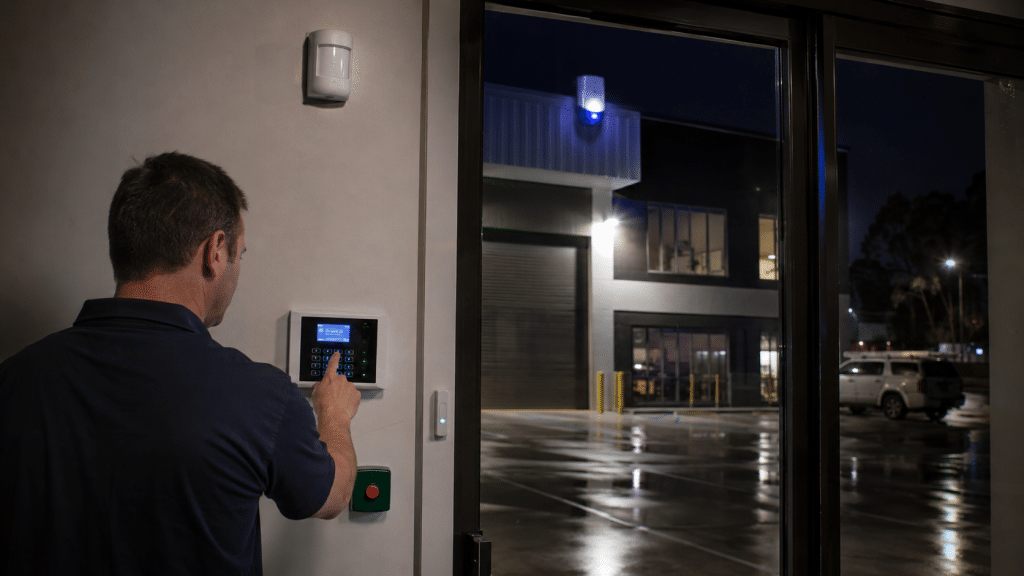
First, sensors watch the protected areas. These may include door contacts, window sensors, motion detectors, reed switches, glass-break detectors and vibration sensors. Next, the control panel receives the signal when a sensor is triggered. Then, the system decides what action to take based on whether the alarm is armed, disarmed, partly armed or in stay mode.
After that, the system may activate a siren, send a mobile notification, alert a monitoring centre or trigger another connected device. For example, it may turn on lights, start camera recording or notify a nominated keyholder.
A basic home alarm might only include a keypad, several motion sensors and a siren. However, a larger commercial system may include multiple partitions, access control integration, duress buttons, 24/7 monitoring and reporting for management.
The “why” behind this design is important. A good system does not only detect entry. It manages risk by zones. For example, a business may arm the warehouse overnight while keeping the office disarmed for cleaners. Similarly, a homeowner may arm perimeter doors while sleeping but keep bedroom movement areas inactive.
Main Components of Intruder Alarm Systems
Most intruder alarm systems include the following parts.
Control Panel
The control panel is the brain of the alarm. It receives signals from sensors, manages user codes, controls sirens and sends alerts. In many modern systems, the panel may connect through Ethernet, Wi-Fi, 4G or dual-path communication.
A reliable panel should support enough zones for the property. It should also allow future expansion. This matters because many properties add extra sensors later after renovations, tenancy changes or stock layout changes.
Keypad or Touchscreen
The keypad lets users arm, disarm and manage the system. Some systems use a traditional PIN keypad. Others use touchscreens, fobs, cards or mobile apps.
For homes, ease of use is critical. If the alarm is difficult to operate, people stop using it. For businesses, user management matters more. Staff codes should be traceable, removable and limited where needed.
Motion Detectors
Motion detectors identify movement inside a protected area. Passive infrared sensors, often called PIR sensors, detect heat movement. Dual-technology sensors may combine infrared with microwave detection to reduce false alarms.
Pet-tolerant sensors can help in homes with cats or dogs, although they need careful placement. A sensor that faces stairs, furniture or direct sunlight may still create problems.
Door and Window Contacts
Door and window contacts detect opening. They are useful because they can trigger before an intruder reaches the inside of the property. In many homes, contacts are placed on entry doors, sliding doors and accessible windows.
For businesses, contacts are often installed on roller doors, stockroom doors, roof hatches and loading docks. These points are common entry risks, so they should not be ignored.
Glass-Break and Shock Sensors
Glass-break sensors listen for the sound pattern of breaking glass. Shock sensors detect impact or vibration. These are useful for shopfronts, glass doors and exposed windows.
However, they must be selected carefully. A busy street, nearby construction or poor sensor placement can increase false alarm risk. Therefore, installers usually assess the environment before choosing these devices.
Sirens and Strobes
Internal sirens create pressure and confusion for intruders. External sirens and strobes alert neighbours, staff or passers-by. They also show that the property has active protection.
In my experience, sirens work best when paired with alerts. A siren alone may be ignored in a busy area, but a siren plus a monitoring alert creates a clearer response.
Communicator
The communicator sends signals outside the property. Older systems often relied on phone lines. However, many modern systems use IP, 4G or dual-path communication.
This is especially important for monitored intruder alarm systems. The nbn security monitoring systems guidance advises users to check compatibility with their alarm provider before switching services, because some existing devices may not work reliably across all technologies.
Wired vs Wireless Intruder Alarm Systems
Both wired and wireless intruder alarm systems can work well. The better choice depends on the building, budget, installation access and long-term maintenance needs.
| Feature | Wired Intruder Alarm Systems | Wireless Intruder Alarm Systems |
| Best suited to | New builds, renovations, commercial sites | Existing homes, rentals, smaller offices |
| Installation | More cabling and labour | Faster and less invasive |
| Reliability | Very stable when installed well | Strong when using quality devices and batteries |
| Maintenance | Less battery replacement | Battery checks are essential |
| Appearance | Hidden cabling possible | Minimal wall damage |
| Flexibility | Harder to move sensors | Easier to reposition |
| Typical concern | Cable access | Signal range and battery life |
Wired systems are often preferred during construction because cabling can be hidden before walls are finished. They can also suit larger sites where long-term durability is the main priority.
Wireless systems are popular in existing Australian homes because installation is quicker and cleaner. They are also useful when running cables would be expensive or disruptive. However, battery maintenance must be managed properly.
Hybrid systems combine both. For example, a business may use wired sensors in the main building and wireless sensors in a detached storeroom.
Monitored vs Self-Monitored Intruder Alarm Systems
One of the biggest choices is whether to use professional monitoring or self-monitoring.
Self-monitored intruder alarm systems send alerts to your phone. This can suit homeowners who want control and lower ongoing costs. However, it depends on you noticing the alert and responding quickly.
Monitored intruder alarm systems send signals to a control room or monitoring centre. Depending on the service arrangement, the centre may contact keyholders, follow an escalation plan or request an authorised response. This is often better for businesses, high-value homes, vacant properties and sites where people travel often.
The Australian Security Industry Association Limited standards and codes page lists Australian electronic security standards relevant to alarm systems, monitoring centres, cabling and alarm transmission. These references are useful for understanding the administrative and technical framework behind professional installations.
| Option | Benefits | Limitations | Best for |
| Self-monitored | Lower ongoing cost, app control, direct alerts | Relies on owner availability | Homes, small offices, low-risk sites |
| Professionally monitored | 24/7 response pathway, escalation process, reporting | Ongoing fees apply | Businesses, high-value homes, vacant sites |
| Hybrid | Flexible alerts plus professional backup | Needs clear setup | Owners who want control and support |
From my experience, monitoring is most valuable when nobody is always available to check alerts. For example, a retail owner may be busy, asleep or travelling when an alarm activates. In that case, a defined escalation process can be worth the monthly cost.
Intruder Alarm Systems for Australian Homes
Home intruder alarm systems should match the way people live. A family home needs a different setup from a city apartment or investment property.
For a typical Australian house, the most important areas are front doors, back doors, sliding doors, garage access, hallway paths and rooms with valuables. External sheds may also need protection, especially if they store tools, bikes or work equipment.
A useful home design may include:
- Door contacts on main entry points
- Motion sensors in hallways and living areas
- A keypad near the main entry
- A mobile app for alerts
- Internal and external sirens
- Optional perimeter protection for night mode
- Optional smoke, flood or panic functions where supported
Stay mode is especially helpful. It allows people to arm part of the alarm while they are inside. For example, doors and windows can stay protected overnight while bedroom movement zones remain inactive.
Homeowners should also consider everyday behaviour. An alarm that takes too long to arm will be used less often. Therefore, app control, fobs and simple keypad locations can improve compliance.
Intruder Alarm Systems for Apartments and Townhouses
Apartments need a more focused approach. The main risks are usually entry doors, balconies, accessible windows, storage cages and car spaces. Since apartment buildings often have shared areas, it is important to separate private alarm coverage from body corporate or strata-managed areas.
Wireless intruder alarm systems can be useful in apartments because they avoid major cabling. However, residents should check tenancy, strata or body corporate rules before drilling, mounting external sirens or changing common-area equipment. This is an administrative step, not legal advice.
For townhouses, the design often sits between a house and an apartment. Ground-floor doors, internal garage access and side gates deserve attention.
Intruder Alarm Systems for Businesses
Business intruder alarm systems need stronger planning because they protect people, stock, equipment, records and trading continuity.
A small office may only need door contacts, motion sensors and app alerts. However, a warehouse may need roller door contacts, beam sensors, partitioned areas, staff codes, duress buttons and after-hours monitoring.
Retail stores often need glass-break detection, panic buttons and integration with CCTV. Meanwhile, medical clinics, pharmacies, jewellery stores and cash-handling sites may need higher-grade devices and more formal response procedures.
The biggest business mistake is installing an alarm without mapping how the site operates. Before installation, ask:
- Who opens and closes the site?
- Which areas need to be armed separately?
- Who receives alerts after hours?
- What happens if the first keyholder does not answer?
- Are there cleaners, contractors or delivery staff?
- Is stock moved after hours?
- Does the site need reporting for management or insurance?
From my experience, user-code management is one of the most overlooked parts of business alarm setup. Every staff member should not share one PIN. Individual codes make it easier to remove access when people leave and review who armed or disarmed the system.
Intruder Alarm Systems and CCTV Integration
Intruder alarm systems become more useful when paired with CCTV. The alarm detects the event. The camera helps verify what happened.
For example, if a motion sensor triggers in a warehouse at 2:00 am, CCTV can help confirm whether it is an intruder, an animal, a loose sign or a staff member. This matters because false alarms waste time and reduce trust in the system.
However, integration should be practical. More cameras do not always mean better security. The goal is to cover likely entry points, high-value areas and response-critical zones.
In homes, CCTV integration may include front doors, driveways, side paths and backyards. In businesses, it may include counters, stock areas, loading docks, server rooms and external perimeters.
Australian Compliance and Admin Considerations
Compliance for intruder alarm systems in Australia can involve several administrative layers. These may include security licensing, cabling rules, monitoring procedures, police alarm response expectations, electrical safety and insurer requirements.
This section is general information, not legal advice. For specific obligations, property owners should check with a licensed security provider, insurer, strata manager or relevant authority.
Key admin points include:
- Licensed installation: Security work is regulated by state and territory rules. Requirements can vary between New South Wales, Victoria, Queensland, South Australia, Western Australia, Tasmania, the ACT and the Northern Territory.
- Cabling work: If cabling is required, it should be handled by appropriately registered or licensed people.
- Monitoring setup: Monitored systems should have clear keyholder lists and escalation instructions.
- False alarm management: Poorly designed systems can create repeated false alarms, which may affect response quality and costs.
- Insurance alignment: Some insurers may ask for specific alarm features, monitoring or maintenance records.
- Strata or landlord approval: Tenants and apartment owners may need approval for visible devices, drilling or common-area changes.
A professional installer should explain these steps clearly. They should not turn compliance into fear. Instead, they should help you complete the right admin tasks for your property.
Installation Checklist for Intruder Alarm Systems
Use this numbered checklist before installing intruder alarm systems in an Australian home or business.
- Map entry points
List all doors, windows, roller doors, roof access points, garages, balconies and side entries. - Identify high-value zones
Mark rooms with stock, safes, tools, keys, IT equipment, cash, jewellery, medicines or confidential files. - Choose the alarm type
Decide whether wired, wireless or hybrid makes sense for the building. - Decide on monitoring
Choose self-monitoring, professional monitoring or a hybrid approach. - Plan user access
Decide who needs codes, fobs or app permissions. - Design arming modes
Set up away mode, stay mode, night mode or business partitions as needed. - Reduce false alarm risks
Consider pets, air movement, sunlight, insects, loose doors and staff routines. - Check communications
Confirm whether alerts will use internet, 4G, dual-path or another method. - Document response steps
Create a simple plan for who responds and what they should do. - Schedule maintenance
Plan battery checks, sensor testing, user-code reviews and monitoring updates.
This process keeps the project practical. It also helps the installer design a system around real use, not guesswork.
Common Mistakes When Choosing Intruder Alarm Systems
Many people buy intruder alarm systems based on price alone. While budget matters, the cheapest system can become expensive if it causes false alarms, misses key entry points or cannot be expanded.
Another common mistake is overprotecting the wrong areas. For example, placing sensors in low-risk spaces while ignoring a side door or internal garage access can leave a real weakness.
A third mistake is poor communication setup. If a system cannot send alerts reliably, it becomes a local noise maker. Therefore, alarm communication should be tested, especially when internet or mobile coverage is inconsistent.
Businesses often make one more mistake: shared user codes. Shared codes reduce accountability. They also make staff changes harder to manage.
Finally, many owners forget maintenance. Batteries, sensors, sirens, app users and contact lists should be reviewed. A system that worked three years ago may not suit the property today.
Cost Factors for Intruder Alarm Systems in Australia
The cost of intruder alarm systems in Australia varies because properties vary. A small apartment may only need a few wireless sensors. A multi-level commercial site may need many zones, cabling, monitoring, user management and integration.
Common cost factors include:
| Cost Factor | Why It Matters |
| Number of sensors | More doors, windows and rooms need more devices |
| Wired or wireless design | Cabling may increase labour in existing buildings |
| Monitoring | Professional monitoring adds ongoing fees |
| App control | Some systems include subscriptions or cloud services |
| Site complexity | Warehouses, strata buildings and multi-site businesses need more planning |
| Integration | CCTV, access control and automation can add cost |
| Maintenance | Batteries, testing and servicing should be budgeted |
As a general estimate, basic systems may suit lower budgets, while monitored commercial systems require a larger investment. However, the right quote should be based on a site assessment, not a one-size-fits-all package.
How to Choose an Installer for Intruder Alarm Systems
A good installer should ask questions before recommending equipment. They should want to understand how the property is used, who comes and goes, what needs protection and how alerts should be handled.
Look for an installer who can explain:
- Why each sensor is placed in a specific location
- How the system reduces false alarms
- What happens during an alarm activation
- How users are added and removed
- What maintenance is required
- Whether the system can expand later
- Which admin or licensing requirements apply
Also, ask for a clear scope of work. It should list devices, locations, monitoring options, warranty details and training. This avoids confusion later.
For Australian homes and businesses that want practical help with design, installation and upgrades, Eclipse Security can provide tailored security alarm solutions for Australian properties.
Best Practices for Reducing False Alarms
False alarms are more than annoying. They can train people to ignore alerts. They may also waste time for owners, keyholders, monitoring centres and responders.
To reduce false alarms:
- Use the right sensor for each area.
- Avoid pointing PIR sensors at direct sunlight, heaters or moving curtains.
- Choose pet-tolerant devices where needed.
- Ensure doors and windows close firmly.
- Train all users properly.
- Remove old staff codes.
- Test the system after renovations or layout changes.
- Keep monitoring contact lists current.
- Replace batteries before they fail.
- Service the system on a planned schedule.
From my experience, most false alarm problems are not caused by bad technology. They are caused by poor design, poor training or poor maintenance.
Intruder Alarm Systems for Rental Properties
Rental properties need a balanced setup. Landlords want asset protection, while tenants need simple daily use and privacy.
A rental alarm should be easy to operate. It should also allow user codes to be changed between tenancies. Wireless devices may be suitable because they are less invasive, but installation approvals still matter.
For short-stay accommodation, user management becomes even more important. Temporary codes, remote arming and clear guest instructions can reduce problems.
Intruder Alarm Systems for Multi-Site Businesses
Multi-site businesses need consistency. If each branch uses different alarm processes, management becomes messy.
A better approach is to standardise:
- User-code policies
- Opening and closing procedures
- Monitoring escalation lists
- Maintenance schedules
- Reporting requirements
- Alarm response instructions
This helps head office manage risk. It also makes staff training easier.
For example, a business with locations in Sydney, Melbourne and Brisbane may want each site to report opening and closing events. That way, managers can see whether a store was armed on time.
Smart Features in Modern Intruder Alarm Systems
Modern intruder alarm systems often include smart features. These may include app control, push notifications, event logs, remote arming, automation and camera verification.
These features are useful, but they should not distract from the basics. A smart alarm still needs good sensor placement, reliable communication and a clear response plan.
App control is especially helpful for busy owners. However, app access should be managed carefully. Former staff, old tenants or unused devices should be removed.
Automation can also help. For example, the alarm can trigger lights when activated. This may make an intruder feel exposed. Still, automation should support security rather than replace it.
People Also Ask: Intruder Alarm Systems in Australia
1. Are intruder alarm systems worth it in Australia?
Yes, intruder alarm systems are worth considering if you want deterrence, early detection and faster alerts. They are most effective when paired with good locks, lighting, CCTV where suitable and a clear response plan.
2. What is the difference between a burglar alarm and an intruder alarm?
The terms are often used in similar ways. In general, an intruder alarm system detects unauthorised entry, while “burglar alarm” is the more common consumer term for the same type of protection.
3. Do I need a monitored alarm system?
You may need monitoring if the property is often vacant, holds valuable assets or requires a reliable after-hours response. Self-monitoring can work for lower-risk homes, but it depends on you noticing and acting on alerts.
4. Can wireless intruder alarm systems be reliable?
Yes, quality wireless intruder alarm systems can be reliable when installed correctly and maintained. However, signal strength, battery life and device placement must be checked.
5. How often should an intruder alarm system be serviced?
Many systems should be checked at least annually, although higher-risk commercial sites may need more frequent servicing. Batteries, sirens, sensors, communication paths and user access should all be reviewed.
Expert Q&A: Deeper Questions About Intruder Alarm Systems
1. What zones should an intruder alarm system cover first?
Start with likely entry points. These usually include front doors, back doors, sliding doors, garage access points, shopfronts, roller doors and accessible windows. After that, protect internal paths and high-value rooms.
2. Should I install sensors outside the building?
Outdoor sensors can help, but they need careful design. Weather, animals, trees, passing cars and sunlight can all create false alarms. For many properties, external detection works best when designed by an experienced installer.
3. Can intruder alarm systems work during a power outage?
Many systems include backup batteries. However, backup time varies by system, battery condition and connected devices. Communication may also depend on internet or mobile network availability, so this should be tested.
4. What should happen after an alarm activation?
There should be a clear response process. For homes, that may mean checking app alerts and calling a trusted keyholder. For businesses, it may involve a monitoring centre, escalation list and authorised responder.
5. Can intruder alarm systems reduce insurance premiums?
Some insurers may consider alarm systems when assessing risk, but discounts are not guaranteed. Always check directly with your insurer and keep installation, monitoring and maintenance records where relevant.
Conclusion: Choosing the Right Intruder Alarm System
Intruder alarm systems are most effective when they are designed around real risks, real routines and real response steps. In Australia, that means considering the property type, entry points, user behaviour, monitoring needs, communications and administrative requirements.
A strong system does not need to be complicated. It needs to detect the right events, reduce false alarms and notify the right people quickly. Therefore, the best starting point is a proper site assessment, followed by a clear design and user training.
Whether you are protecting a family home, apartment, retail store, office, warehouse or multi-site business, choose an alarm that fits the way the property is used. Then maintain it, test it and keep response details current.