
On this page17
- Introduction
- What Are Food Manufacturing Access Solutions?
- 1. Why Food Manufacturing Access Solutions Matter in Australia
- 2. How Food Manufacturing Access Solutions Work
- 3. Planning Food Manufacturing Access Solutions Around Production Zones
- 4. Comparing Food Manufacturing Access Solutions
- 5. Selecting Hygiene-Friendly Access Control Hardware
- 6. Integrating Food Manufacturing Access Solutions With CCTV and Alarms
- 7. Australian Food Safety and Workplace Requirements
- 8. Managing Employees, Contractors and Visitors
- 9. Step-by-Step Food Manufacturing Access Solutions Implementation Checklist
- 10. Testing and Maintaining Food Manufacturing Access Solutions
- 11. Understanding Food Manufacturing Access Solutions Costs in Australia
- 12. Practical Examples of Food Manufacturing Access Solutions
- 13. People Also Ask About Food Manufacturing Access Solutions
- 14. Frequently Asked Questions About Food Manufacturing Access Solutions
- 15. Conclusion: Choosing the Right Food Manufacturing Access Solutions
Not sure what your site needs?
A technical consultant from our Hallam office will look at the site and recommend a system, free of charge.
Request an assessment 1300 66 11 99Introduction
Food manufacturing Access Solutions are an important part of protecting Australian food production facilities, employees, equipment and sensitive processing areas. From dairy factories and meat processing plants to bakeries and packaged food warehouses, manufacturers need reliable ways to manage who enters their premises and where people can move within them.
However, security in food manufacturing involves more than locking doors. Businesses must also consider hygiene procedures, contamination risks, workplace safety and daily production needs.
For example, a delivery driver may need access to a loading area but should not enter an open-food processing room. Similarly, maintenance contractors may require temporary access to machinery without receiving unrestricted entry to other production areas.
Therefore, a well-designed access control system helps businesses manage these movements while keeping operations practical.
Across Australia, manufacturers can choose from electronic access cards, key fobs, PIN systems, mobile credentials, intercoms and integrated security platforms. The right combination depends on the site's layout, products, hygiene zones and operational risks.
This guide explains how food manufacturing access control works, which solutions suit different facilities, and what Australian businesses should consider before installation.
What Are Food Manufacturing Access Solutions?
Food manufacturing Access Solutions are physical and electronic controls that manage who can enter each area of a food production site, when they may enter, and how access is recorded. They typically combine doors, credentials, readers, visitor procedures and security monitoring while respecting hygiene rules and safe emergency exits.

Table of Contents
- Why Food Manufacturing Access Solutions Matter
- How Access Control Systems Work
- Access Solutions for Different Manufacturing Zones
- Comparing Access Control Technologies
- Hygiene-Friendly Hardware and Installation
- Integrating Access Control With CCTV and Alarms
- Australian Food Safety and Workplace Requirements
- Managing Employees, Contractors and Visitors
- Step-by-Step Implementation Checklist
- Testing and Maintaining Access Systems
- Understanding Installation Costs
- Practical Food Manufacturing Examples
- People Also Ask
- Frequently Asked Questions
- Conclusion
1. Why Food Manufacturing Access Solutions Matter in Australia
Food manufacturing sites face security challenges that differ from those in ordinary offices or retail buildings.
First, production facilities often contain several working environments. These can include raw material storage, preparation rooms, processing lines, packaging areas, cold storage, laboratories and loading docks.
Each area has a different purpose and risk level.
For instance, a technician may need entry to a machinery room but not to a high-care packaging zone. Meanwhile, a warehouse operator may need access to dispatch areas throughout a shift.
Without clear access rules, unnecessary movement between zones can increase security and hygiene risks.
Protecting products from unwanted interference
Unauthorised access can expose raw materials, finished products and production equipment to unnecessary risks.
For example, someone entering an ingredient storage area without permission could interfere with stock or disrupt inventory controls.
Electronic access systems help reduce these opportunities by limiting entry to approved people.
However, these systems cannot guarantee product safety. They must support broader controls such as supervision, stock management, hygiene procedures and incident reporting.
Supporting food safety procedures
Food production depends on controlled processes.
As a result, manufacturers often need to separate areas where raw food is handled from those used for cooked or ready-to-eat products.
Access restrictions can support these boundaries by guiding employees through approved entry points.
For example, staff may be directed through a changing room or handwashing station before entering a controlled production area.
Importantly, electronic access permission does not prove that a worker has washed their hands or followed every hygiene step. Separate food safety procedures are still necessary.
Improving employee accountability
A modern access control platform can record events such as:
- A credential being accepted or rejected.
- A restricted door opening.
- A door remaining open longer than expected.
- Access taking place outside an approved schedule.
- An administrator changing a person's access permissions.
These records can help authorised managers review security incidents.
However, a credential log identifies the credential used. It does not always prove which individual physically passed through the door, particularly if credentials are shared.
Therefore, businesses should discourage shared access cards and maintain clear credential policies.
Supporting continuous production
Many Australian food facilities operate early morning, evening or overnight shifts.
Consequently, traditional arrangements that depend on someone physically opening every restricted door may become inefficient.
Electronic access systems allow managers to assign permissions based on work schedules.
For example, cleaning teams can receive access during planned sanitation periods without gaining permanent entry to every part of the factory.
This approach can improve operational control while reducing unnecessary access.
2. How Food Manufacturing Access Solutions Work
Food manufacturing Access Solutions typically combine several connected components.
The main purpose is simple: identify a person, check their permissions and decide whether access should be allowed.
Access credentials
A credential identifies a user to the access control system.
Common options include proximity cards, electronic key fobs, mobile phone credentials and PIN codes.
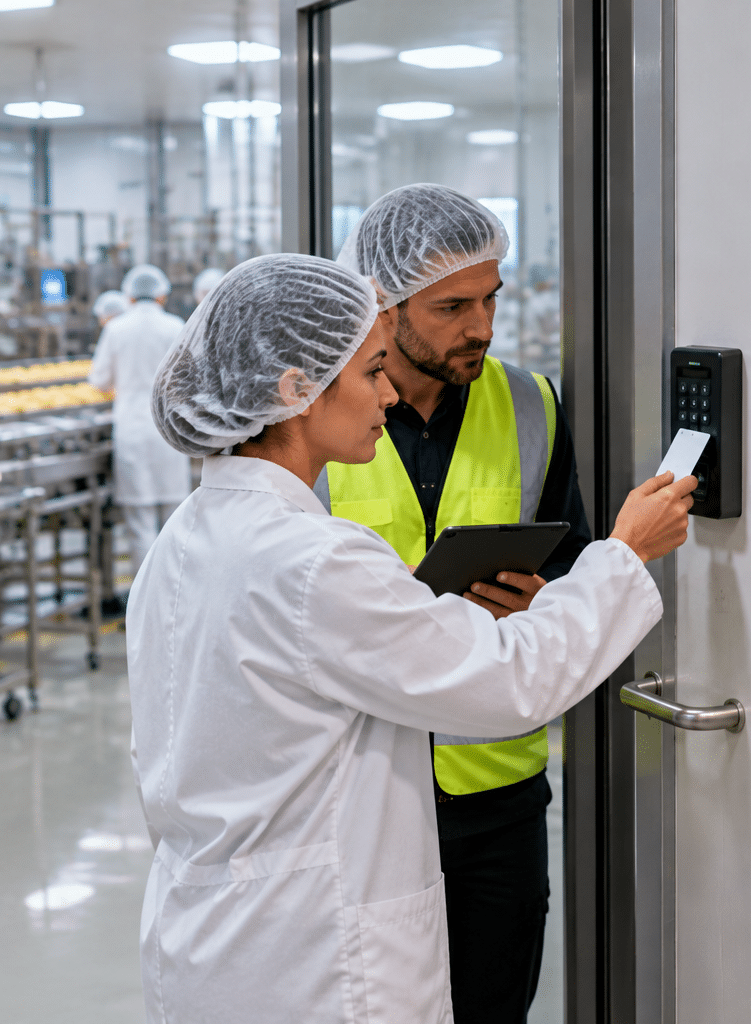
For example, an authorised worker may present a card to a reader beside a production-area door.
The system checks whether that credential is permitted to open the door at that time.
Electronic door controllers
A controller processes access requests according to configured rules.
It may check the person's assigned access group, working hours and approved locations.
If the request is valid, the controller sends a signal to the relevant locking hardware.
Some systems can continue operating locally during a network interruption. However, this depends on the specific product and configuration.
Electronic locks and door hardware
Electronic locks control access through a door.
Different options suit different door types and security requirements.
For example, a standard staff entrance may use an electric strike, while another location may need a different locking arrangement.
Importantly, the choice must account for emergency escape, door construction and applicable building and fire safety requirements.
Central management software
Management software allows authorised administrators to issue, change and remove access permissions.
It may also provide event reports and alerts.
For example, when an employee changes departments, an administrator can remove access to their previous work area and assign the permissions needed for their new role.
This reduces the need to replace physical keys every time staff responsibilities change.
3. Planning Food Manufacturing Access Solutions Around Production Zones
Effective security begins with understanding how people, materials and equipment move through the facility.
Rather than installing readers on every available door, businesses should identify which boundaries genuinely need control.
A practical assessment starts at the main entrance, follows raw materials through production and finishes at dispatch.
This approach helps identify where access restrictions can support both security and food handling procedures.
Food manufacturing Access Solutions for entry and reception
The main entrance is often the first security boundary.
Depending on the facility, suitable measures may include electronic staff credentials, visitor intercoms and controlled reception doors.
For instance, employees may enter using individual access cards while delivery drivers and visitors request assistance through an intercom.
Visitor movement can then follow a managed check-in process.
This arrangement reduces casual access without making ordinary staff entry unnecessarily difficult.
Access control for raw material receiving
Ingredient receiving areas may experience frequent movement from delivery drivers, forklift operators and warehouse employees.
Therefore, access control should distinguish between authorised workers and external visitors.
A suitable design may include controlled pedestrian doors, separate driver waiting areas and supervised entry for contractors.
However, electronic door access should not be treated as a substitute for dock safety.
Vehicle movement, pedestrian separation, loading procedures and forklift risks need their own safety controls.
Food manufacturing Access Solutions for high-care processing
Some production facilities use high-care or high-hygiene zones to help reduce contamination risk.
These areas may require additional controls around clothing, footwear, hand hygiene and worker movement.
For example, employees may need to pass through an approved changing area before entering a high-care production room.
Electronic access control can help direct staff through that route.
However, the system should be designed with the food safety team. It must not create shortcuts around required hygiene steps or introduce new contamination risks.
Food manufacturing Access Solutions for cold storage
Cold rooms and freezers create special design challenges.
Low temperatures, moisture and condensation can affect equipment.
As a result, readers, cables, locks and door sensors must be suitable for their actual installation environment.
The system also needs to support safe access and escape.
For example, workers must not become trapped because a credential reader, controller or power supply has failed.
Cold-room emergency release arrangements and other safety measures should be checked by suitably qualified specialists.
Food manufacturing Access Solutions for loading and dispatch
Finished goods areas often contain valuable stock and frequent vehicle activity.
Controlled access can help separate warehouse workers, transport operators and visitors.
For instance, an external driver might be authorised to enter a designated waiting area but not a finished-product storage room.
CCTV and alarms may provide additional visibility around loading docks.
Nevertheless, delivery schedules should be considered carefully so security measures do not create unsafe congestion.
Protecting utilities and technical rooms
Food plants also contain important infrastructure such as electrical switchrooms, refrigeration equipment, communications cabinets and machinery control areas.
These spaces may require restricted access due to safety and operational risks.
For example, refrigeration technicians may receive temporary access to a designated service room during a planned maintenance visit.
After the task ends, their credentials can be disabled.
This reduces unnecessary access to critical equipment while supporting legitimate maintenance work.
4. Comparing Food Manufacturing Access Solutions
Different access control technologies offer different advantages.
The best option depends on the site, environment and people using the system.
| Access solution | Main advantages | Considerations | Suitable applications |
| Access cards | Familiar, simple to issue and deactivate | Cards may be lost or shared | Staff entrances and general production areas |
| Key fobs | Compact and convenient | Need a replacement and cancellation process | Warehouses and employee access |
| PIN keypads | No physical card required | Codes can be observed or shared | Selected low-risk doors |
| Mobile credentials | Permissions may be managed digitally | Depend on compatible devices and site conditions | Offices and selected staff areas |
| Biometric readers | Link authentication to a physical characteristic | Privacy, hygiene, glove use and reliability concerns | Carefully assessed restricted locations |
| Mechanical keys | Simple operation without network services | Difficult to manage when many keys are issued | Selected secondary doors and backup arrangements |
| Integrated access control | Central rules, event records and security integration | Greater planning and maintenance needs | Larger or multi-zone facilities |
Which option is best?
For many factories, electronic cards or fobs provide a practical starting point.
They can support individual permissions without requiring staff to use shared access codes.
However, a large facility may benefit from a centrally managed system that connects several buildings or production areas.
Similarly, businesses with changing contractor teams may value time-limited digital credentials.
Biometric access requires closer review. Fingerprint recognition can be affected by gloves, moisture or dirty hands. In addition, biometric data raises privacy and data protection considerations.
Therefore, manufacturers should evaluate real working conditions before choosing any credential technology.
The most advanced technology is not always the most suitable.
5. Selecting Hygiene-Friendly Access Control Hardware
Food manufacturing Access Solutions must work reliably in environments where cleaning is a normal part of daily operations.
This creates an important difference between ordinary commercial security and food production security.
Consider frequent cleaning
Some production areas require regular washing, sanitising or chemical cleaning.
As a result, exposed readers and locking hardware may need protection against moisture and cleaning chemicals.
Installers should check the manufacturer's product specifications and approved cleaning instructions.
An ingress protection rating, commonly called an IP rating, describes protection against the entry of solid objects and water under defined test conditions.
However, an IP rating alone does not prove that a device can withstand every sanitiser, cleaning method or production environment.
Choose suitable surfaces
Hardware installed near food processing areas should avoid creating unnecessary dirt traps.
Depending on the location, smooth and corrosion-resistant materials may help with cleaning.
For example, stainless-steel housings can suit some industrial environments.
Nevertheless, the material grade, surface finish, mounting arrangement and chemical compatibility should all be assessed.
The surrounding door, seals and wall penetrations also matter.
A cleanable reader is of limited value if its installation leaves gaps where moisture or debris can collect.
Consider gloves and protective clothing
Employees may wear gloves, protective clothing or other personal protective equipment.
Therefore, a system that works well in an office may be inconvenient on a processing line.
For example, fingerprint readers may not be suitable where employees must keep protective gloves on.
A contactless card reader could provide a more practical alternative.
Importantly, system design should not encourage workers to remove required protective equipment merely to unlock a door.
Address humidity and condensation
Cold storage rooms, chilled processing areas and wet production environments can expose equipment to condensation.
Manufacturers should consider cable protection, suitable mounting positions and condensation management.
Moreover, regular inspections can identify early signs of corrosion or water damage.
These steps can improve reliability, although no equipment should be assumed to be maintenance-free.
6. Integrating Food Manufacturing Access Solutions With CCTV and Alarms
Access control becomes more useful when it operates alongside other relevant security measures.
For example, an access event may identify when a restricted door was opened, while a nearby camera may help authorised staff review the surrounding activity.
However, security integration should follow clear operational goals rather than connecting systems without a defined need.
CCTV integration
CCTV can provide visual context for access control events.
A food manufacturer might use cameras to monitor main entrances, loading areas or restricted equipment rooms.
If a door is opened outside normal working hours, an authorised manager may review the related access event and available footage.
Nevertheless, cameras should be positioned to meet legitimate security needs while respecting employee privacy and workplace policies.
Intrusion alarm integration
Intrusion alarms can help identify suspicious movement or entry when areas are unoccupied.
For example, a warehouse alarm may be armed after the final shift.
A properly designed integration can coordinate authorised access and alarm operation.
However, these rules must be tested carefully to avoid unnecessary alarms or missed events.
Remote monitoring and administration
Some systems allow authorised managers or service providers to review events remotely.
This can be useful for multi-site manufacturers.
However, remote administration also creates cyber security responsibilities.
The Australian Signals Directorate's Australian Cyber Security Centre recommends measures such as limiting external access, separating industrial control networks and using multi-factor authentication for relevant privileged access.
Its guidance on protecting industrial control systems offers a useful starting point for technical planning.
Food manufacturers should avoid exposing security controllers or industrial control systems directly to the public internet without an approved security architecture.
In addition, administrators should have individual accounts, appropriate permissions and access logs.
7. Australian Food Safety and Workplace Requirements
Australian businesses must consider food safety, workplace safety and applicable building requirements when planning access control.
However, it is important to distinguish between legal duties and optional security improvements.
Electronic access control can support compliance procedures, but it does not automatically establish compliance.
Food Standards Australia New Zealand
Food Standards Australia New Zealand, or FSANZ, develops food standards used in Australia.
According to the FSANZ food safety standards guidance, Standard 3.2.2 addresses food safety practices, while Standard 3.2.3 covers food premises and equipment.
These standards include requirements relevant to preventing contamination and maintaining suitable food premises.
For example, premises design and food handling procedures should reduce opportunities for food contamination.
Access restrictions may help support this objective by controlling unnecessary movement into food preparation or processing areas.
However, these standards do not impose a universal requirement for every food manufacturing door to have an electronic card reader.
The specific requirements depend on the operation and applicable regulations.
Some primary production and processing activities also fall under sector-specific standards.
Therefore, each manufacturer should review its obligations with its food safety manager and relevant regulator.
HACCP and controlled access
Hazard Analysis and Critical Control Points, commonly called HACCP, is a structured approach to identifying and controlling food safety hazards.
Manufacturers may use HACCP principles within their food safety management systems.
Access control can support selected procedures, such as restricting entry to a high-care processing area.
However, an electronic security system is not automatically a critical control point.
Whether access arrangements form part of a food safety control must be determined through the site's hazard analysis.
For example, controlled access might support a hygiene boundary, but it cannot replace sanitation, temperature control or allergen management.
Workplace health and safety
Food manufacturers must also manage risks to workers and visitors.
In particular, electronic locking systems must not compromise emergency escape.
Safe Work Australia's Model Code of Practice: Managing the Work Environment and Facilities provides guidance on workplace entry, exit, facilities and emergency planning.
The legal status of model codes varies by jurisdiction.
Victoria also has its own occupational health and safety legislative framework.
Therefore, businesses should confirm the requirements that apply in their state or territory.
Emergency exits and electronic locks
Access-controlled doors must be designed around safe escape.
For example, an installer should assess what happens during:
- A power failure.
- A fire alarm activation.
- A controller fault.
- A network outage.
- An emergency evacuation.
Some locking products unlock when power is removed. Others remain secure against entry but allow mechanical escape.
These arrangements have different applications.
Therefore, the correct design depends on the door, fire strategy, building requirements and operational risks.
Qualified security and fire safety professionals should review the proposed arrangement before installation.
Administrative records and compliance reviews
Access control systems can support internal administrative tasks.
For example, managers may maintain records of employee permissions, contractor authorisations and access reviews.
These records can help demonstrate how security procedures are managed.
However, access logs should not be presented as proof that all food safety requirements were met.
Manufacturers should have relevant records and procedures reviewed by their food safety advisers, suitably licensed specialists and regulators where required.
8. Managing Employees, Contractors and Visitors
Food manufacturing Access Solutions are only effective when access permissions remain accurate.
A well-installed system can still create problems if former employees retain active credentials or contractors receive unnecessary permissions.
Therefore, access management needs clear responsibility.
Employee access groups
Businesses should create access groups based on job responsibilities.
For example, production staff may need permission for specific processing areas, while warehouse staff require access to receiving and dispatch.
Maintenance employees may need additional permissions for machinery rooms.
However, not every worker needs unrestricted access.
This principle is called least-privilege access. It means giving people only the permissions needed for their duties.
Temporary contractor permissions
Contractors often work at factories for short periods.
For example, a refrigeration specialist may attend the site for scheduled maintenance.
The contractor could receive a temporary credential with limited access.
Before access is approved, the business should complete any required induction, safety checks and authorisation steps.
After the work finishes, the credential should expire or be removed.
Visitor management
Visitors may include auditors, customers, suppliers and service technicians.
A suitable visitor procedure might include identification checks, registration, induction and an assigned host.
Where necessary, visitors should remain under supervision.
However, digital visitor registration alone does not replace hygiene instructions, protective clothing or other site-specific controls.
Employee departures
When a worker leaves the business, access permissions should be removed promptly.
Similarly, lost credentials should be disabled once reported and verified.
A clear process reduces uncertainty and helps prevent old credentials from remaining active.
9. Step-by-Step Food Manufacturing Access Solutions Implementation Checklist
Installing Food manufacturing Access Solutions requires planning across security, operations, food safety and workplace safety teams.
The following checklist provides a practical starting point for Australian manufacturers.
- Review the facility layout. Identify entrances, exits, production rooms, storage areas and other locations that may require controlled access.
- Identify security and hygiene risks. Consider unauthorised entry, contamination risks, stock protection and operational disruption.
- Map people and material movement. Document how employees, contractors, visitors, ingredients and finished products move through the site.
- Classify access zones. Separate public areas, general staff areas, restricted production spaces and critical infrastructure rooms.
- Define user permissions. Decide which roles require access to each area and during which working hours.
- Review door and safety requirements. Have appropriately qualified specialists assess locks, emergency escape, fire interfaces and any required building approvals.
- Select suitable credentials. Compare cards, fobs, mobile access and other options based on staff needs and workplace conditions.
- Choose environment-appropriate hardware. Review moisture exposure, cleaning chemicals, temperature, corrosion and hygiene requirements.
- Plan security integration. Determine whether CCTV, intercoms, alarms or other approved systems should connect to access control.
- Protect the management network. Establish secure administration, backups, user permissions and appropriate network separation.
- Install and test the system. Verify access rules, door functions, alarms, emergency operation and fault responses before handover.
- Train employees and administrators. Explain how credentials work, how to report failures and how permissions are managed.
- Schedule ongoing reviews. Check hardware condition, access permissions, event logs and system performance at intervals based on site risk.
This checklist should be adapted to each facility. It does not replace site-specific engineering, food safety or regulatory assessments.
10. Testing and Maintaining Food Manufacturing Access Solutions
A successful installation is only the beginning.
Over time, doors experience wear, staff permissions change and production areas may be modified.
Therefore, regular maintenance is important.
Test normal access
First, confirm that authorised employees can enter their approved areas.
Then test whether a credential is rejected at locations outside its permissions.
For example, a warehouse credential should not open a restricted laboratory door unless that permission has been intentionally granted.
Testing should include relevant shift schedules and temporary access rules.
Test abnormal conditions
Next, assess how the system behaves during faults.
Important scenarios include a lost network connection, controller failure, door held open and loss of normal power.
Emergency release and fire system interactions must be tested according to the approved design and site procedures.
These checks should be performed by competent personnel.
Review event records
Access logs can help identify unusual activity.
For instance, repeated denied-access attempts at a restricted door may warrant investigation.
However, an unusual event does not automatically prove wrongdoing.
Managers should consider legitimate explanations, such as an employee using an outdated credential or entering through the wrong door.
Inspect physical hardware
Door hardware should also receive regular attention.
Maintenance may include checking door alignment, reader operation, cable protection, locks, sensors and environmental seals.
In wet processing areas, signs of corrosion or moisture damage deserve particular attention.
Moreover, maintenance work must avoid creating new food contamination risks.
Review access permissions
Regular permission reviews help keep the system aligned with staffing changes.
A manager might confirm whether current employees still need each assigned access group.
The review frequency should reflect the site's risks and staff turnover.
There is no single review interval suitable for every food manufacturer.
11. Understanding Food Manufacturing Access Solutions Costs in Australia
The cost of Food manufacturing Access Solutions varies depending on the facility and chosen technology.
Therefore, an accurate quotation usually requires a site assessment.
Factors affecting installation costs
Several factors can influence the total investment.
Number of controlled doors: A single-door installation is different from a system managing several production buildings.
Existing infrastructure: Suitable cabling, power supplies and compatible equipment may reduce the amount of new installation work.
Door construction: Fire-rated doors, insulated cold-room doors and industrial doors can require specialised hardware or additional design work.
Environmental conditions: Washdown areas, cold rooms and corrosive environments may need more suitable equipment.
Software and integration: Central management, CCTV integration, reporting and remote administration can increase system complexity.
Ongoing costs: Businesses should consider maintenance, replacement credentials, software support, licensing and future upgrades.
Avoid comparing quotes on price alone
The cheapest initial installation may not offer the lowest long-term cost.
For example, equipment that is unsuitable for regular washdowns may require more repairs or early replacement.
Likewise, a system without reliable credential management could create unnecessary administrative work.
Therefore, manufacturers should compare quotations using the same scope, performance requirements and maintenance expectations.
Request a detailed proposal
A useful proposal should explain the controlled doors, equipment types, system functions and implementation stages.
It should also identify any exclusions.
For example, the business should know whether fire interface work, network equipment, door repairs or specialist approvals are included.
Clear scope documents make quotations easier to compare and reduce misunderstandings during installation.
12. Practical Examples of Food Manufacturing Access Solutions
The following examples are illustrative. They show how different facilities might apply access control principles rather than describing completed client projects.
Example 1: A Melbourne packaged food facility
Consider a packaged food manufacturer operating across two production shifts.
The site includes reception, raw material storage, preparation rooms, packaging and dispatch.
Initially, several internal doors use shared mechanical keys.
However, managers want better control over contractor entry and restricted production areas.
A possible solution could include individual staff credentials, defined production access groups and time-limited contractor permissions.
CCTV could support monitoring at selected external entrances.
Before installation, the business would review emergency exit requirements, food safety procedures and door suitability.
Example 2: A dairy processing operation
A dairy facility may have chilled production areas and rooms requiring regular cleaning.
In this environment, hardware selection is particularly important.
For example, contactless readers may be more convenient for employees wearing protective clothing.
Equipment near wet areas would need suitable protection against moisture and approved cleaning chemicals.
Meanwhile, cold-room access arrangements would require careful review of emergency escape and door operation.
The access system could support hygiene boundaries, but staff would still need to follow all food handling procedures.
Example 3: A bakery with overnight production
An industrial bakery may operate while most office staff are absent.
Production workers could have scheduled access to the bakery and relevant amenities.
Delivery drivers might use an intercom at a designated entrance.
Maintenance contractors could receive temporary access when authorised work is scheduled.
As a result, the business gains greater control over entry without requiring every shift to rely on shared keys.
However, the system must account for staff breaks, emergency access and unexpected production changes.
Example 4: A multi-building manufacturing site
A larger food manufacturer might operate separate buildings for processing, packaging, storage and administration.
A central access platform may simplify credential management across the site.
For example, one employee credential could provide access to approved areas in more than one building.
Nevertheless, each building may have different environmental and safety requirements.
Therefore, system design should remain specific to each location rather than applying identical hardware everywhere.
These examples illustrate why food manufacturing security should begin with an assessment of real site operations.
13. People Also Ask About Food Manufacturing Access Solutions
What is the best access control system for a food manufacturing facility?
The best system depends on the factory layout, hygiene requirements, workforce and security risks. Electronic cards or fobs are practical for many facilities, while larger operations may benefit from centralised management and integrated monitoring.
Is electronic access control mandatory for food manufacturers in Australia?
There is no universal requirement for every Australian food factory door to use electronic access control. However, manufacturers must meet applicable food safety, workplace safety and building requirements, and electronic access systems can support some of those responsibilities.
Can access control systems be installed in washdown areas?
Yes, but equipment must be suitable for the expected water exposure, cleaning chemicals and environmental conditions. Installers should check product specifications, installation details and the site's sanitation procedures before selecting hardware.
How can food manufacturers control visitor access?
Businesses can use intercoms, controlled reception points, visitor registration and temporary credentials to manage entry. However, visitor induction, supervision and hygiene procedures remain important, particularly near food processing areas.
14. Frequently Asked Questions About Food Manufacturing Access Solutions
1. How should access control work during a power failure?
The correct response depends on the door's role in building security and emergency escape.
Some electronic locks are configured to unlock when power is removed. Others can remain secure against outside entry while still permitting safe exit through approved mechanical arrangements.
Therefore, designers must assess each controlled door individually.
For example, a restricted storage room may have different requirements from a designated emergency exit.
Battery backup can support selected systems, but it does not remove the need for compliant emergency operation.
Manufacturers should have the final design reviewed and tested by appropriately qualified personnel.
2. How can access control records support a food safety investigation?
Access logs can help authorised investigators build a timeline of activity near a relevant area.
For example, they may show that particular credentials were used at a restricted entrance during a defined period.
However, the records do not prove what happened inside the room or confirm that hygiene procedures were followed.
Consequently, investigators may need to compare access events with production records, staff rosters, CCTV footage and other available evidence.
Businesses should establish suitable retention, access and privacy procedures for these records.
This supports responsible investigation without treating electronic logs as complete proof of an incident.
3. Can an existing food factory upgrade its locks without replacing every door?
In some cases, yes.
Existing doors may be suitable for electronic locks, readers and controllers.
However, compatibility depends on the door construction, frame, hardware, fire rating and intended operating conditions.
For instance, an ordinary internal staff door may be easier to upgrade than an insulated cold-room door.
Before any modification, the installer should confirm that the proposed equipment will not affect required fire performance, hygiene or emergency escape.
Therefore, an on-site inspection is usually a sensible first step.
4. Are biometric access systems suitable for food production environments?
Biometric systems can be suitable for selected applications, but they are not automatically the best choice.
Fingerprint readers may be difficult to use when employees wear gloves or have wet hands.
Facial recognition can avoid direct reader contact, although lighting, protective clothing, accuracy and privacy still require assessment.
Biometric information also needs careful handling because it relates to an individual's physical identity.
Therefore, businesses should review data collection, storage, retention, worker consultation and applicable privacy obligations before adoption.
Less intrusive credentials may be preferable where they achieve the same security goal.
5. How should manufacturers measure the performance of their access control system?
Performance should be measured against clear operational and security objectives.
For example, a manufacturer could monitor credential failures, unresolved door alarms, system availability and the time required to remove access for departing staff.
The business could also review maintenance incidents and employee feedback.
However, fewer alarms do not automatically mean better security. Alarm settings may simply be too broad or too narrow.
Therefore, performance reviews should consider both technical results and actual site conditions.
A useful system provides reliable authorised access, appropriate restrictions and safe operation without unnecessary disruption.
15. Conclusion: Choosing the Right Food Manufacturing Access Solutions
Food manufacturing Access Solutions can help Australian manufacturers protect restricted areas, manage staff and contractor access, and strengthen daily security procedures.
However, a suitable system must do more than control entry.
It should reflect the facility's production flow, hygiene requirements, working hours, maintenance needs and emergency safety arrangements.
Electronic access cards, intercoms, CCTV integration and central management can all provide value when selected for a clear purpose.
Equally important, manufacturers should involve their food safety, operations and workplace safety teams before making installation decisions.
For facilities in Melbourne, Victoria and across Australia, a professional site assessment can help identify suitable options and practical priorities.
Looking to improve access security at your food manufacturing facility? Explore Eclipse Security's commercial access control and integrated security solutions and enquire about a site-specific security assessment to discuss your facility's requirements.