


Introduction
Electronic Security for Factories is an important part of protecting manufacturing facilities, valuable equipment, employees, raw materials and finished products across Australia. Unlike standard offices or retail premises, factories face complex security challenges. These include large operational areas, multiple entry points, heavy machinery, delivery vehicles, contractors and production activities that may continue around the clock.
Imagine a manufacturing facility in Melbourne where employees begin work before sunrise, delivery trucks enter throughout the day and expensive machinery remains onsite overnight. Without effective security controls, unauthorised access, theft, vandalism and operational disruptions can create serious problems.
However, installing security cameras alone does not necessarily provide adequate protection.
Factory security requires a coordinated approach that combines CCTV surveillance, electronic access control, intrusion detection, alarm monitoring and clear security procedures.
From a practical security planning perspective, one of the most important lessons is that every factory has different vulnerabilities. A food processing facility may prioritise hygiene-controlled areas, while an automotive manufacturer may focus on expensive equipment and intellectual property.
Therefore, selecting the right electronic security solution starts with understanding how the factory operates.
This guide explains the essential technologies, installation processes, Australian requirements, costs and maintenance considerations. It also provides practical advice to help factory owners, operations managers and facility managers make informed security decisions.
What Is Electronic Security for Factories?
Electronic Security for Factories is the use of connected cameras, access controls, intrusion alarms, intercoms and monitoring to protect manufacturing sites. A well-designed system helps manage entry, detect unusual activity, record incidents and support a planned response without disrupting production, worker safety or emergency exits.
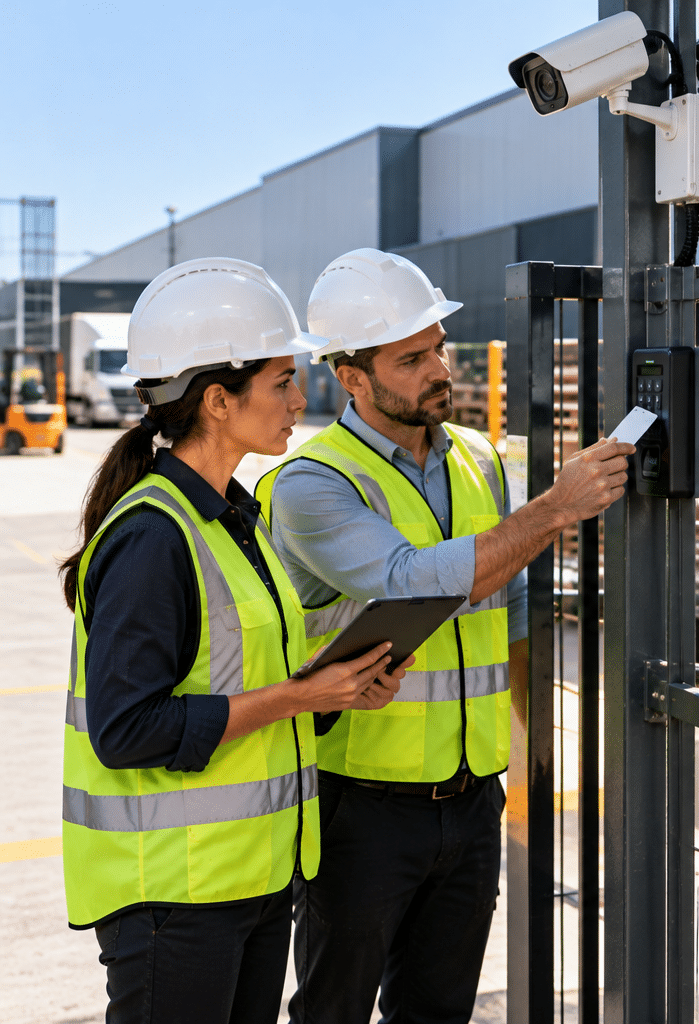
Table of Contents
- Why Electronic Security for Factories Matters
- Understanding Security Risks in Australian Factories
- Essential Electronic Security Systems for Factories
- Designing Security Around Factory Operations
- Comparing Factory Security Technologies
- CCTV Surveillance for Manufacturing Facilities
- Electronic Access Control for Factories
- Intrusion Detection and Security Alarm Monitoring
- Cybersecurity for Connected Factory Security Systems
- Privacy and CCTV Responsibilities in Australia
- Australian Security Licensing and Workplace Safety
- How Much Does Electronic Security for Factories Cost?
- Factory Security Installation Checklist
- Testing, Maintenance and Long-Term Performance
- Common Factory Security Mistakes
- People Also Ask
- Expert Questions and Answers
- Conclusion
1. Why Electronic Security for Factories Matters
Australian manufacturing businesses operate in environments where physical security and uninterrupted production are closely connected.
Factories often contain expensive machinery, valuable stock, specialist tools and sensitive commercial information. Consequently, security incidents can affect more than the immediate value of stolen or damaged property.
A break-in may interrupt production, delay customer orders and create additional repair expenses.
Furthermore, unauthorised access to restricted areas can introduce workplace safety risks.
Protecting high-value manufacturing assets
Manufacturing equipment can represent a major financial investment. Production machines, specialised tools, electrical components and raw materials may be difficult or expensive to replace.
Therefore, Electronic Security for Factories should help protect these assets through a combination of controlled entry, surveillance and intrusion detection.
For example, a factory storing high-value metal components may benefit from cameras overlooking storage areas, controlled access to inventory rooms and alarms that operate outside authorised hours.
Each security measure addresses a different risk.
Reducing operational disruption
Security incidents can affect production schedules and delivery commitments.
For example, damage to a loading dock or theft of essential equipment may prevent a factory from operating normally.
Although security technology cannot eliminate every incident, it can improve detection and support a faster, more organised response.
Supporting employee and contractor safety
Factory environments often contain hazardous machinery, chemicals, restricted production areas and heavy vehicle movements.
As a result, unauthorised entry can create serious risks.
Electronic access control can help restrict entry to trained or approved personnel. However, access systems must complement workplace safety procedures rather than replace them.
Improving accountability
Security systems also help establish a reliable record of relevant events.
Access logs can show when credentials were used, while CCTV footage may help explain what happened during an incident.
However, these records should be handled responsibly, with appropriate privacy and access controls.
The aim is not to monitor every employee continuously. Instead, the goal is to maintain appropriate visibility over important security events.
2. Understanding Security Risks in Australian Factories
Before investing in Electronic Security for Factories, businesses should carry out a site-specific security risk assessment.
A risk assessment identifies what needs protection, how an incident might occur and which controls are most useful.
Importantly, it should reflect real working conditions.
External perimeter vulnerabilities
Large factories may have fences, pedestrian entrances, vehicle gates, loading docks and rear service doors.
These areas require careful attention because they often connect public or shared spaces with restricted industrial areas.
Potential vulnerabilities include poorly illuminated entrances, unsecured gates, blind spots and doors that remain open during deliveries.
Therefore, perimeter planning should begin with an inspection of every practical access route.
Internal factory vulnerabilities
Not every security risk comes from outside the property.
Internal risks may involve unauthorised movement into restricted spaces, misplaced access cards, poor visitor supervision or inadequate control over sensitive inventory.
For example, employees who work in a packing area may not need access to confidential design offices or high-value component storage.
Role-based permissions can help manage these differences.
Operational and environmental conditions
Industrial premises can be difficult environments for electronic equipment.
Depending on the site, cameras and sensors may encounter:
- Dust, moisture or airborne particles
- High or low temperatures
- Machinery vibration
- Changing lighting conditions
- Forklift and vehicle movements
- Electromagnetic interference
- Outdoor exposure to rain, heat and wind
Consequently, equipment should be chosen for its actual installation environment.
A camera suitable for a clean office may not be appropriate for an outdoor loading bay or dusty production area.
After-hours security risks
Some Australian factories operate around the clock. Others close overnight or on weekends.
When a facility is unoccupied, unusual activity may go unnoticed unless security systems can detect and report it.
For this reason, alarm zoning, remote monitoring and clear response procedures deserve particular attention.
3. Essential Electronic Security Systems for Factories
An effective Electronic Security for Factories strategy usually combines several technologies.
Each system serves a different purpose. Together, they create layers of protection.
CCTV security cameras
Closed-circuit television, commonly called CCTV, provides visual surveillance and recorded evidence.
Factory cameras may monitor entrances, loading docks, vehicle gates, storage rooms and other areas where surveillance is justified.
Modern systems can also provide remote viewing and event-based recording, subject to secure access and suitable network connections.
However, CCTV is primarily a visibility and evidence tool. A camera does not physically prevent someone from entering a restricted area.
Electronic access control systems
Access control regulates who can enter designated areas.
Depending on the equipment, employees may use cards, key fobs, PINs or approved mobile credentials.
For example, factory managers can assign different access permissions to production workers, maintenance teams and administrative staff.
This reduces dependence on shared physical keys and makes it easier to withdraw access when an employee leaves.
Intrusion detection alarms
Intrusion alarms detect events that may indicate unauthorised entry.
Typical devices include door contacts, motion detectors and suitable perimeter sensors.
However, detectors must be positioned carefully in industrial environments. Moving machinery, environmental conditions and normal factory activity can otherwise generate unwanted alarms.
Intercom and visitor entry systems
Intercoms allow authorised staff to communicate with visitors before granting entry.
They are especially useful at vehicle gates, reception entrances and delivery areas.
For example, a truck driver arriving outside standard delivery hours can contact a designated employee without entering a restricted production space.
Alarm monitoring services
Alarm monitoring provides a process for receiving security events and following an agreed response plan.
Depending on the monitoring agreement, a monitoring operator may contact nominated staff, request verification or arrange an appropriate response.
Therefore, the value of monitoring depends on both the technology and the quality of the response instructions.
Security system integration
Integration allows different security systems to work together.
For example, an access event may help an authorised operator locate relevant CCTV footage. Similarly, an alarm activation may present associated camera views for verification.
However, integration should be planned carefully. Poorly designed connections can increase technical complexity and cyber risk.
The best integrated system is not necessarily the one with the most features. It is the one that reliably supports the factory’s daily operations.
4. Designing Electronic Security for Factories Around Real Operations
Security should support production rather than interfere with it.
Therefore, Electronic Security for Factories should be designed around the way people, materials and vehicles move throughout a manufacturing site.
Manufacturing and production areas
Production floors may contain expensive equipment and sensitive manufacturing processes.
CCTV can help provide general visibility at suitable locations, while access control can restrict entry to high-risk areas.
However, surveillance must not be treated as a substitute for machine guarding, trained supervision or established safety controls.
Loading docks and dispatch areas
Loading docks are particularly important because employees, contractors, drivers and goods frequently move through them.
Useful security measures may include cameras with suitable coverage, controlled pedestrian doors and intercoms at delivery points.
Additionally, recorded vehicle arrival information can support incident investigations.
Nevertheless, camera positioning should avoid interfering with reversing vehicles, forklift operations or emergency access.
Raw material and finished goods storage
Factories may store expensive raw materials, specialist components or ready-to-dispatch products.
Consequently, storage areas often require stronger access control and appropriate surveillance.
For example, a restricted stockroom can use electronic entry permissions and a camera covering its doorway.
This creates an entry record and provides visual information if an incident occurs.
Plant rooms and IT infrastructure
Electrical rooms, communications cabinets, server rooms and production control areas may require additional protection.
Access to these spaces should be limited to authorised personnel.
However, physical security systems should not be connected directly to sensitive industrial control networks without an appropriate technical assessment.
External yards and vehicle parking
Outdoor environments introduce different challenges.
Cameras need suitable weather protection, appropriate lighting and stable mounting.
Meanwhile, vehicle access systems should support safe traffic movements.
The combination of physical barriers, lighting and electronic monitoring is often more effective than relying on cameras alone.
5. Comparing Electronic Security Technologies for Factories
Choosing Electronic Security for Factories becomes easier when each technology is matched to a clear objective.
The following comparison highlights their common uses and limitations.
| Security technology | Primary purpose | Common factory applications | Important limitation |
| CCTV surveillance | Provide visual monitoring and recorded footage | Entrances, warehouses, loading docks | Does not physically stop intrusion |
| Electronic access control | Manage authorised entry | Production zones, plant rooms, offices | Requires correct permissions and door hardware |
| Intrusion alarms | Detect potential unauthorised activity | External doors, restricted rooms, after-hours areas | False alarms are possible |
| Video intercoms | Communicate with visitors before entry | Gates, reception, delivery entrances | Requires an available response process |
| Perimeter detection | Detect activity near boundaries | Fences, yards and exposed site boundaries | Environmental conditions affect performance |
| Alarm monitoring | Receive events and follow response instructions | Unoccupied or high-risk factories | Response depends on the agreed service |
| Integrated management | Bring selected events and records together | Larger or multi-building facilities | Adds technical and cybersecurity complexity |
No single technology is suitable for every situation.
For example, a small factory operating only during business hours may need a different combination of systems from a large industrial facility with continuous production.
Therefore, security planning should prioritise the site’s highest risks rather than simply purchasing every available product.
6. CCTV Surveillance for Manufacturing Facilities
CCTV is one of the most visible components of Electronic Security for Factories.
However, camera quantity alone does not determine how useful a surveillance system will be.
Camera placement, image quality, lighting and recording reliability are equally important.
Choose cameras based on the task
First, determine what each camera is expected to show.
A wide-angle camera may be useful for monitoring general movement across a production area.
However, a different field of view may be required when the purpose is to capture clear details at an entrance.
Camera selection should consider viewing distance, lighting, resolution and the amount of detail needed.
Consider industrial lighting conditions
Manufacturing facilities may contain bright windows, dark storage spaces and changing artificial light.
These conditions can affect image quality.
Therefore, cameras should be tested during the periods when they will be used.
For example, a loading dock camera may perform well at midday but produce poor images at night when vehicles approach with headlights.
Avoid obstructed camera views
Factory layouts are rarely static.
Pallets, shelving, equipment and temporary storage can block camera views.
Consequently, a site assessment should consider both current and likely future obstructions.
Installing a camera directly behind a frequently used storage position may provide little long-term value.
Plan footage storage
Businesses should decide how footage will be stored, accessed and retained.
Retention depends on the purpose of recording, applicable obligations, expected incident reporting periods and available storage.
Importantly, there is no single universal CCTV retention period suitable for every Australian factory.
Longer retention requires more storage and may increase privacy risk.
Therefore, the retention policy should be documented before the system is commissioned.
Review video analytics carefully
Some cameras offer features such as motion alerts, object classification and virtual boundary detection.
These tools may help prioritise events.
However, analytics can produce false positives or miss events, especially in busy industrial environments.
They should be tested under realistic conditions rather than accepted solely on manufacturer claims.
7. Electronic Access Control for Factories
Access control is another important part of Electronic Security for Factories.
Unlike CCTV, which records activity, access control helps decide who can enter specific areas.
This makes it particularly valuable where employees, contractors and visitors have different responsibilities.
Use role-based access permissions
A factory can create permissions based on job requirements.
For example:
- Production employees may access designated production areas.
- Warehouse workers may access stock and dispatch zones.
- Maintenance technicians may enter approved equipment rooms.
- Administration staff may access offices and common areas.
- Contractors may receive limited access for specific tasks.
However, permissions should not be broader than necessary.
This approach is commonly called least-privilege access.
Manage shift changes effectively
Australian factories may operate morning, afternoon and overnight shifts.
Consequently, access rules should reflect approved working arrangements.
Time-based permissions can help control when certain credentials are valid.
However, supervisors should have a safe process for handling genuine exceptions, such as emergency maintenance work.
Protect against shared credentials
When employees share cards or PINs, access records become less reliable.
Therefore, credentials should normally be assigned to individual authorised users.
Lost cards should be reported promptly, and permissions should be reviewed when roles change.
Plan for contractors and temporary workers
Maintenance providers, cleaners, equipment technicians and delivery contractors may need temporary access.
A useful process includes confirming identity, recording the visit, approving the relevant zones and removing access when the work ends.
Additionally, contractors should receive the necessary safety induction before entering operational areas.
Protect emergency exit routes
Electronic locks must never compromise safe evacuation.
Some locks release when power is lost, while others remain secure. These behaviours are often described as fail-safe and fail-secure.
However, selecting the correct arrangement depends on the door, fire safety design, emergency escape requirements and applicable building rules.
Therefore, qualified specialists should review electronic locking arrangements before installation.
8. Intrusion Detection and Security Alarm Monitoring
Alarm systems are valuable because they focus attention on unusual events.
For example, a factory alarm may detect an external door opening after the facility has closed.
However, successful alarm design requires more than installing sensors.
Divide the factory into suitable alarm zones
A large factory may require separate zones for:
- Administration offices
- Production floors
- Loading docks
- High-value storage rooms
- Plant and equipment rooms
- External perimeter areas
Zoning helps identify where an event occurred.
Furthermore, it may allow selected areas to remain protected while authorised staff continue working elsewhere.
Reduce unwanted alarms
Industrial sites contain moving machinery, vehicles, ventilation systems and changing temperatures.
Therefore, intrusion detectors should be selected and positioned for those conditions.
For example, a detector facing a frequently moving roller door may produce unnecessary events if its design and operating schedule are unsuitable.
Correct sensor selection, commissioning and staff training can reduce unwanted activations.
Establish clear response procedures
Alarm monitoring is most useful when responsibility is clearly defined.
A typical process may involve:
- A detector sends an event to the alarm system.
- The system communicates the event to the nominated monitoring service.
- The monitoring operator follows the agreed instructions.
- Authorised contacts receive notifications where required.
- An appropriate response is arranged according to the circumstances.
However, the exact actions depend on the monitoring contract and the nature of the incident.
Businesses should not assume that every alarm automatically produces a police response.
Test communication reliability
Factory alarm systems may use internet or mobile communications.
If an important communication path fails, events might not be delivered as expected.
Therefore, designers should assess whether backup communication or power arrangements are appropriate.
Regular testing should confirm that an event can reach the intended recipient.
9. Cybersecurity for Electronic Security for Factories
Modern Electronic Security for Factories often relies on network-connected devices.
These include IP cameras, network video recorders, electronic door controllers and remote management software.
Although connectivity provides useful features, it can introduce cyber risks.
A compromised security device may expose footage, allow unauthorised access or provide an entry point into other connected systems.
Therefore, cybersecurity should be considered from the beginning of the project.
Separate security networks where appropriate
Factories may operate several different technology environments.
These can include office IT systems, CCTV networks and operational technology, known as OT.
OT refers to systems that monitor or control industrial equipment and processes.
Where appropriate, network segmentation can help limit communication between systems.
According to the Australian Cyber Security Centre’s network segmentation and segregation guidance, network boundaries can reduce opportunities for unauthorised movement between connected environments.
In practical terms, a compromised camera should not automatically provide unrestricted access to factory production systems.
Use strong account protection
Security system accounts should use unique credentials.
Additionally, multi-factor authentication should be enabled where supported, especially for remote administration.
Shared administrator accounts should be avoided where practical.
This helps establish accountability and reduces the impact of compromised login details.
Keep firmware and software updated
Connected security devices may contain software vulnerabilities.
Manufacturers release updates to address known problems and improve reliability.
Therefore, maintenance plans should include checking vendor support and applying appropriate security updates.
However, updates should be scheduled and tested carefully so they do not unexpectedly interrupt critical operations.
Secure remote access
Remote viewing can be useful for factory managers and authorised security personnel.
Nevertheless, remote access should use secure authentication and properly configured connections.
Unnecessary internet exposure should be avoided.
Furthermore, permissions should be withdrawn when contractors or former employees no longer require access.
Prepare for equipment failure
Cybersecurity also involves resilience.
For example, businesses should consider what happens if network connectivity, a recorder or a power supply fails.
Suitable backup arrangements, documented recovery procedures and periodic testing can reduce disruption.
However, the appropriate level of redundancy depends on the site’s risks and operational requirements.
10. CCTV Privacy and Employee Monitoring in Australia
Electronic Security for Factories should protect business assets while respecting privacy.
Cameras may record employees, contractors, drivers and visitors.
Therefore, organisations should understand which privacy and surveillance laws apply to their operations.
Understand Australian privacy responsibilities
According to the Office of the Australian Information Commissioner (OAIC) guidance on security cameras, organisations covered by the Privacy Act 1988 must handle personal information collected through CCTV in accordance with applicable Australian Privacy Principles.
However, the Privacy Act does not cover every Australian business in exactly the same way.
State and territory surveillance laws may also apply, including rules concerning workplace monitoring and audio recording.
Consequently, a factory should review its specific circumstances rather than assume a general CCTV policy is sufficient.
Explain why cameras are used
A clear surveillance policy should describe the purposes of recording.
These might include protecting property, investigating security incidents and managing unauthorised entry.
Where required, suitable notices should explain that CCTV operates on the premises.
Additionally, workers should receive relevant information about workplace surveillance arrangements.
Restrict access to recorded footage
Not every manager or employee needs permission to view security footage.
Therefore, video access should be limited to approved roles.
Administrative controls should also cover footage exports, incident investigations and requests to share recordings.
Establish a retention and deletion process
Keeping footage indefinitely may create unnecessary privacy and storage risks.
A documented policy should explain why recordings are retained, who can access them and when they should be deleted or securely de-identified.
However, footage relevant to an incident or legal requirement may need different handling.
Avoid unnecessary surveillance
Camera locations should have a clear security purpose.
Areas where individuals reasonably expect a high level of privacy require particular care.
Furthermore, audio recording can raise additional legal concerns.
Businesses should obtain appropriate advice before activating features that collect information beyond the intended security purpose.
11. Australian Security Licensing and Workplace Safety
Security projects must account for both technical performance and applicable Australian requirements.
However, licensing and regulatory obligations differ between jurisdictions.
Therefore, Electronic Security for Factories should be installed and maintained with suitable professional oversight.
Victorian security industry licensing
For manufacturing facilities in Melbourne and other parts of Victoria, installer and security adviser licensing is an important consideration.
Victoria Police regulates private security activities in the state.
Its private security licensing information explains the relevant activities, including security equipment installation and security advice.
Changes introduced from 19 June 2025 brought private security activities under a licensing framework that businesses should check before engaging a provider.
Therefore, factory managers should verify the current authorisations relevant to their proposed work.
Requirements may differ elsewhere in Australia.
Electrical and building requirements
Electronic security installations may involve electrical equipment, cabling, powered doors and building infrastructure.
Consequently, work should be carried out by appropriately qualified and authorised personnel where required.
Door hardware, fire protection systems and emergency exits also need careful coordination.
Security controls should not obstruct safe evacuation or compromise the operation of required safety systems.
Workplace health and safety
Australian workplaces have obligations to manage safety risks.
Security installation work may introduce hazards such as working at heights, electrical risks and interaction with operating machinery.
Therefore, installers and factory managers should coordinate safe work arrangements.
Where necessary, installation should occur during planned maintenance periods or production shutdowns.
Compliance records and administration
Factory managers should retain appropriate project records.
These may include contractor licence checks, design drawings, test reports, relevant approvals, staff training records and maintenance documentation.
However, these records are administrative support for compliance management, not proof that every legal requirement has been satisfied.
A suitably licensed or qualified professional should review the relevant obligations for the particular site.
12. How Much Does Electronic Security for Factories Cost?
The cost of Electronic Security for Factories varies considerably.
A small manufacturing workshop may require a relatively simple installation.
Meanwhile, a large industrial facility with multiple buildings, restricted production zones and extensive perimeter areas may need a more complex design.
Therefore, a reliable quote should follow a site assessment.
Factors that influence installation costs
Factory size and layout: Larger sites may require more cameras, cabling, network equipment and installation labour.
Equipment quality: Industrial-rated products may cost more than basic devices but can be better suited to harsh operating conditions.
Security requirements: High-risk storage, restricted areas and after-hours monitoring can increase system complexity.
Existing infrastructure: Reusable cabling or suitable network equipment may reduce certain installation expenses.
Recording requirements: Greater storage capacity may be needed for higher resolution, longer retention or more cameras.
Integration requirements: Connecting alarms, CCTV and access control can add design and commissioning work.
Ongoing support: Monitoring, software subscriptions, maintenance and equipment replacement should also be considered.
Consider total ownership costs
The lowest installation quote is not always the lowest long-term cost.
For example, an inexpensive system may require frequent repairs or early replacement.
Therefore, compare proposals using total cost of ownership.
This includes the purchase price, installation, subscriptions, maintenance, energy use and expected replacement costs.
Ask for itemised quotations
A useful quotation should identify the proposed devices, installation scope, recording arrangements, warranty terms and support services.
Additionally, it should explain any assumptions.
If a provider recommends a large number of cameras, ask how each camera addresses a specific risk.
This helps prevent unnecessary spending.
No fixed national installation price can accurately represent every Australian factory without knowing the site’s requirements.
13. Electronic Security for Factories: 12-Step Installation Checklist
A structured process helps ensure the security system meets operational needs.
Use the following numbered checklist when planning Electronic Security for Factories.
- Identify the assets requiring protection. List valuable machinery, raw materials, stock, sensitive information and critical infrastructure. Prioritise assets according to business impact and exposure.
- Complete a site security assessment. Inspect boundaries, doors, gates, loading bays and internal restricted areas. Include security concerns reported by employees and supervisors.
- Review factory operating schedules. Document shifts, delivery periods, cleaning arrangements and after-hours maintenance. Security settings must reflect legitimate business activity.
- Define security objectives. Decide whether each proposed measure is intended to deter, detect, restrict entry, provide evidence or support incident response.
- Select suitable security technology. Choose cameras, alarms, access controls and intercoms according to identified risks. Avoid unnecessary features that add cost without solving a problem.
- Check environmental conditions. Consider dust, moisture, temperature, lighting and vibration. Ensure that proposed equipment suits each installation location.
- Review emergency access and evacuation. Confirm that electronic locking and access rules do not compromise safe exits, emergency procedures or required fire safety arrangements.
- Plan network and data protection. Decide how devices will connect, who can administer them and how footage and access records will be protected.
- Verify installer qualifications and licensing. Check the current requirements in the relevant Australian state or territory. Record the checks as part of project administration.
- Schedule installation carefully. Coordinate work with production managers to reduce disruption. Where required, arrange safe access around machinery and vehicle movements.
- Test the completed system. Check camera views, access permissions, alarms, communications, recording, relevant power-failure behaviour and agreed monitoring procedures.
- Arrange training and ongoing maintenance. Provide clear operating instructions, assign system ownership and establish a schedule for testing and servicing.
Completing this checklist does not guarantee that every risk has been eliminated.
However, it provides a practical structure for avoiding common planning and installation problems.
14. Testing, Handover and Long-Term Security Performance
Electronic Security for Factories should be treated as an ongoing operational system rather than a one-time purchase.
Even a well-designed installation can become less effective if permissions, equipment or factory layouts change.
Confirm performance during commissioning
Commissioning is the process of checking that the completed installation performs as intended.
For example, installers should confirm that cameras capture the required views under relevant lighting conditions.
Access control tests should verify that authorised users can enter approved areas while other permissions are restricted.
Alarm testing should confirm that the correct events reach the intended recipients.
Document the completed installation
A professional handover should provide relevant information about the system.
This may include:
- Equipment schedules and locations
- Applicable system drawings
- Operating instructions
- Administrative access arrangements
- Recording and retention settings
- Maintenance requirements
- Warranty and support details
- Test and commissioning records
However, sensitive credentials and technical documentation should be stored securely.
Train authorised staff
Factory employees responsible for security should understand the system’s normal operation.
For example, authorised users may need to know how to report a lost access card, review an alarm or request relevant footage.
Training should also explain what staff must not do.
Sharing credentials, disabling security equipment without approval or exporting recordings casually can weaken security.
Establish a maintenance schedule
Regular maintenance may include checking camera lenses, reviewing recording performance and testing alarm communications.
Access permissions should also be reviewed after staff departures or operational changes.
Furthermore, software support and cybersecurity updates should be assessed periodically.
Review security after factory changes
Manufacturing facilities evolve.
Production lines move, new storage areas are created and additional contractors begin working onsite.
Consequently, the original security design may no longer provide the intended coverage.
A review should follow significant changes to the site, operating procedures or security risks.
Measure useful security outcomes
Factory managers can track practical indicators such as:
- Percentage of scheduled security tests completed
- Number of unresolved equipment faults
- Frequency of unwanted alarms
- Time taken to disable former employees’ credentials
- Availability of footage during authorised investigations
- Completion of planned maintenance tasks
These measures help assess whether the system is being operated effectively.
However, a falling incident count alone does not prove that the system caused the improvement.
15. Common Factory Security Mistakes to Avoid
Factory security investments can underperform when planning focuses on equipment rather than actual risks.
The following mistakes are particularly important to avoid.
Installing cameras without clear objectives
A large number of cameras does not guarantee useful footage.
Instead, define the purpose of each camera before deciding where to install it.
Ignoring employee and vehicle movement
Security equipment can interfere with operations if entrances, loading docks and access schedules are poorly planned.
Therefore, operational staff should be involved in the design process.
Using inappropriate equipment
Consumer-grade equipment may not be suitable for demanding industrial conditions.
As a result, product selection should consider environmental ratings, support availability and expected operating conditions.
Neglecting cybersecurity
Network-connected cameras and access controllers require suitable protection.
However, factories sometimes treat electronic security as separate from IT security.
This can create avoidable vulnerabilities.
Failing to maintain access permissions
Old credentials may remain active after employees or contractors leave.
Therefore, access reviews should form part of standard staff onboarding, role changes and offboarding.
Overlooking monitoring procedures
An alarm is less useful if nobody knows who should respond.
Clear responsibilities, reliable contact information and tested escalation arrangements are essential.
Treating installation as the final step
Security systems require maintenance, training and periodic reassessment.
Without these activities, protection can gradually weaken as site conditions change.
16. People Also Ask: Electronic Security for Factories
Do factories in Australia need both CCTV and access control?
Many factories benefit from both because the systems perform different functions. CCTV provides visual records, while access control helps restrict entry to authorised personnel. However, the right combination depends on the factory’s layout, activities and security risks.
Can factory security systems work without an internet connection?
Some CCTV, access control and alarm functions can operate on local networks without continuous internet access. However, remote viewing, cloud services and offsite alarm reporting may require network or mobile connectivity. The required functions should be confirmed during system design.
How long should factories keep CCTV footage in Australia?
There is no single retention period that automatically applies to every Australian factory. Businesses should consider the reason for recording, relevant laws, incident management needs and storage security before establishing a documented retention policy.
Is 24-hour alarm monitoring necessary for every manufacturing facility?
Not necessarily. Continuous monitoring may be valuable for high-risk or frequently unoccupied sites, while other factories may use different arrangements based on staffing and risk. The decision should consider response capability, potential losses and ongoing service costs.
17. Expert Questions and Answers About Electronic Security for Factories
Q1. How should a factory manage security during power failures?
Factories should assess which security functions must remain available during a power interruption.
For example, selected alarm panels, access controllers and network equipment may benefit from an uninterruptible power supply, commonly called a UPS.
However, backup power capacity should be based on actual equipment demand and the required operating period.
Additionally, emergency exit behaviour and fire safety interfaces must be reviewed separately by qualified professionals.
A backup power system should be tested regularly. Merely installing one does not guarantee that it will operate during an incident.
Q2. How can factories reduce false alarms caused by machinery and forklifts?
The first step is to identify the source of unwanted activations.
For example, vibration, heat changes, moving equipment and unsuitable detector placement can affect some intrusion sensors.
Therefore, installers should select devices designed for the environment and configure detection areas to avoid routine operational movement where possible.
Testing should take place while the factory is operating normally.
However, reducing sensitivity should not be the automatic response to every unwanted alarm. Excessive changes can leave genuine intrusion risks undetected.
Q3. Should manufacturers replace their existing CCTV system or upgrade it?
The answer depends on the age, condition and capabilities of the existing equipment.
Some facilities can retain suitable cameras or cabling while upgrading recorders, storage or network infrastructure.
However, older equipment may lack software support, adequate image quality or appropriate cybersecurity features.
Before choosing an upgrade, an installer should assess compatibility, recording reliability and the expected remaining service life.
A phased replacement may be practical where the existing system still meets part of the factory’s requirements.
Q4. What should factory managers request after a security installation?
Factory managers should request a structured handover that explains exactly what has been installed.
Relevant records may include equipment locations, system settings, commissioning results, operating instructions and maintenance recommendations.
Additionally, the handover should identify the people responsible for ongoing administration and technical support.
Managers should confirm that their authorised team can perform essential tasks, including credential changes, permitted footage retrieval and fault reporting.
This reduces dependence on individual employees or contractors.
Q5. How can manufacturers plan security across multiple factories?
Multi-site security planning should establish consistent principles while allowing each location to address its own risks.
For example, a business may use common access permission rules, incident reporting procedures and maintenance standards across several facilities.
However, factory layouts, operating hours and local conditions can differ significantly.
A central management system may improve administration, but it also introduces additional network, availability and access-control considerations.
Therefore, companies should assess centralised and site-level responsibilities before adopting a multi-location solution.
18. Conclusion: Build a Safer and More Resilient Factory
Electronic Security for Factories is an important investment in protecting manufacturing assets, controlling access and supporting business continuity.
However, effective protection depends on more than buying cameras and alarms.
A well-planned approach begins with understanding the factory’s risks, daily operations and existing infrastructure.
From there, CCTV surveillance can provide visibility, electronic access control can regulate entry, intrusion alarms can detect unusual events and monitoring services can support organised responses.
Equally important are cybersecurity, privacy, workplace safety, equipment maintenance and staff training.
For Australian manufacturers, these considerations should form part of a coordinated security strategy that reflects local requirements and the realities of industrial operations.
Eclipse Security Systems provides commercial security services, including CCTV, electronic access control, alarm systems, intercoms and monitoring, and identifies manufacturing and industrial premises among its service sectors.
Planning to improve security at your factory?
Explore Eclipse Security Systems’ commercial and industrial security solutions and request a site-specific security assessment to identify vulnerabilities, review suitable technologies and develop a practical security plan for your manufacturing facility.
A strong factory security strategy is not about installing the most equipment. It is about choosing appropriate controls, maintaining them properly and ensuring they support safe, reliable operations.