


Vape detector installation is becoming a serious consideration for Australian schools, workplaces, shopping centres, transport hubs and managed facilities that need a practical way to identify vaping in areas where normal cameras are not suitable. From my experience working around security and detection planning, the best results come when detectors are treated as part of a wider prevention system, not as a stand-alone “gotcha” device.
Vaping is now a major facilities management issue. Toilets, change rooms, stairwells and other enclosed areas are common trouble spots because they offer privacy and limited supervision. However, these are also sensitive spaces, so installation needs careful planning. A well-designed system should support health, safety, duty-of-care and policy enforcement while respecting privacy and avoiding unnecessary disruption.
Australia’s vaping environment has also changed quickly. The Australian Government has introduced stronger controls on vaping products, and public health agencies continue to highlight youth vaping concerns. According to the Australian Government Department of Health, Disability and Ageing, all vapes and vaping products can only be sold through pharmacies for therapeutic purposes, and disposable vapes cannot be bought from pharmacies. Therefore, schools and facility managers are often looking for ways to support policy compliance on-site.
Table of Contents
- What Is Vape Detector Installation?
- Definition
- Why Vape Detection Matters in Australia
- How Vape Detectors Work
- Where Vape Detectors Should Be Installed
- Professional vs DIY Vape Detector Installation
- Step-by-Step Vape Detector Installation Checklist
- Compliance, Privacy and Administration
- Common Mistakes to Avoid
- Costs and Planning Factors
- Maintenance and Testing
- People Also Ask
- Expert Q&A
- Conclusion
What Is Vape Detector Installation?
Vape detector installation is the process of placing, wiring, configuring and testing sensors that identify vape aerosol, unusual air particles or related environmental changes in indoor areas. In Australia, it is commonly used in school toilets, workplaces and shared facilities to support safety policies without using cameras in private spaces.
Why Vape Detector Installation Matters in Australia
Vape detector installation matters because vaping often happens in areas where direct supervision is limited. In schools, this can include toilets and change rooms. In workplaces, it may include staff bathrooms, enclosed corridors, store rooms or back-of-house areas. In public facilities, it can include lifts, stairwells and shared amenities.
The issue is not only about rule-breaking. It can affect health, air quality, fire safety, student wellbeing, staff confidence and public amenity. For example, NSW Health states that smoking and vaping are banned on school grounds and within four metres of a school entrance in NSW. It also encourages schools to combine clear policies, education and student support, rather than relying on detection alone.
National data also shows why the topic is so active. The Australian Institute of Health and Welfare reported that in 2022–2023, more than one in four Australians aged 14 to 17 had used e-cigarettes or vapes at least once. That does not mean every young person vapes, but it does explain why schools and families are paying attention.
Because of this, vape detector installation is best seen as one layer in a broader response. It can help identify problem areas, trigger timely staff alerts and provide evidence for behaviour management. However, it should sit alongside education, wellbeing support, supervision, clear signage and documented procedures.
How Vape Detectors Work
Most vape detectors are environmental sensors. They are not cameras. Instead, they monitor air quality and detect changes that may suggest vaping.
Depending on the model, a detector may measure:
- Fine airborne particles
- Volatile organic compounds
- Changes in air quality
- Temperature or humidity shifts
- Noise events, such as tampering or aggression
- Occupancy or crowding indicators
- Masking attempts, such as aerosols or sprays
When the device identifies a likely vaping event, it can send an alert. This may go to a mobile app, email, SMS gateway, security platform, building management system or local dashboard. Some systems also integrate with CCTV in nearby public corridors, access control records or incident reporting workflows.
However, vape detector installation should be planned carefully because sensors are only as useful as their placement and response process. If the device is placed too close to strong airflow, cleaning chemicals or steam, false alerts may increase. If it is placed too far from the vaping area, detection may be slow or inconsistent.
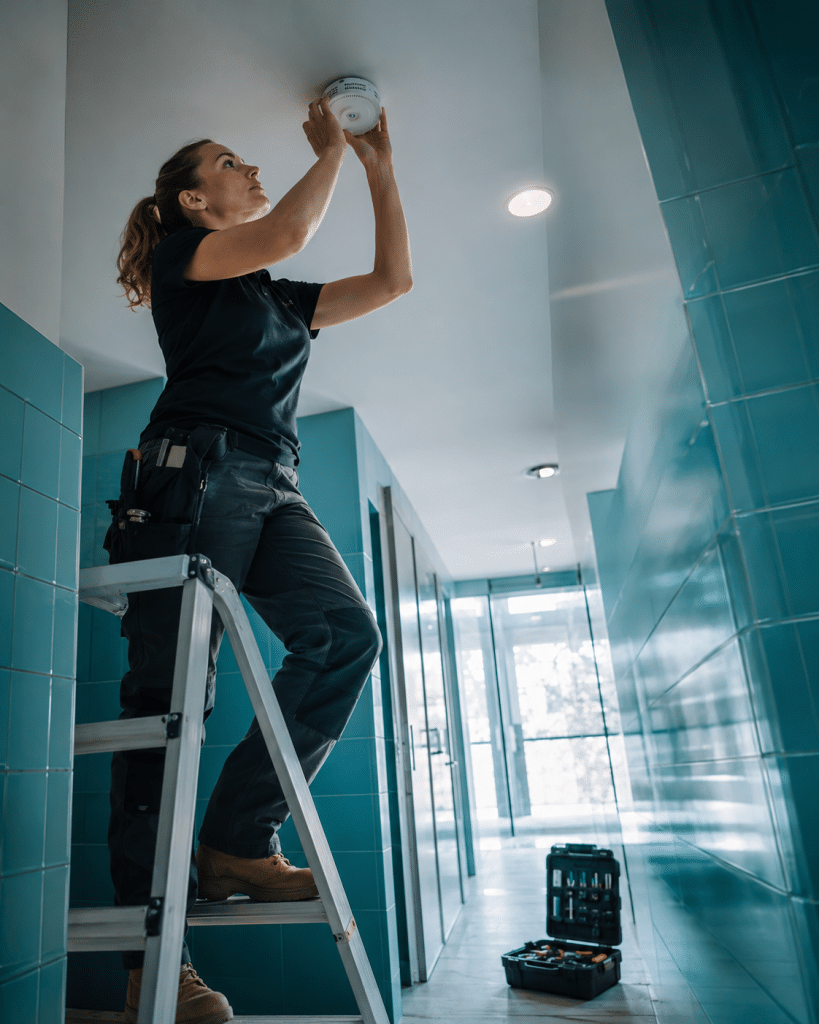
In practice, the best installations start with a site walk-through. From my experience, this is where many problems are solved early. A good installer will check ceiling height, ventilation, power access, network coverage, tamper risk, room layout and staff response paths before recommending device locations.
Vape Detector Installation in Schools
Schools are one of the most common environments for vape detector installation in Australia. This is because vaping often occurs in spaces where teachers cannot supervise constantly, especially student toilets.
For schools, the goal should be prevention and early response, not surveillance for its own sake. A detector can help staff identify when vaping may be happening, but the school still needs a clear and fair process for responding.
A practical school plan should include:
- A written vaping policy
- Clear student and parent communication
- Staff response procedures
- Welfare and counselling pathways
- Records of incidents and actions
- Review meetings after installation
- Privacy-aware placement decisions
The Therapeutic Goods Administration explains that Australia’s vaping reforms changed the way vapes can be imported, manufactured, supplied and advertised. This broader regulatory shift has increased attention on prevention in youth settings, including schools.
Even so, vape detector installation should not replace student support. If alerts lead only to punishment, students may change locations or tamper with equipment. Therefore, schools usually get better results when detection is paired with education, supervision and wellbeing conversations.
Vape Detector Installation for Workplaces and Commercial Sites
Workplaces also use vape detector installation to manage indoor air quality, safety rules and employee complaints. This can include offices, warehouses, factories, hospitality venues, hospitals, aged care facilities and retail centres.
In a workplace, the installation process usually starts with a risk review. The manager or safety officer identifies where vaping complaints occur, where air quality is affected, and where policy enforcement is difficult.
Common commercial locations include:
- Staff toilets
- Shared bathrooms
- Locker rooms
- Stairwells
- Loading areas
- Storage rooms
- Enclosed break areas
- Plant rooms or service corridors
The advantage of a detector is that it provides a time-stamped alert. This can help managers respond consistently, rather than relying only on complaints. However, the organisation should clearly tell staff what the system does, where it is installed and how alerts are handled.
In Australia, workplace use should also consider privacy, consultation and internal HR procedures. This is an administrative and governance issue, not legal advice. For formal requirements, employers should seek advice from a qualified HR, privacy or legal professional.
Best Locations for Vape Detector Installation
Placement is one of the most important parts of vape detector installation. A poor location can lead to missed events, false alerts or staff frustration.
The best location depends on airflow and behaviour. Vape aerosol moves with room ventilation, open doors, exhaust fans and air conditioning. Therefore, the detector should usually be positioned where aerosol is likely to travel before it is diluted.
Good placement areas often include:
- Central ceiling zones in bathrooms
- Near toilet entry areas, but not inside cubicles
- Above shared sink areas
- Ceiling zones in enclosed stairwells
- Near known congregation points
- Away from direct air vents
- Away from steam-heavy showers
- Away from strong chemical storage
In toilets, privacy is critical. Vape detectors should not include cameras in private areas. If a broader security system uses CCTV, cameras should only cover lawful public or semi-public areas, such as corridors outside amenities, and should be assessed through proper privacy procedures.
For larger facilities, one detector may not cover every risk area. Multiple devices may be needed if the room is large, divided by partitions or affected by strong exhaust systems. Also, multi-level buildings may need a floor-by-floor plan.
Professional vs DIY Vape Detector Installation
Some facility managers ask whether vape detector installation can be done in-house. The answer depends on the system, building type, network requirements and compliance expectations.
| Option | Best For | Advantages | Risks or Limits |
| Professional installation | Schools, commercial buildings, public facilities and multi-site sites | Correct placement, cabling, commissioning, integrations and documentation | Higher upfront cost |
| In-house installation | Small sites with plug-and-play devices and simple alerts | Lower initial cost and faster basic setup | Poor placement, weak Wi-Fi, limited reporting and no formal handover |
| Hybrid approach | Facilities teams working with a licensed security provider | Internal knowledge plus expert commissioning | Needs clear responsibility split |
| Full security integration | Sites with CCTV, access control or security monitoring | Better incident response and centralised alerts | Requires planning, testing and user training |
For most schools and commercial sites, professional vape detector installation is the safer option. This is especially true when the system needs PoE cabling, network configuration, alert routing or integration with existing security infrastructure.
A professional installer can also document the system. This matters because administrators may later need to explain why each detector was placed in a specific area, how alerts are managed and who receives notifications.
Step-by-Step Vape Detector Installation Checklist
Use this checklist as a practical starting point.
- Confirm the problem areas
Review complaints, incident records, staff observations and high-risk locations. This helps avoid installing devices where they are not needed. - Define the purpose
Decide whether the system is mainly for student wellbeing, workplace compliance, air quality, incident response or asset protection. - Review privacy and communication needs
Prepare clear notices, staff briefings and internal procedures. Explain that the device detects environmental changes, not images. - Inspect the site
Check ceiling type, power options, network availability, ventilation, tamper risk and room layout. - Choose suitable detector models
Compare detection features, alert options, reporting tools, integration ability and warranty terms. - Plan detector locations
Place sensors where vape aerosol is likely to travel. Avoid air vents, steam-heavy areas and chemical storage zones. - Install power and network connections
Many commercial systems use Power over Ethernet. Others may use Wi-Fi or low-voltage wiring. - Configure alerts
Decide who receives alerts, during what hours and through which channel. Avoid sending alerts to too many people. - Test real-world performance
Commission the system and test alert timing, coverage and false alert behaviour. - Train staff
Show nominated users how to read alerts, respond to incidents and record outcomes. - Document the handover
Keep device locations, user access details, warranty information and maintenance schedules. - Review after launch
After the first few weeks, check whether alerts match real incidents and adjust thresholds if needed.
Compliance, Privacy and Administrative Considerations
Vape detector installation can support compliance, but it should not be treated as a substitute for formal advice. In Australia, each school, workplace or facility may have its own policy obligations, privacy processes and consultation requirements.
For practical purposes, administrators should consider:
- Who owns the policy?
- Who receives alerts?
- Who investigates incidents?
- How are records stored?
- How long are records kept?
- Are students, staff or visitors informed?
- Is signage needed?
- Does the system integrate with other security tools?
- Who reviews false alerts?
- Who has access to dashboards?
This is mainly administrative work. It helps ensure the system is fair, consistent and explainable. For example, a school may want the wellbeing team involved, while a workplace may involve HR and WHS staff.
The Australian Institute of Health and Welfare notes that youth e-cigarette use has become a visible public health concern. However, a detector is only one response. A balanced program should include prevention, education and support.
Common Vape Detector Installation Mistakes
The first common mistake is installing detectors without a response plan. Alerts are useful only when staff know what to do next.
The second mistake is poor placement. A detector near an exhaust fan may miss events, while one near cleaning chemicals may create false alerts.
The third mistake is assuming one device covers a whole building. In reality, coverage depends on room size, partitions, air movement and ceiling height.
The fourth mistake is ignoring privacy communication. Even when a device has no camera, people may feel monitored if the system is not explained clearly.
The fifth mistake is failing to test after installation. A detector should be commissioned in real site conditions. Otherwise, staff may lose confidence in alerts.
The sixth mistake is overpromising results. Vape detector installation can reduce blind spots, but it cannot guarantee that vaping will stop. It works best as part of a wider behaviour, health and safety strategy.
Vape Detector Installation Costs in Australia
Costs vary because each site is different. A small office bathroom may need one device and simple notifications. A secondary school may need multiple devices, network cabling, dashboard access, staff training and staged rollout.
Key cost factors include:
- Number of detectors
- Device brand and sensor features
- Ceiling height and construction
- Power and network access
- Wi-Fi strength or PoE cabling needs
- Integration with existing security systems
- Dashboard or software subscription fees
- Alerting method
- After-hours monitoring needs
- Ongoing maintenance
As an estimate, simple single-device projects may be relatively modest, while multi-building school or commercial deployments can become more complex. Any cost guide should be treated as indicative until a site inspection is completed.
A good quote should show the device cost, installation labour, cabling, configuration, training, software fees and support terms. It should also explain what is excluded, such as electrical upgrades, ceiling repairs or third-party network work.
Maintenance and Testing After Installation
Vape detector installation is not finished once the device is mounted. The system needs periodic testing and maintenance.
A simple maintenance plan should include:
- Checking alert delivery
- Reviewing false alerts
- Cleaning or inspecting sensor housings
- Confirming dashboard access
- Updating firmware where required
- Testing network connection
- Reviewing user permissions
- Checking tamper alerts
- Updating response procedures
- Reviewing incident trends
For schools, termly reviews may work well. For workplaces or public facilities, quarterly reviews may be suitable. High-risk sites may need more frequent checks.
From my experience, the most useful review is not only technical. It should also ask whether the system is changing behaviour. For example, are incidents reducing? Are alerts concentrated in one area? Are students or staff moving to a different location? These answers help improve supervision and prevention.
Integrating Vape Detection With Existing Security
Many sites already have CCTV, access control, alarms or intercom systems. Vape detector installation can sometimes connect with these systems.
Possible integrations include:
- Email alerts to supervisors
- Mobile notifications to staff
- Security control room alerts
- CCTV bookmarks for nearby corridors
- Access control event matching
- Building management system notifications
- Incident report exports
However, integration should be purposeful. Connecting every system together can create noise if alerts are not managed well. Instead, start with the response goal. Then choose the simplest integration that supports that goal.
For example, a school may only need an alert to the deputy principal and facilities manager. A shopping centre may need the alert to go to the control room. A workplace may need HR and site security to receive separate reporting.
If your site needs a practical assessment, one helpful next step is to speak with an Australian security provider that understands detection, placement and response workflows. Eclipse Security can assist with security planning through its Australian security system installation and advice services.
People Also Ask: Vape Detector Installation in Australia
How does vape detector installation work in school toilets?
Vape detectors are usually installed on ceilings in shared toilet areas, not inside cubicles. They detect air quality changes linked to vaping and send alerts to nominated staff so the school can respond through its policy.
Are vape detectors legal in Australia?
Vape detectors may be used in Australia, but each site should consider privacy, consultation, signage and policy requirements. This is an administrative compliance matter, and organisations should get qualified advice for their specific circumstances.
Can vape detectors tell who was vaping?
Most vape detectors do not identify a person by themselves. They detect a likely event in a location and time window. Staff may then follow the site’s normal procedure, which may include supervision, attendance checks or corridor review where appropriate.
Do vape detectors work with all vapes?
No detector can promise perfect detection in every condition. Performance depends on sensor type, aerosol volume, airflow, placement and maintenance. Good vape detector installation improves reliability, but testing and review are still needed.
Where should a vape detector be installed?
The best location is usually a ceiling area where vape aerosol is likely to pass before it is removed by ventilation. Installers should avoid direct air vents, steam-heavy zones and areas exposed to cleaning chemicals.
Expert Q&A: Vape Detector Installation
1. What should a site audit include before vape detector installation?
A proper audit should check the room layout, airflow, ceiling type, power access, network options, risk areas and staff response paths. It should also identify privacy-sensitive zones and decide who will receive alerts after installation.
2. Can vape detector installation reduce false complaints?
Yes, it can help. Instead of relying only on smell or reports, staff receive time-stamped alerts from a sensor. However, alerts should still be reviewed carefully because cleaning products, aerosols or unusual air conditions may sometimes affect readings.
3. Should schools tell students about vape detectors?
In most cases, clear communication is better than secrecy. When students understand that detectors are used for safety, wellbeing and policy support, the system is less likely to be seen as hidden surveillance. Schools should align communication with their policies.
4. How many detectors does a building need?
It depends on the building. One small bathroom may need one detector, while a large school block may need several. A site inspection is the best way to assess coverage because walls, partitions and ventilation can limit detection.
5. What makes professional vape detector installation worthwhile?
Professional installation improves placement, wiring, configuration, testing and documentation. It also helps ensure the system fits the site’s response process. For schools and commercial buildings, that planning often matters as much as the device itself.
Conclusion
Vape detector installation is a practical way for Australian schools, workplaces and shared facilities to identify vaping in sensitive indoor areas without using cameras. However, the system works best when it is designed carefully, installed in the right locations and supported by clear procedures.
The strongest approach is balanced. Use detection to reduce blind spots, but also invest in education, wellbeing, communication and fair administration. In addition, review performance after installation so the system keeps improving over time.
For Australian sites, the next step is a site-specific assessment. That should include risk areas, privacy needs, network access, alert workflows and maintenance planning. With the right design, vape detector installation can support safer, cleaner and better-managed facilities without overpromising what technology can do.