


Security Solutions forHealthcare must protect patients, clinicians, visitors, medicines, information and critical services without making a healthcare facility feel hostile. In Australia, that requires more than installing cameras or alarms. It requires a coordinated, risk-based system designed around clinical workflows, privacy obligations and the way people actually move through the facility.
From practical experience with integrated security environments, the strongest results come from planning technology, procedures and staff responses together. For example, a duress button has limited value if responders cannot identify its precise location. Likewise, an access card system may create delays if emergency and after-hours workflows were not considered during design.
This guide explains how hospitals, medical centres, specialist clinics, pharmacies, laboratories, aged-care environments and allied health providers can assess and improve their physical security. It focuses on practical Australian conditions and provides general administrative guidance rather than legal advice.
Security Solutions forHealthcare combine access control, video surveillance, duress alarms, intercoms, intrusion detection and documented response procedures to protect people, property and clinical operations. In Australia, an effective system should reflect each facility’s risks, privacy responsibilities, patient needs and emergency workflows while supporting safe, uninterrupted care.
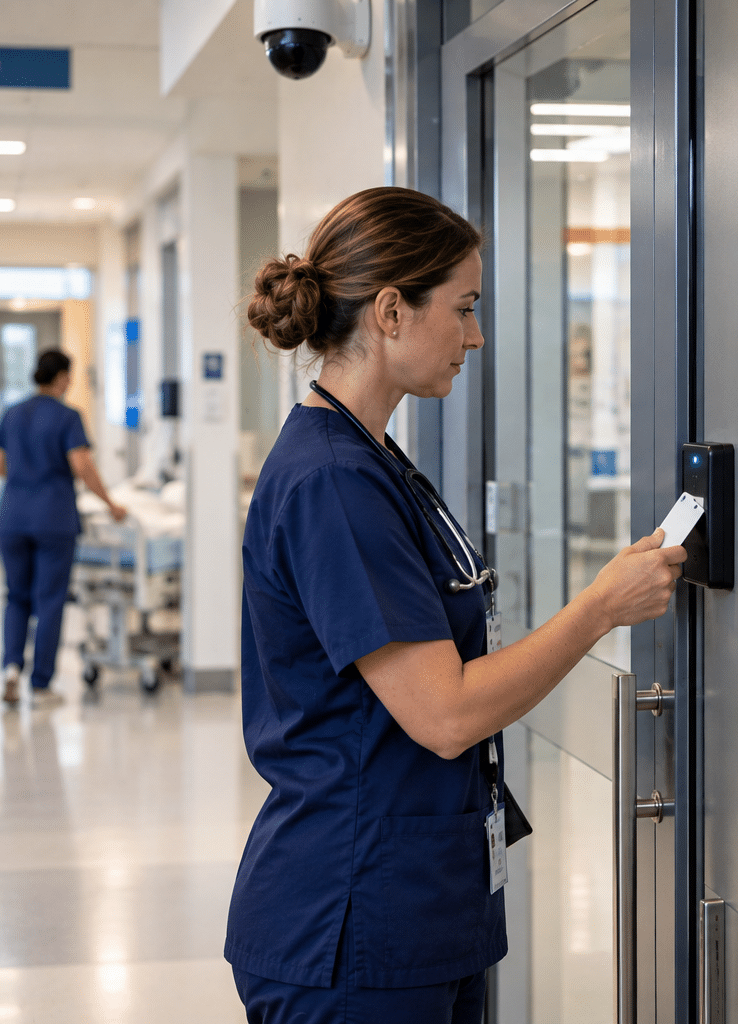
Table of Contents
- Why healthcare security requires a specialised approach
- Risks facing Australian healthcare facilities
- Core Security Solutions forHealthcare
- Comparing standalone and integrated security
- Security planning by facility type
- Designing access control around clinical workflows
- CCTV placement, monitoring and privacy
- Duress alarms and staff safety
- Intercoms and visitor management
- Protecting medicines, records and restricted rooms
- Cybersecurity and connected physical-security systems
- Australian governance and compliance considerations
- Implementation checklist
- Measuring performance and maintaining the system
- Common mistakes to avoid
- People Also Ask
- Expert Q&A
- Conclusion
Why Security Solutions forHealthcare Require Special Planning
A healthcare facility is not a normal commercial building. It may operate continuously, remain partly open to the public and contain people experiencing pain, distress, confusion or behavioural changes. Staff may also work alone, carry medicines, manage sensitive conversations or move between public and restricted spaces.
Consequently, security controls must reduce risk without obstructing care.
A conventional office can lock most doors outside business hours. However, a hospital emergency department must remain accessible while controlling entry into treatment areas. Similarly, a medical centre may welcome patients through reception but restrict access to consultation rooms, medicine storage, staff areas and record rooms.
Security Solutions forHealthcare therefore need to balance several objectives:
- Keep emergency and patient pathways accessible.
- Prevent unauthorised entry into clinical and staff-only areas.
- Give workers a discreet way to request urgent help.
- Support investigation of incidents.
- Protect medicines, equipment and personal information.
- Manage contractors, visitors and after-hours access.
- Preserve patient dignity and privacy.
- Maintain safe egress during emergencies.
- Continue operating during power, network or device failures.
The human side matters just as much as the technology. A technically advanced system can still fail if alerts are ignored, access permissions are outdated or staff do not understand the response procedure.
Risks Facing Australian Healthcare Facilities
The risk profile differs between a metropolitan hospital, suburban dental clinic, regional health service and community mental health facility. Nevertheless, several common risks appear across the sector.
Occupational violence and aggression
Healthcare workers may encounter verbal abuse, threats, intimidation or physical aggression. Risk may increase in emergency departments, mental health settings, drug and alcohol services, after-hours clinics and locations where staff work alone.
The Victorian Department of Health’s guidance on security arrangements for occupational violence and aggression treats security as part of a wider prevention and response framework. Therefore, cameras and alarms should support—not replace—staff training, escalation procedures, environmental design and incident review.
Unauthorised access
Public access is necessary in many healthcare settings. Yet treatment rooms, staff offices, plant rooms, pharmacies, laboratories, medication stores and data infrastructure should not be freely accessible.
Unauthorised entry can expose patients and staff to harm. It can also lead to theft, privacy breaches, disruption or tampering with essential equipment.
Theft and diversion
Healthcare sites may hold medicines, prescription stationery, portable electronics, specialist instruments and personal belongings. Some items have high resale value, while controlled medicines present additional risks.
The appropriate response is layered. Access control limits entry, CCTV creates visual evidence, storage controls protect high-risk assets, and audit trails help identify unusual activity.
Patient wandering or unauthorised departure
Some patients may become disoriented because of cognitive impairment, medication, illness or distress. However, controls must be proportionate and clinically appropriate. A security system should support the care plan rather than automatically treating every patient as a security threat.
Possible measures include controlled doors, local alerts, staff notifications and defined response zones. Any restrictive practice implications require review through the facility’s clinical, legal and governance processes.
Privacy and information exposure
Healthcare providers handle sensitive personal information. A physical breach can become a privacy incident if an intruder accesses paper records, screens, server rooms or conversations in consultation areas.
Therefore, Security Solutions forHealthcare should consider both physical and information security. Reception layouts, monitor positioning, record storage and contractor access may be just as important as cameras.
Service interruption
Damage, unauthorised access or poorly designed controls can interrupt clinical operations. For instance, a failed electronic lock could delay staff if no tested contingency exists. Likewise, a network outage could disable central monitoring if the solution lacks local resilience.
For this reason, healthcare security design should include backup power, fail-safe or fail-secure decisions, manual override processes and regular testing.
Core Security Solutions forHealthcare
No single product can address every risk. A well-designed solution normally uses several complementary layers.
Electronic access control
Access control determines who can enter a door, at what time and under what conditions. Instead of relying only on mechanical keys, authorised users receive cards, mobile credentials or another approved identifier.
Important healthcare applications include:
- Staff-only clinical areas
- Pharmacies and medicine rooms
- Laboratories
- Medical-record storage
- Server and communications rooms
- Plant and maintenance areas
- Ambulance entries
- After-hours staff entrances
- High-risk consultation zones
Role-based permissions are usually more manageable than issuing broad access. For example, a clinician may require access to treatment areas but not the server room. Meanwhile, a contractor may receive temporary access only to a defined location during an approved time window.
Video surveillance
CCTV can deter some unwanted behaviour, support live situational awareness and provide evidence after an incident. However, it should have a documented purpose for each camera.
Useful locations may include entrances, reception approaches, loading areas, car parks, corridors and controlled-door approaches. Conversely, cameras should not be installed in areas where people reasonably expect a high level of privacy unless a specific, lawful and carefully reviewed justification exists.
Image quality should match the operational goal. A broad overview may show movement, while an identification point requires a suitable angle, lighting and pixel density. Therefore, camera count alone is not a reliable measure of coverage.
Duress and personal safety systems
Fixed duress buttons can protect reception desks, consultation rooms, pharmacies and cash-handling positions. Wireless or wearable devices may suit mobile workers or large facilities.
An effective duress system should answer five questions:
- Who receives the alert?
- Can responders identify the exact location?
- What action must they take?
- What happens if the first responder is unavailable?
- How is the incident recorded and reviewed?
Silent activation may be preferable where an audible alarm could escalate danger. Nevertheless, the right configuration depends on the risk assessment and response plan.
Intercom and controlled entry
Video intercoms allow staff to communicate with a visitor before unlocking a door. They are useful for after-hours entrances, maternity areas, pharmacies, laboratories, loading zones and smaller clinics without a dedicated security officer.
Remote release should be carefully designed. Staff need a clear view of the caller and sufficient information to make an access decision. In addition, the released door should remain visible or monitored so another person cannot enter unnoticed.
Intrusion detection
Intrusion alarms protect facilities when areas are closed or unoccupied. Door contacts, motion detectors, glass-break sensors and specialised devices can create layered detection.
Because some healthcare sites operate around the clock, alarm partitions may be required. One wing can remain active while another is secured. Clear zoning also helps monitoring staff identify the affected location quickly.
Visitor and contractor management
Visitor management can range from a reception log to a digital system that records identity, host, purpose, entry time and departure. The process should match the facility’s risk without creating unnecessary collection of personal information.
Contractors may need additional controls because they often enter plant rooms, communications spaces or clinical areas. Their access should be approved, time-limited and removed when work ends.
Standalone Versus Integrated Healthcare Security
Integration can make alarms more meaningful. For instance, a duress activation may automatically display nearby cameras, show the room location and create an incident record. However, integration also requires disciplined configuration, network management and maintenance.
| Capability | Standalone systems | Integrated security platform |
| Alarm handling | Operators check separate systems | Related information can appear together |
| Investigation | Records may require manual comparison | Events, access logs and footage can be correlated |
| User administration | Credentials may be updated in several places | Central administration may reduce duplication |
| Initial complexity | Often simpler for a small site | Requires more planning and configuration |
| Scalability | Can become difficult across many locations | Better suited to coordinated multi-site management |
| Failure impact | A fault may remain isolated | Resilience must prevent one failure affecting everything |
| Best fit | Small, low-complexity premises | Hospitals, larger clinics and multi-site groups |
An integrated platform is not automatically better. A small clinic may achieve a reliable outcome using a modest number of well-configured systems. In contrast, a major hospital may need centralised event management because operators cannot efficiently monitor separate interfaces.
The decision should be based on risk, staffing, site scale, response requirements and whole-of-life cost.
Security Solutions forHealthcare by Facility Type
Hospitals and day hospitals
Hospitals have complex movement patterns. Patients, clinicians, contractors, students, visitors and emergency responders may use the same building for different purposes.
Security zoning can separate:
- Public areas
- Patient-care zones
- Staff-only areas
- Highly restricted clinical or infrastructure rooms
- Loading and logistics areas
- After-hours pathways
Priority systems often include enterprise access control, CCTV, duress, intercoms, intrusion detection and a central control function. In addition, emergency plans should address lockdown, evacuation, fire interfaces and system outages.
General practices and specialist clinics
Smaller clinics still face meaningful risks. Reception staff may work near public entrances, clinicians may consult alone, and medicines or sensitive records may be stored onsite.
A practical package may include:
- Reception duress buttons
- Cameras covering entry and reception approaches
- Controlled staff-area doors
- After-hours intrusion detection
- Video intercom entry
- Secure communications or record rooms
- A documented response and testing process
These controls should be easy to operate. Otherwise, staff may bypass them during busy periods.
Pharmacies and medicine-handling areas
Security planning should consider public entry, dispensary access, high-risk storage, deliveries, after-hours intrusion and duress. Cameras should support the required operational view, while access logs can help investigate entry into restricted areas.
However, access technology does not replace medicine-management procedures. Physical security, inventory controls and clinical governance must operate together.
Mental health and community health services
Security must be trauma-aware and proportionate. Highly visible barriers can sometimes increase anxiety or create an institutional atmosphere. Therefore, discreet duress devices, carefully planned room layouts and safe staff escape paths may be preferable to overt controls in some settings.
Consultation rooms should be reviewed for furniture placement, door access, blind spots and potential hazards. In addition, response procedures should define when staff seek assistance and how responders enter safely.
Aged-care and dementia-support environments
These environments may need to manage wandering while maintaining dignity and freedom of movement. Controls could include monitored exits, access permissions, alerts and secure external boundaries.
Importantly, security decisions should involve clinical leaders and resident-care representatives. Technology must align with care plans, consent requirements and applicable restrictive-practice controls.
Regional and remote healthcare sites
Remote sites may have fewer onsite responders and longer external response times. Consequently, system reliability, communications redundancy and clear escalation paths are especially important.
Remote monitoring can help, but it should not create false confidence. The provider must confirm who can attend, how quickly they can respond and what staff should do while assistance is travelling.
Designing Access Control Around Clinical Workflows
Access control works best when permissions follow real duties rather than job titles alone. Before programming credentials, map who needs each space, during which hours and for what purpose.
Use role-based access
Create access groups such as clinical staff, administration, pharmacy, facilities, cleaning, contractors and security. Then assign doors and schedules to each group.
This method simplifies changes. When a person moves roles, administrators can assign the new group instead of editing many individual doors.
Apply least privilege
Least privilege means giving each person only the access required for their responsibilities. It reduces exposure if a credential is lost, shared or misused.
Nevertheless, permissions must remain practical. If authorised clinicians are repeatedly delayed, they may prop doors open or share credentials. Therefore, staff feedback should be reviewed after deployment.
Manage the credential lifecycle
A reliable process covers:
- Identity verification
- Approval
- Credential issue
- Activation date
- Access group assignment
- Changes of role
- Lost-card response
- Temporary suspension
- Deactivation when employment or work ends
- Periodic permission review
Prompt deactivation is especially important for departing staff and contractors. In addition, lost cards should be reported and disabled quickly.
Plan for emergencies and failures
Each controlled door requires an intentional response to fire alarms, power failures, network outages and lockdown events. “Fail-safe” doors unlock under specified failure conditions, while “fail-secure” doors remain locked. The correct choice depends on life safety, clinical operations and the door’s purpose.
These decisions should be reviewed by qualified security, fire, building and healthcare stakeholders. They should never be based only on convenience.
CCTV in Security Solutions forHealthcare
Healthcare CCTV requires careful design because operational security and patient privacy can conflict.
Give every camera a defined purpose
For each proposed camera, document whether the goal is detection, observation, recognition, identification or general situational awareness. Then select the lens, angle, resolution and lighting to support that purpose.
For example, a high-mounted wide-angle camera may show that an incident occurred. Yet it may not provide a useful facial image. Conversely, a camera focused on an entry point can capture identification-quality footage but may not cover the entire waiting area.
Address privacy from the beginning
Privacy should be designed into the system, not added after installation. Consider camera placement, masking, recording duration, user permissions, audit logs, signage and disclosure procedures.
The Office of the Australian Information Commissioner’s Guide to Health Privacy explains how Australian privacy principles apply to health information. Although CCTV footage is not automatically health information in every circumstance, recordings may reveal identity, attendance at a health service or other sensitive context. Facilities should obtain organisation-specific privacy advice where required.
Limit access to recordings
Not every manager or receptionist needs unrestricted footage access. Permissions may distinguish between live viewing, playback, export and administration.
Additionally, exported footage should be controlled. A documented process can record who requested it, why it was released, who authorised the release and how the file was protected.
Set evidence-based retention periods
Longer retention is not always better. It increases storage cost and the amount of information exposed if a system is compromised.
Choose a period based on incident-reporting timelines, operational needs, organisational policy and applicable requirements. Then confirm that the actual recording capacity meets the intended period under real camera settings.
Duress Alarms and Staff Safety
A duress system is a request for a response—not the response itself. Therefore, Security Solutions forHealthcare should connect the activation device to a clear chain of action.
Fixed buttons suit predictable work positions, such as reception counters. Meanwhile, wearable devices can assist staff who move between rooms. Mobile-app alerts may provide flexibility, but they depend on phone availability, battery life, connectivity and user interaction.
Healthcare providers should test:
- Activation from the actual work position
- Signal coverage in every intended area
- Location information shown to responders
- Alert acknowledgement
- Escalation if nobody responds
- Response time
- Reset and reporting procedures
- Backup operation during outages
Routine tests should be announced and recorded so responders can distinguish a test from a real event. Furthermore, post-incident reviews should assess whether the device, notification and human response all worked as intended.
Intercoms, Reception and Visitor Flow
Reception is often the point where openness and security meet. Good design allows staff to welcome patients while retaining control of restricted areas.
Useful measures include clear sightlines, controlled doors behind reception, discreet duress activation and a safe retreat path. Screens or counters should be chosen through risk assessment rather than installed as a default response.
After hours, a video intercom can route calls to an onsite desk or approved remote location. However, staff should follow a consistent verification procedure before releasing the door.
Visitors should also understand where they may go. Clear wayfinding reduces accidental entry into restricted areas and lowers the burden on staff.
Protecting Medicines, Records and Critical Rooms
High-risk rooms deserve stronger protection than ordinary offices. This does not necessarily mean adding more devices. Instead, it means aligning physical barriers, electronic control and administrative processes.
A layered approach may include:
- A properly constructed door and frame
- Appropriate locking hardware
- Electronic access permissions
- Door-position monitoring
- Alerts when a door is forced or held open
- CCTV at the approach
- Secure internal cabinets
- Access-log review
- Inventory or key-control procedures
Server rooms, communications cabinets and security control equipment also need protection. If an unauthorised person can disconnect a recorder or network switch, the wider system may be compromised.
Cybersecurity for Connected Physical-Security Systems
Modern CCTV, access control and intercom systems are networked computers. Therefore, they require cybersecurity management throughout their service life.
The Australian Signals Directorate’s Australian Cyber Security Centre presents the Essential Eight mitigation strategies as a baseline for improving cyber resilience. Not every control maps directly to every security appliance, but the core principles—controlled administration, patching, backups and restricted access—remain relevant.
Practical measures include:
- Changing default credentials
- Requiring unique administrative accounts
- Using multi-factor authentication where supported
- Placing security devices on controlled network segments
- Restricting internet exposure
- Maintaining supported firmware
- Backing up configurations
- Logging administrator activity
- Removing unused accounts
- Reviewing vendor remote access
- Recording device models and support dates
- Planning replacement before products reach end of support
Cloud-connected systems also require supplier review. Providers should understand where data is stored, who can access it, how incidents are reported and what happens when the service or internet connection is unavailable.
Cybersecurity responsibilities should be agreed between the healthcare organisation, IT team, installer, integrator and software provider. Otherwise, each party may assume another party is handling critical updates.
Australian Governance and Compliance Considerations
Healthcare security intersects with workplace safety, privacy, clinical governance, building requirements and sector-specific obligations. The exact requirements depend on the organisation, jurisdiction and facility type.
The National Safety and Quality Health Service Standards provide a nationally consistent framework for the care consumers can expect. The Australian Commission on Safety and Quality in Health Care states that public and private hospitals, day hospitals and most public dental practices are required by regulators to be accredited against the standards.
Security technology can support governance, but it does not itself establish compliance. For example, access reports may provide evidence that a restricted area is controlled. However, administrators still need policies, approvals, reviews and corrective actions.
Treat the following as ongoing administrative tasks:
- Maintaining a current security risk register
- Recording system ownership
- Reviewing privacy impacts
- Documenting access approvals
- Keeping incident and test records
- Tracking faults and corrective actions
- Reviewing retention settings
- Training system users and responders
- Reviewing supplier access
- Confirming emergency arrangements
- Scheduling periodic audits
These points are general information, not legal advice. Australian healthcare organisations should have their policies and compliance decisions reviewed by appropriately qualified advisers and responsible internal leaders.
Healthcare Security Implementation Checklist
A staged implementation reduces disruption and makes decisions easier to verify.
- Appoint responsible stakeholders. Include management, clinical leaders, facilities, IT, workplace safety, privacy and frontline users.
- Define the scope. Identify sites, operating hours, sensitive rooms, public zones and systems under review.
- Assess credible risks. Examine past incidents, near misses, local conditions, lone work, after-hours operations and high-risk assets.
- Map people and movement. Document how patients, visitors, staff, contractors, deliveries and emergency services use the facility.
- Prioritise risks. Consider likelihood, consequence and the effectiveness of existing controls.
- Define operational requirements. State what each control must achieve before choosing products.
- Review privacy and information handling. Consider recorded images, access logs, visitor details, alert history and remote access.
- Design the response process. Specify who receives each alarm, what they see and what action they take.
- Plan resilience. Address backup power, network interruption, device failure and manual operation.
- Select compatible systems. Confirm integration, cybersecurity, licensing, support and future expansion needs.
- Pilot high-impact workflows. Test access, duress and visitor processes with actual users where practical.
- Commission the system properly. Verify devices, permissions, alerts, recording, integrations and emergency interfaces.
- Train users and responders. Provide role-specific instruction rather than one generic demonstration.
- Record system information. Maintain drawings, device lists, credentials procedures, configurations and test results.
- Review after implementation. Gather staff feedback, examine incidents and correct unintended workflow problems.
Measuring the Performance of Security Solutions forHealthcare
A successful installation should be measured by outcomes, not device count.
Useful indicators may include:
- Duress alarm response time
- Percentage of devices passing scheduled tests
- Number of forced-door and held-open alarms
- Time taken to disable a lost credential
- Number of expired contractor accounts
- CCTV footage retrieval success
- Critical faults outstanding beyond target time
- Staff completion of security training
- Repeat incidents in the same location
- Percentage of access permissions reviewed on schedule
Metrics need context. A rise in reported incidents may indicate worsening risk, but it may also show that staff have become more confident in reporting. Therefore, combine data with staff feedback and incident analysis.
Preventive maintenance is equally important. Cameras can shift, lenses become dirty, batteries expire and door hardware wears. Consequently, even a system that worked at commissioning can deteriorate without inspection.
Common Healthcare Security Mistakes
Buying equipment before assessing risk
Starting with a preferred product can produce unnecessary features while missing the real operational problem. Define the risk and required outcome first.
Treating CCTV as a complete solution
Cameras may show what happened, but they do not physically control access or guarantee a response. CCTV should form one layer of a broader strategy.
Ignoring staff workflow
If controls regularly delay care, staff may find workarounds. Engage frontline users early and test the proposed process under busy conditions.
Sending every alarm to everyone
Too many low-value notifications create alarm fatigue. Alerts should be prioritised, routed to the right people and supported by clear actions.
Failing to remove old access
Credentials can remain active after employment, placement or contractor work ends. Connect access administration to reliable onboarding and offboarding processes.
Overlooking cyber maintenance
Unpatched recorders, exposed remote-access services and shared passwords can undermine otherwise strong physical security.
Neglecting maintenance and testing
A button that has not been tested cannot be assumed to work. Testing should cover the complete chain from activation to response.
Keeping footage without a clear reason
Unnecessarily long retention increases cost and privacy exposure. Retention should have a documented operational basis.
People Also Ask About Security Solutions forHealthcare
What security systems do Australian healthcare facilities need?
Most facilities need a risk-based combination of access control, CCTV, duress alarms, intrusion detection and visitor management. However, the appropriate mix depends on facility size, patient profile, opening hours, staffing and response capability.
How can healthcare facilities protect staff from violence?
They can improve environmental design, provide duress devices, control restricted areas, train staff and establish clear escalation procedures. Technology is most effective when supported by incident reporting, response drills and regular risk reviews.
Can CCTV be used in Australian medical centres?
CCTV can be used for legitimate security purposes, subject to applicable privacy, workplace and surveillance requirements. Facilities should document the purpose, avoid unjustified monitoring, restrict footage access and obtain qualified advice for their jurisdiction.
How much do Security Solutions forHealthcare cost?
Costs vary according to door numbers, camera coverage, cabling, integrations, monitoring, site conditions and support requirements. A small clinic may need a limited solution, while a hospital may require enterprise infrastructure; therefore, a site assessment is more reliable than a generic per-device estimate.
Should a healthcare facility integrate access control and CCTV?
Integration can improve response and investigation by connecting door events with relevant video. However, smaller facilities may prefer well-managed standalone systems if integration complexity would provide little practical benefit.
Expert Q&A About Healthcare Security
1. How should healthcare organisations prioritise security upgrades?
Start with risks that could cause serious harm and where existing controls are weak. Staff duress, uncontrolled access to high-risk rooms and unreliable emergency response usually warrant early attention, although priorities must come from the facility’s own assessment.
2. What information should be included in a healthcare security brief?
The brief should cover operating hours, user groups, risk scenarios, room classifications, alarm responses, privacy needs, network responsibilities, integrations, resilience, training, maintenance and acceptance testing. It should describe required outcomes rather than merely list devices.
3. How often should access permissions be reviewed?
Review frequency should reflect risk and staff turnover. High-risk access may require more frequent checks, while all permissions should also be reviewed when people change roles, leave the organisation or complete temporary work.
4. What should happen after a serious security incident?
First, follow emergency and clinical response procedures. Afterwards, preserve relevant evidence, record the event, support affected people and conduct a multidisciplinary review of the environment, technology, procedures and response. Corrective actions should have owners and completion dates.
5. How can healthcare providers avoid becoming dependent on one security supplier?
Use documented requirements, obtain system records, clarify data ownership, retain configuration backups and understand licensing before purchase. In addition, consider open or widely supported integrations where appropriate and document how another qualified provider could maintain the solution.
Conclusion
Effective Security Solutions forHealthcare combine physical protection, reliable technology, trained people and clear response procedures. In Australia, they must also respect privacy, clinical priorities, workplace safety and the practical realities of facilities that may remain open and accessible around the clock.
The best starting point is a site-specific risk assessment. From there, healthcare providers can prioritise access control, CCTV, duress, intercom and intrusion measures according to real operational needs. They can then test the full response process, monitor performance and adjust the solution as risks change.
For a tailored assessment and integrated approach, speak with the team at Eclipse Security’s commercial security specialists. A carefully planned solution can strengthen safety and oversight while allowing healthcare professionals to focus on patient care.