


Security alarm installation is one of the most practical steps Australian homeowners, renters, landlords and business operators can take to reduce risk, improve response times and protect people, property and stock. From my experience reviewing security projects, the best results usually come from proper planning rather than simply buying the loudest siren or the newest app-based kit.
A well-installed alarm system should match the site, the people using it and the type of risk involved. For example, a café in Melbourne, a warehouse in Western Sydney and a family home in Brisbane all need different alarm designs. However, the core process is similar: assess entry points, choose suitable sensors, install equipment correctly, test every zone, train users and maintain the system over time.
According to the Australian Bureau of Statistics, 1.8% of Australian households experienced a break-in during the 2024–25 financial year, which shows why practical prevention still matters for everyday properties. Security licensing also varies by state and territory, and ASIAL notes that most Australian jurisdictions require both security businesses and individuals to hold suitable licences for security work.
Table of Contents
- What Is Security Alarm Installation?
- Why Security Alarm Installation Matters in Australia
- How a Security Alarm System Works
- Main Types of Security Alarm Installation
- Wired, Wireless and Hybrid Alarm Systems Compared
- Security Alarm Installation Checklist
- Home Security Alarm Installation Considerations
- Business Security Alarm Installation Considerations
- Monitoring, Apps and Back-to-Base Alarms
- Australian Licensing, Standards and Admin Checks
- Common Mistakes to Avoid
- People Also Ask
- Security Alarm Installation Q&A
- Conclusion
What Is Security Alarm Installation?
Security alarm installation is the process of designing, fitting, configuring and testing an alarm system that detects unauthorised entry, movement or tampering. A proper installation includes sensors, a control panel, sirens, user access, backup power and optional monitoring, so the system can alert the right people quickly.
In simple terms, installation turns alarm equipment into a working security system. The installer decides where sensors should go, how each zone should behave, how users will arm and disarm the system, and what happens when an alarm activates.
Good installation is not just technical. It also considers habits. For example, pets, shift workers, cleaners, delivery drivers and elderly family members can all affect how an alarm should be set up. Therefore, a system that works well on paper may perform poorly if it does not match real daily use.
Why Security Alarm Installation Matters in Australia
Australia has a mix of security needs. Some households want peace of mind while travelling. Meanwhile, many businesses want after-hours protection for stock, tools, cash areas and staff-only rooms. Because risks vary by property type, security alarm installation should start with a site-specific assessment.
A useful alarm system can help in several ways. First, visible alarm components may discourage opportunistic offenders. Second, fast detection can reduce the time an intruder spends inside a property. Third, alerts can help owners, managers or monitoring centres respond sooner. Finally, event logs can support internal reviews after an incident.
However, alarms are not magic shields. They work best as one layer in a wider security plan. For instance, strong locks, lighting, CCTV, access control, staff procedures and insurance documentation all support the alarm. As a result, a balanced system is usually better than relying on one device.
The Australian Government’s smart device security rules also show why connected products deserve careful attention. Home Affairs states that the Cyber Security (Security Standards for Smart Device) Rules 2025 commenced on 4 March 2026 after a transition period, introducing mandatory cyber security standards for most consumer smart devices acquired in Australia.
How a Security Alarm System Works
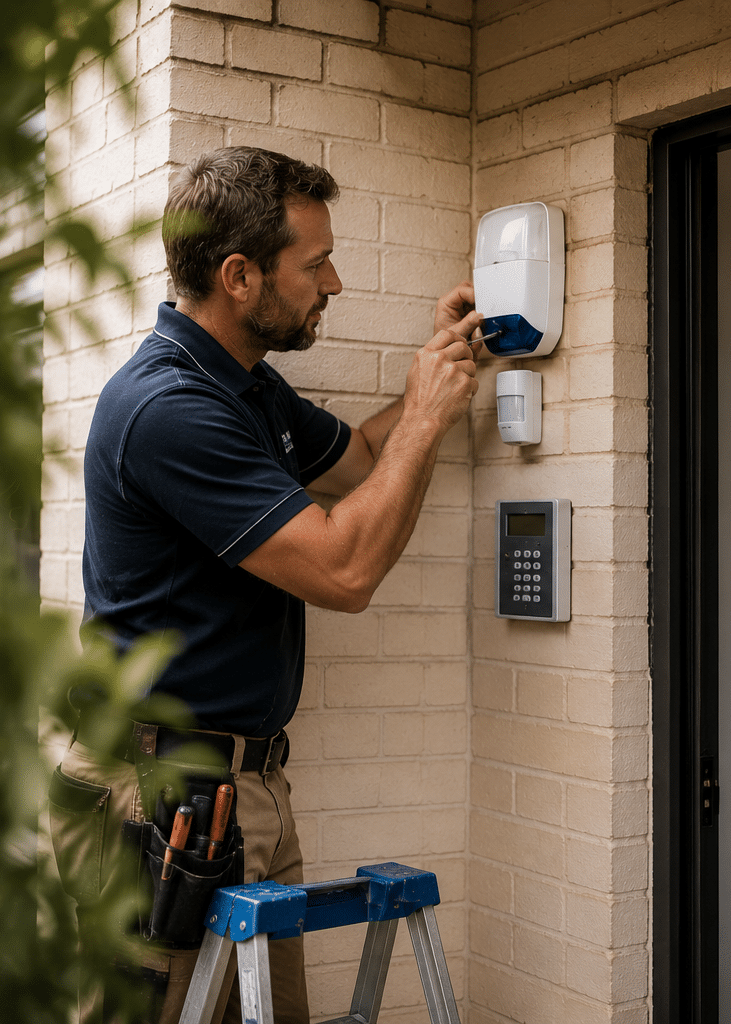
Most alarm systems follow a simple chain of events. A sensor detects activity. Then the control panel checks whether that zone is armed. If the event matches the alarm rules, the system triggers an alert. After that, it may sound sirens, notify an app, send a signal to a monitoring centre or activate another programmed response.
The main parts include:
- Control panel: The brain of the system. It receives signals and runs programmed rules.
- Keypad or touchscreen: The user interface for arming, disarming and checking faults.
- Door and window contacts: Sensors that detect opening.
- Motion detectors: Devices that detect movement within selected areas.
- Glass-break detectors: Sensors that listen for breaking glass patterns.
- Sirens and strobes: Audible and visual alerts.
- Battery backup: Backup power during outages.
- Communicator: A module that sends alerts through mobile, internet or other communication paths.
- App access: Optional remote control and notifications.
From my experience, zone design is one of the most important parts of security alarm installation. A “zone” is a defined area or device group, such as the front door, hallway motion sensor or warehouse roller door. Clear zone names make alarms easier to understand during a real event.
For example, “Zone 4” is not helpful at 2:00 am. “Rear storeroom motion” is much clearer.
Main Types of Security Alarm Installation
Security alarm installation can be grouped in several ways. The right choice depends on the building, budget, risk level and user needs.
Residential Security Alarm Installation
Residential systems protect houses, townhouses, units and apartments. They often include entry sensors, motion detectors, sirens and app notifications. In many homes, the main goal is simple: detect a break-in quickly and make the system easy for the family to use.
For homes with pets, installers may use pet-tolerant motion detectors or adjust the sensor layout. However, “pet-friendly” does not mean “false-alarm proof”. Placement, pet size and room layout still matter.
Commercial Security Alarm Installation
Commercial systems protect offices, shops, warehouses, clinics, factories and hospitality venues. These systems often need more zones, multiple users, opening and closing reports, duress features and monitoring.
For example, a retail store may need sensors on the front entry, rear door, stockroom, office and cash area. In contrast, a warehouse may need roller door contacts, beam sensors, internal motion detectors and separate partitions for different tenancy areas.
Monitored Alarm Installation
A monitored alarm sends signals to a monitoring centre or nominated responders. This can be useful when no one is onsite. Monitoring may support faster escalation, especially for businesses, holiday homes and high-value assets.
Standards Australia’s AS 2201.2:2022 relates to monitoring centres and specifies requirements for the construction, equipment, staffing and operation of centres used to monitor client alarm and security systems.
Smart Alarm Installation
Smart alarms connect to apps and other devices. They can be convenient, especially for remote arming, push notifications and user management. However, smart alarms also need strong cyber hygiene. Therefore, default passwords, weak Wi-Fi, shared logins and outdated firmware should be avoided.
Wired, Wireless and Hybrid Alarm Systems Compared
Choosing between wired, wireless and hybrid equipment is a common decision during security alarm installation. Each option has strengths and limits.
| Alarm type | Best suited to | Main advantages | Possible limitations |
| Wired alarm system | New builds, renovations, commercial sites, larger properties | Stable connections, fewer battery changes, strong long-term option | More cabling work, harder to retrofit in finished walls |
| Wireless alarm system | Existing homes, rentals, small offices, apartments | Fast installation, less disruption, flexible sensor placement | Battery maintenance, signal range planning required |
| Hybrid alarm system | Mixed old and new sites, staged upgrades | Combines wired reliability with wireless flexibility | Needs careful design and compatible equipment |
In many Australian properties, hybrid systems are a practical middle ground. For example, an existing building may already have wired sensors on some doors, while wireless sensors can be added to new areas without major cabling.
Security Alarm Installation Checklist
A structured process reduces mistakes. Use this numbered checklist before, during and after installation.
- Confirm the purpose of the alarm. Decide whether the main goal is home protection, staff safety, stock protection, after-hours detection or insurance support.
- Map likely entry points. Review front doors, rear doors, windows, roller doors, roof access, garages and shared access areas.
- Identify high-value zones. Note areas with tools, stock, cash, keys, documents, servers or personal valuables.
- Choose suitable sensors. Match door contacts, motion detectors, glass-break sensors, beams and tamper switches to the site.
- Plan user access. Decide who needs codes, app access, temporary access or restricted access.
- Consider pets and daily routines. Plan arming modes around children, pets, cleaners, staff shifts and late arrivals.
- Check power and communications. Confirm mains power, battery backup, Wi-Fi, mobile coverage and internet reliability.
- Install and label every zone clearly. Use plain names that make sense during an alarm event.
- Test every device. Open doors, walk-test motion sensors, test sirens and confirm app or monitoring signals.
- Train users. Show people how to arm, disarm, bypass a zone, respond to alerts and report faults.
- Document the setup. Keep zone lists, user instructions, warranty details and maintenance records.
- Schedule maintenance. Review batteries, sensors, communication paths and user lists at planned intervals.
Home Security Alarm Installation Considerations
For homes, simplicity matters. If the system is too hard to use, people will stop using it. Therefore, a good home alarm should be easy to arm at night, easy to disarm in the morning and clear when something is wrong.
Many homes benefit from two arming modes. “Away mode” arms the full system when everyone leaves. “Stay mode” arms perimeter areas while allowing movement inside selected rooms. This is useful at night because it may protect doors and windows while the household sleeps.
Placement is also important. Motion detectors should not face heat sources, moving curtains, reflective surfaces or areas where pets climb. Door contacts should be fitted securely so they do not trigger when a door rattles in wind. Sirens should be loud enough to alert occupants, but the system should still follow local noise expectations and common-sense neighbourhood practice.
For renters, wireless systems may be attractive because they often need less drilling. However, tenants should check lease conditions and owner approval before installing fixed equipment. This is an administrative step, not legal advice.
Business Security Alarm Installation Considerations
Business security alarm installation is usually more complex than residential installation. Businesses often have more users, more entry points and greater after-hours risk. They may also need audit trails, staff duress features, monitoring, access schedules and separate alarm areas.
For example, a medical clinic may need different access for reception staff, cleaners and practitioners. A warehouse may need one alarm area for the office and another for storage. A restaurant may need early-morning supplier access without giving full alarm control to every contractor.
From my experience, business owners should focus on three practical questions:
- Who needs access?
- What areas should they access?
- What should happen if an alarm activates?
The answers shape the system design. For instance, a manager may need full control, while a cleaner may only need access on certain days. In addition, opening and closing reports can help owners see whether the alarm was armed after trading.
Businesses should also think about false alarms. False alarms waste time and reduce trust in the system. Often, they come from poor sensor placement, rushed user training, weak communication paths or unclear procedures. Therefore, installation should include staff handover, not just hardware fitting.
For site-specific help, Eclipse Security can assist with practical planning and installation through its Australian security alarm and electronic security services.
Monitoring, Apps and Back-to-Base Alarms
Monitoring adds another layer to security alarm installation. Instead of relying only on a local siren, the alarm can send signals to a monitoring centre or nominated contacts. This may suit businesses, larger homes, investment properties and sites that are often empty.
There are several alert options:
| Alert option | How it works | Best for |
| Local siren only | Siren sounds onsite when the alarm triggers | Basic deterrence and nearby attention |
| App notification | Alarm sends alerts to a user’s phone | Owners who can respond quickly |
| SMS or call alerts | Alerts go to nominated contacts | Simple escalation |
| Back-to-base monitoring | Signals go to a monitoring centre | Businesses, higher-risk sites and unattended properties |
| Video verification integration | Alarm event is checked with camera footage where available | Reducing uncertainty before escalation |
App-based control is convenient, but it should be managed carefully. Users should enable strong passwords, avoid shared logins and remove old users when staff leave. Also, if the alarm depends on the internet, the installer should consider backup communication.
Australian Licensing, Standards and Admin Checks
Security alarm installation in Australia is affected by state and territory licensing rules. These rules are not identical. Therefore, owners should confirm that the business and technician are appropriately licensed for the location and type of work.
For example, the Queensland Government says a security equipment installer licence authorises the holder to install, repair, service or maintain equipment such as alarms, monitoring systems, recording systems, access control devices, motion detectors and related security equipment. In NSW, OneGov explains that security industry work requires a current security licence, with Class 2 covering the technical sector.
These checks are administrative safeguards. They help you choose a qualified provider and keep records in order. They are not a substitute for legal advice.
Useful admin checks include:
- Ask for the installer’s licence details.
- Confirm the business name and ABN.
- Ask whether subcontractors are used.
- Request a written scope of work.
- Confirm warranty terms.
- Keep manuals and handover notes.
- Check monitoring terms before signing.
- Ask who owns the equipment and alarm codes.
- Confirm how user data and app access are managed.
Australian consumers and small businesses should also consider cyber security when using connected alarms. The Australian Government provides guidance on security standards for smart devices, while the Australian Bureau of Statistics crime victimisation data provides useful context on household crime trends. For industry licensing context, ASIAL provides an overview of security licensing across Australian states and territories.
Security Alarm Installation Costs in Australia
Costs vary because every site is different. A small apartment with a few wireless sensors will usually cost less than a multi-zone commercial alarm with monitoring, duress buttons and access control integration.
As a general estimate, price can be affected by:
- Number of sensors
- Wired versus wireless design
- Building size and access difficulty
- Monitoring requirements
- App control and communication modules
- Siren and strobe requirements
- Integration with CCTV or access control
- After-hours installation
- Maintenance plan
- Warranty and support level
The cheapest quote is not always the best value. In fact, a poorly designed alarm can cost more later through false alarms, missed coverage, call-outs and user frustration. Therefore, compare the scope, not just the price.
A good quote should explain what is included. It should list equipment, zones, monitoring options, installation labour, user training and support. If the quote is vague, ask for clarification before approving the work.
Common Mistakes to Avoid
Many alarm problems start before installation. Fortunately, most are preventable.
Choosing Equipment Before Assessing the Site
A kit may look good online, but it may not suit the building. For example, thick walls, metal structures, pets and large open areas can all affect performance. Therefore, start with the site, then choose the equipment.
Ignoring User Behaviour
If staff forget to arm the system, the alarm cannot help. If family members share one code, event logs become less useful. As a result, user setup matters as much as sensor setup.
Poor Sensor Placement
Motion detectors need clean fields of view. Door contacts need stable mounting. Outdoor detection needs careful planning because weather, animals and moving plants can cause issues. Good placement reduces false alarms and improves detection.
Weak Communication Backup
If the alarm relies only on Wi-Fi, an internet outage may affect alerts. Therefore, many systems benefit from mobile backup or another communication path.
No Maintenance Plan
Batteries fail. Contacts loosen. Staff leave. Phone numbers change. Because of this, alarm systems should be checked regularly.
How to Choose a Security Alarm Installer
Choosing the right installer can make the difference between a reliable system and a frustrating one. Look for someone who explains options clearly, asks about your routines and provides a written scope.
A good installer should be able to explain:
- Why each sensor is recommended
- What each zone will be called
- How the system handles power outages
- How alerts are sent
- How app access is managed
- What happens during a false alarm
- How maintenance is handled
- What support is available after installation
Also, avoid pressure-based sales tactics. A professional installer should explain trade-offs. For example, wireless sensors may reduce installation disruption, but they still need battery management. Wired sensors may be reliable, but installation can be more invasive in finished buildings.
Security Alarm Installation for Different Property Types
Different buildings need different design choices.
Apartments
Apartments often need compact systems with door contacts, selected motion detection and app alerts. Strata rules may affect external sirens, visible devices or drilling in common areas. Therefore, approvals may be required before work starts.
Houses
Detached homes often need perimeter protection, garage coverage, internal motion detection and night arming. If the home has pets, sensor selection and placement become especially important.
Retail Stores
Retail sites usually need protection for entry doors, stockrooms, cash areas and rear access. Monitoring can be useful because break-ins often happen outside trading hours.
Offices
Offices may need alarm partitions for different businesses, meeting rooms, server cupboards and after-hours access. User codes should be reviewed when staff change.
Warehouses
Warehouses may need roller door contacts, long-range sensors, internal beams and separate office zones. Large spaces require careful testing to avoid blind spots.
People Also Ask
How much does security alarm installation cost in Australia?
The cost depends on the property size, number of sensors, system type and monitoring needs. As a broad estimate, a small wireless home alarm may cost less than a large commercial alarm with multiple zones, but the final price should always be based on a site assessment.
Do I need a licensed installer for a security alarm in Australia?
Licensing requirements vary by state and territory. In many cases, security businesses and individual technicians need suitable licences, so ask for licence details before work starts.
Is a wired or wireless alarm better?
Neither is always better. Wired alarms are often strong for new builds and larger commercial sites, while wireless alarms can suit existing homes, apartments and smaller offices with less installation disruption.
Can I install a security alarm myself?
Some consumer alarm kits are designed for DIY use. However, professional security alarm installation is usually better for larger homes, businesses, monitored alarms and sites where reliability, correct sensor placement and user setup are important.
Does an alarm system stop break-ins?
An alarm cannot guarantee prevention. However, it can deter some offenders, detect unauthorised entry, alert users and support faster response when combined with locks, lighting, CCTV and good procedures.
Security Alarm Installation Q&A
1. What should happen during a professional alarm site assessment?
A professional assessment should review entry points, building layout, daily routines, high-value areas, power, communications and user access. The installer should then recommend sensor locations and explain why each device is needed.
2. How often should an alarm system be serviced?
Many systems benefit from at least an annual check, although higher-risk business sites may need more frequent reviews. Service checks usually include batteries, sensors, sirens, communication paths, user codes and event history.
3. What is the difference between an alarm zone and an alarm area?
A zone is usually a specific sensor or detection point, such as a front door contact. An area, sometimes called a partition, is a group of zones that can be armed separately, such as an office area and warehouse area.
4. Should security alarm installation include CCTV integration?
It depends on the site. CCTV integration can help verify what caused an alarm, but it should not replace good sensor design. For many businesses, alarms and CCTV work best together.
5. What should I ask before signing a monitoring agreement?
Ask about contract length, monthly fees, response procedures, cancellation terms, communication paths, false alarm handling and who receives notifications. Also confirm whether the monitoring centre follows recognised operational standards.
Conclusion
Security alarm installation is most effective when it is planned around real Australian properties, real users and real risks. The best system is not always the most expensive one. Instead, it is the system that detects the right events, avoids unnecessary false alarms and is easy for people to use every day.
For homes, that may mean simple arming modes, pet-aware sensor placement and reliable app alerts. For businesses, it may mean monitored alarms, user-level access, clear reporting and separate alarm areas. In both cases, licensing checks, strong passwords, proper handover and maintenance should be part of the process.
A well-designed alarm is one layer in a broader security plan. Therefore, combine it with good locks, lighting, CCTV, access control, staff procedures and regular reviews. When installed carefully, a security alarm system can provide clearer alerts, better control and greater confidence when you are away from the property.