


A well-designed School Security System & Alarm Monitoring Melbourne solution is more than a set of cameras and an alarm panel. Melbourne schools have students, teachers, administrative staff, contractors, parents and visitors moving through different areas throughout the day. After hours, the risk profile changes again. Therefore, school security needs to combine technology, clear procedures, controlled access and reliable incident response. This guide takes a practical security-planning approach and explains how Melbourne schools can build a layered system without making unrealistic claims about what security technology can achieve.
What Is School Security System & Alarm Monitoring Melbourne?
School Security System & Alarm Monitoring Melbourne refers to a coordinated security setup for Melbourne schools that combines intrusion alarms, 24/7 alarm monitoring, CCTV, access control, intercoms and documented response procedures. Its purpose is to detect incidents early, verify what is happening, control access and support a faster, safer response.
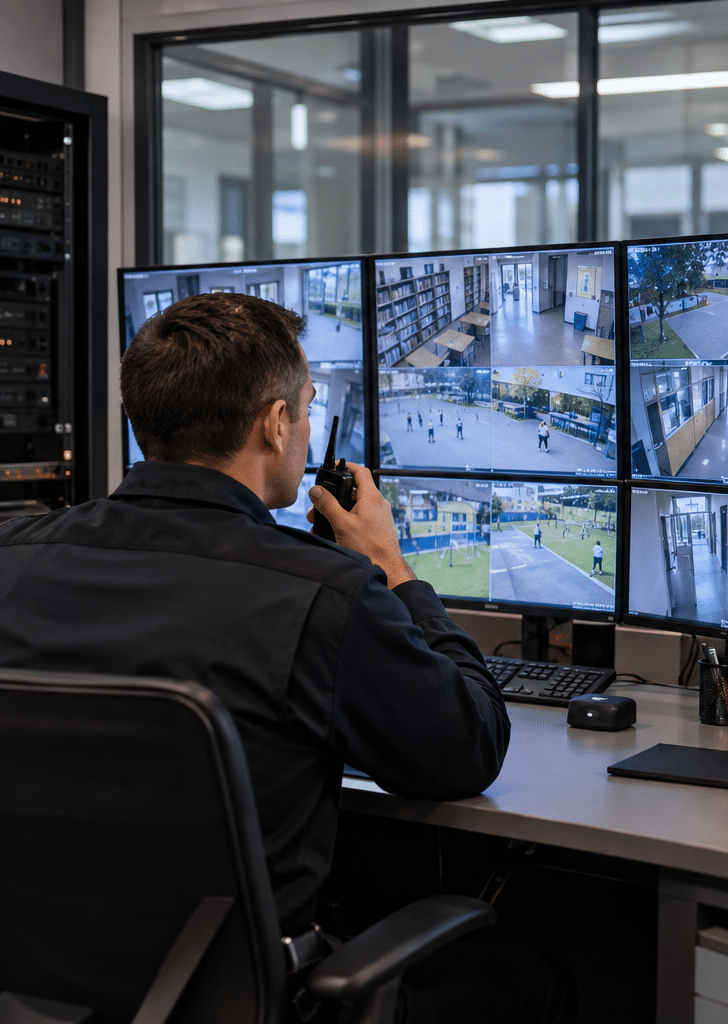
Table of Contents
- Why School Security Requires a Layered Approach
- What a School Security System Should Include
- How Alarm Monitoring Works in Melbourne Schools
- Monitored Alarms vs Local-Only Security
- CCTV and Video Surveillance in Schools
- Access Control for Melbourne School Campuses
- Intercoms, Duress Alarms and Communication
- Designing Security Around the School Day
- School Security System & Alarm Monitoring Melbourne Checklist
- Reducing False Alarms
- Australian Standards and Victorian Requirements
- Maintenance and System Testing
- Choosing a School Security Provider
- People Also Ask
- School Security Q&A
- Conclusion
Why School Security Requires a Layered Approach
Schools are different from conventional offices.
An office may have a relatively predictable workforce and limited visitor traffic. In contrast, a school can have hundreds or thousands of people moving between classrooms, administration areas, sporting facilities, libraries, car parks and outdoor spaces.
Parents may arrive for appointments. Contractors may need temporary access. Community groups may use buildings outside school hours. Teachers may work before or after normal operating times.
Therefore, one security control rarely solves every problem.
A camera may record an unauthorised person, for example, but it does not automatically prevent that person from entering a restricted building. An access-control reader can restrict a door, but it may not detect someone entering through a window. Likewise, an intrusion detector can identify movement after hours, but the alarm becomes far more useful when somebody receives the event and follows a predefined response procedure.
This is the principle of layered security.
A practical school system may combine:
- perimeter and building security
- intrusion detection
- monitored alarms
- CCTV
- electronic access control
- visitor entry management
- video or audio intercoms
- duress alarms
- emergency communication
- documented response procedures
- routine maintenance and testing.
The goal is not to turn a school into a fortress. Instead, security should support normal school operations while creating appropriate barriers, visibility and response options.
Victorian government schools are expected to consider physical security as part of their wider emergency planning. The Department of Education states that schools must take reasonable steps to protect people and assets, reduce the impact of physical security incidents and respond effectively to incidents and emergencies. It also requires physical security to be addressed within the school’s Emergency Management Plan.
Victorian government schools can review the official Department of Education Physical Security guidance.
What Should a School Security System Include?
A strong school security system in Melbourne should begin with risks and workflows rather than a shopping list of products.
For example, a primary school with one administration entrance has different requirements from a multi-campus secondary college with workshops, performance facilities, sports buildings and extensive after-hours activities.
1. Intrusion Alarm System
An intrusion alarm identifies conditions that may indicate unauthorised access.
Typical devices can include:
- motion detectors
- door contacts
- window contacts
- glass-break detection
- reed switches
- internal sirens
- external sirens
- alarm keypads
- control panels.
However, detector quantity alone does not determine security quality.
Placement matters.
For example, protecting a corridor that gives access to several classrooms may sometimes provide more useful detection than placing independent sensors everywhere without considering how an intruder would actually move through the property.
Alarm zoning is also important.
Instead of treating an entire school as one area, the system may separate:
- administration
- classroom blocks
- libraries
- ICT rooms
- maintenance buildings
- sports facilities
- portable buildings
- staff areas
- storage areas.
Therefore, authorised after-hours users may be able to access one approved zone without disabling security across the whole campus.
How School Alarm Monitoring Works in Melbourne
An alarm system and an alarm monitoring service are related, but they are not the same thing.
A local alarm may sound a siren when a detector activates.
A professionally monitored alarm sends the event through a communications pathway to a monitoring centre.
A typical workflow is:
- A detector identifies an event.
- The alarm panel processes the signal.
- The alarm event is transmitted to the monitoring centre.
- The monitoring system identifies the site and alarm zone.
- An operator reviews the event according to the site’s instructions.
- The agreed contact or response procedure is followed.
- The event is recorded for later review.
The response depends on the situation and the instructions configured for that school.
For example, the procedure could involve contacting nominated staff, arranging an authorised security response, checking associated information or escalating the event where appropriate.
Importantly, professional monitoring should not be confused with an automatic guarantee of police attendance.
Victoria Police has defined procedures for alarm response. Monitoring businesses that identify a need for police assistance follow the applicable escalation process.
Therefore, schools should ask a prospective monitoring provider a simple question:
What exactly happens after each type of alarm signal reaches your monitoring centre?
The answer should be clear enough for school leadership to understand.
School Security System & Alarm Monitoring Melbourne: Monitored vs Local-Only Systems
Different security arrangements provide different capabilities.
| Security approach | What happens after activation? | Main advantage | Important limitation |
| Local-only alarm | Siren or local notification activates | Simple deterrence and local awareness | Nobody may act if the site is empty |
| App-notification alarm | Selected users receive an alert | Staff can see alerts remotely | Relies heavily on users noticing and responding |
| Professionally monitored alarm | Signal reaches a monitoring centre | Provides a structured response pathway | Response depends on the event and agreed instructions |
| Integrated alarm + CCTV | Alarm can be reviewed alongside video information where configured | Adds useful situational context | Requires careful design, privacy controls and maintenance |
| Integrated school security platform | Alarm, CCTV and access control work together | Better event correlation and central management | More complex and requires trained administration |
For many campuses, the answer is not simply choosing one row from the table.
A layered design may combine several methods.
For example, an after-hours door event may trigger an alarm while associated CCTV provides additional context. Meanwhile, authorised staff may receive a notification and the monitoring centre can follow the school’s agreed response instructions.
Integration should serve an operational purpose rather than being added simply because the technology supports it.
CCTV in a School Security System
CCTV can be valuable for several reasons.
It can provide:
- situational awareness
- recorded evidence
- oversight of selected entrances
- visibility of external areas
- support when reviewing incidents
- information associated with an alarm event.
However, CCTV is not automatically effective because a school has many cameras.
The important questions are:
What are we trying to see?
Why do we need to see it?
Who needs access?
How long should relevant footage be retained?
What happens when an incident occurs?
A camera covering a doorway requires a different design from a camera intended to provide general coverage of a large external area.
Lighting also matters.
So do mounting position, field of view, image quality and environmental conditions.
Therefore, design should happen before installation.
CCTV Privacy and Administration
Schools must also consider privacy and access controls.
For Victorian government schools, the Department of Education’s CCTV policy places specific controls around who may administer and access CCTV. It states that active CCTV administrators must be current department employees and that nominated access must be recorded. It also specifies circumstances in which live and recorded footage may be used.
That means CCTV administration is part of the security system, not an afterthought.
Non-government schools should confirm the policies, privacy obligations, governance requirements and sector guidance that apply to their organisation.
This article provides general administrative and security-planning information, not legal advice.
Access Control for Melbourne Schools
Physical keys still have a place, but they become difficult to manage on larger campuses.
Consider what happens when:
- a key is lost
- a contractor does not return a key
- a staff member changes roles
- access should only be available at certain times
- dozens of rooms need different permission levels.
Electronic access control can make these situations easier to administer.
Instead of relying only on physical keys, authorised users can receive electronic credentials.
Depending on the system, credentials may include:
- cards
- fobs
- mobile credentials
- PINs
- other approved identification methods.
Permissions can then be assigned according to role, location or schedule.
For example, a teacher might have access to the main building from early morning until evening but no access to a restricted plant room.
Meanwhile, maintenance personnel may receive permissions for specific areas.
A sports coordinator may need access to a gym after normal school hours without requiring the main classroom block to be opened.
That flexibility can improve both security and daily operations.
Access Control Should Follow the School’s Workflow
A common planning mistake is choosing readers and door hardware before mapping how people move through the school.
Instead, start with questions such as:
- Where should visitors enter?
- Which doors should normally remain locked?
- Which areas contain higher-value assets?
- Where do contractors need access?
- What happens during an evacuation?
- What happens during a lockdown?
- Which areas operate after hours?
- Who approves new credentials?
- Who removes access when somebody leaves?
Technology should support those processes.
Not replace them.
Intercoms, Duress Alarms and School Communication
An intercom provides another layer of controlled entry.
For example, reception staff can communicate with a visitor before releasing an electronically controlled entrance.
A video intercom may provide visual information as well.
This can be useful where the administration office is not physically positioned beside the main entrance.
However, schools also need to think beyond visitor communication.
Duress alarms can provide a way for authorised users to raise an alert when assistance may be required.
The important issue is response.
Installing a button without clearly defining what happens after it is pressed creates uncertainty.
For each duress point, document:
- who receives the alert
- whether the alarm is silent or audible
- how the location is identified
- how the incident is verified
- who initiates the next action
- what staff should do while waiting for assistance.
For Victorian government schools, specific departmental procedures may apply to certain duress systems and school environments. Therefore, schools should ensure the system aligns with their existing emergency and incident procedures rather than treating it as a separate technology project.
Designing Security Around the School Day
Good School Security System & Alarm Monitoring Melbourne planning should recognise that a campus changes throughout the day.
Before School
Staff begin arriving while many buildings remain empty.
The security system may need staged disarming so that opening one building does not unnecessarily disarm another.
During School Hours
The focus changes.
Rather than after-hours intrusion, priorities may include:
- controlled visitor entry
- restricted staff-only areas
- campus awareness
- communication
- protection of sensitive rooms
- management of access credentials.
After School
Students may leave while staff, contractors and extracurricular activities remain.
This is where flexible zoning becomes useful.
Evenings and Weekends
Community groups may use selected facilities.
For example, a hall could be accessible while classrooms remain secured.
Overnight
Intrusion detection, alarm monitoring and external surveillance become more prominent because fewer authorised people are present.
This is why copying the same configuration from a conventional office can be ineffective.
School operations need to be mapped first.
10-Step School Security System & Alarm Monitoring Melbourne Checklist
Schools considering a new system or an upgrade can use the following planning process.
- Map the campus and its users.
Identify buildings, entrances, high-traffic zones, restricted areas, external spaces and after-hours facilities. - Identify realistic risks.
Consider unauthorised entry, vandalism, theft, personal-safety events, property damage and other site-specific concerns. - Review existing security equipment.
Record current alarms, cameras, access-control hardware, intercoms, cabling and monitoring arrangements. - Define security zones.
Decide which buildings or areas need independent arming, access permissions or monitoring. - Plan detection and verification.
Determine where intrusion detectors, CCTV and other devices can provide useful information. - Create an alarm response matrix.
Document who should be contacted for each event and what actions should follow. - Review licensing, policy and privacy requirements.
Confirm applicable Victorian requirements and school-sector policies before procurement. - Test real operational scenarios.
Walk through staff arrival, late departures, contractors, community use, alarms and emergency events. - Train authorised users.
Provide simple instructions for alarms, access credentials, intercoms and relevant incident procedures. - Schedule maintenance and review.
Test the system periodically and revise configurations when buildings, staff or risks change.
The result should be a security system that people can actually operate.
Reducing False Alarms in Melbourne Schools
False or unwanted alarms can weaken an otherwise good system.
They can occur because of:
- incorrect arming procedures
- staff entering an armed area
- poorly configured detectors
- environmental conditions
- changes to room layouts
- equipment faults
- outdated contact lists
- inadequate staff training.
Therefore, reducing unwanted alarms is partly a technical job and partly an administrative one.
Consider a teacher entering a building early and forgetting that a particular zone is armed.
The alarm panel may be working perfectly.
The problem is the operating process.
Clear training and appropriate access-control integration can help reduce such situations.
Schools should also review repeated alarms.
Do not simply reset the system every time.
Ask why the event occurred.
Repeated alarms from the same zone may indicate a detector problem, configuration problem, environmental issue or user-training gap.
Fixing the cause makes monitoring more useful.
Australian Standards and Victorian Security Requirements
Standards and licensing matter because electronic security is a professional industry.
As of September 2026, Victoria Police states that private-security activities in Victoria are regulated through its Licensing and Regulation Division. Security equipment installers are among the activities covered, and security equipment includes alarms, alarm-monitoring systems, cameras and electronic access-control devices.
Schools and procurement teams can check current requirements through Victoria Police private security guidance.
This is particularly important because Victorian private-security licensing arrangements have changed in recent years.
Therefore, rather than relying on an old licence copy or an outdated statement on a website, verify the current status when engaging a provider.
Alarm Monitoring Standards
Australian electronic-security standards also cover alarm systems and monitoring centres.
ASIAL’s current electronic-security standards information lists AS 2201.2:2022 – Alarm and electronic security systems, Part 2: Monitoring centres. ASIAL also operates a monitoring-centre grading and certification scheme.
Schools researching a monitoring provider can review ASIAL electronic security standards.
Useful procurement questions include:
- Which monitoring centre receives our alarms?
- What is its current grading or certification?
- Which version of the applicable standard does it operate under?
- What communications redundancy is available?
- What happens if the primary communications path fails?
- How are events recorded?
- How do you maintain our response instructions?
- How often should our contact list be reviewed?
These are administrative due-diligence questions rather than legal advice.
Why Alarm Monitoring Instructions Matter
Monitoring technology only knows what the system tells it.
It does not automatically know the school’s priorities.
Therefore, schools need clear alarm instructions.
For example, an alarm from an ICT storage room at 2:00 am may have a different significance from a staff member accidentally entering an armed area at 6:30 am.
The monitoring procedure may need details such as:
- school name and campus
- relevant alarm zones
- nominated contacts
- contact order
- after-hours instructions
- escalation rules
- approved security response arrangements
- notes about authorised activities.
These records must also stay current.
A response list containing a former principal or staff member is not useful.
Therefore, schools should review monitoring instructions after staffing changes and at scheduled intervals.
Integrating Alarms, CCTV and Access Control
Integration can improve the usefulness of each system.
Imagine an access-controlled external door.
If the door is forced open, the system may generate an event.
An associated alarm can raise the alert.
CCTV can provide visual context.
The event can then be investigated according to the school’s procedure.
This is more useful than maintaining several separate systems that do not exchange meaningful information.
However, integration should remain manageable.
A school does not benefit from hundreds of alerts that nobody understands.
Therefore, decide which events require attention.
Examples might include:
- forced door
- door held open beyond an approved period
- intrusion alarm
- communication failure
- duress activation
- selected system faults.
Prioritisation keeps the security system usable.
Maintenance Is Part of School Security
Security equipment cannot be installed and forgotten.
Schools change constantly.
Rooms are renovated.
Furniture moves.
Vegetation grows.
Staff change.
New buildings open.
Temporary classrooms appear.
Network infrastructure changes.
All these factors can affect security equipment.
For example, a camera that had a clear view when installed might later be partially obscured. A detector may be affected by a changed room layout. An access-control door may develop a mechanical problem even though the electronic reader continues to work.
Regular maintenance should therefore check both the devices and the operation of the complete system.
A maintenance review may cover:
- alarm detectors
- control panels
- backup power
- communications paths
- sirens
- CCTV image quality
- camera positioning
- recording equipment
- storage status
- access-controlled doors
- locks and door hardware
- intercoms
- duress devices
- monitoring signals
- authorised-user lists.
Schools should also test whether staff know what to do.
Technology and procedures need to work together.
Choosing a School Security Provider in Melbourne
Do not choose a provider based only on camera resolution or the number of sensors included in a quote.
Instead, assess the complete service.
Ask whether the provider can explain:
- why each device is required
- how the school will use the system
- how alarm monitoring works
- how access permissions are administered
- how CCTV access is controlled
- what maintenance is recommended
- who provides technical support
- how faults are handled
- how the design can scale when the campus changes.
Also confirm relevant licences and current monitoring-centre credentials where applicable.
A good proposal should connect equipment to a risk or operating requirement.
For example:
Risk: unauthorised after-hours access to an ICT area.
Control: appropriate intrusion detection and access restriction.
Verification: suitable event or CCTV information where permitted.
Response: documented monitored-alarm procedure.
That logic is more useful than simply saying, “Install ten cameras and fifteen sensors.”
People Also Ask About School Security System & Alarm Monitoring Melbourne
What security systems do Melbourne schools need?
The appropriate system depends on the campus, operating hours and risk profile. Common layers include intrusion alarms, professional alarm monitoring, CCTV, access control, intercoms and documented emergency or incident procedures.
Is 24/7 alarm monitoring useful for schools?
It can be useful because many school buildings are unattended overnight, on weekends and during some holiday periods. Monitoring provides a structured process for receiving and handling alarm signals, but it does not guarantee that every activation results in emergency-service attendance.
Can CCTV be installed in Victorian schools?
Yes, but applicable privacy, access and school-sector requirements must be followed. Victorian government schools have specific Department of Education requirements governing CCTV installation, management and access to footage.
Should school alarms integrate with access control?
Integration can be valuable when it simplifies operations. For example, authorised access may support appropriate arming and disarming workflows, while forced-door events can generate security alerts. However, integration should be designed around the school’s actual procedures.
Q&A: School Security and Alarm Monitoring
1. How should a school decide where intrusion detectors are installed?
Start with how an unauthorised person could enter and move through the building. Entrances, connecting corridors, sensitive rooms and areas containing important assets may require consideration. Final placement should follow a professional site assessment rather than a generic detector count.
2. What should a school ask an alarm monitoring company before signing a contract?
Ask where alarms are monitored, what current grading or certification applies, how communication failures are handled, what happens after each alarm type, how response instructions are stored and how contact lists are updated. The school should understand the complete response chain before service begins.
3. How often should school security contact lists be updated?
They should be reviewed whenever responsible staff change and as part of scheduled security reviews. Schools should avoid leaving old employees, outdated phone numbers or unavailable contacts in monitoring instructions.
4. Can an existing school security system be upgraded instead of completely replaced?
Often, parts of an existing system may remain useful. However, compatibility, condition, cybersecurity, manufacturer support, cabling and integration requirements need to be assessed before deciding what can be retained. A site audit can separate reusable infrastructure from equipment that needs replacement.
5. How can schools measure whether their security system is working effectively?
Look beyond whether devices simply power on. Review unwanted-alarm frequency, equipment faults, response procedures, access-control records, camera usefulness during real incident reviews, staff training and whether security arrangements still match campus operations. Regular review turns security from a one-off installation into an ongoing risk-management process.
Building a Practical Security Strategy for Melbourne Schools
The strongest school-security design is not necessarily the system with the most equipment.
It is the system that makes sense when something actually happens.
Staff should know how to operate it.
The monitoring centre should have current instructions.
Access permissions should reflect real responsibilities.
Cameras should provide useful images.
Alarm zones should match how buildings are used.
Maintenance should identify faults before a critical event exposes them.
Furthermore, security should evolve with the school.
A new building, changed entrance, additional portable classroom or expanded after-hours program can alter the risk profile.
Therefore, security reviews should be part of facility planning rather than something that happens only after an incident.
For Victorian government schools, Department policy also emphasises the relationship between physical security and emergency management. Schools are required to maintain Emergency Management Plans and prepare for scenarios such as lockdowns, lockouts and evacuations.
In an immediate emergency involving danger to people or property, normal security monitoring procedures should never replace the appropriate emergency response, including contacting emergency services on 000 where required.
Conclusion
A reliable School Security System & Alarm Monitoring Melbourne strategy combines people, procedures and technology. Intrusion alarms detect events. Professional monitoring provides a structured response pathway. CCTV can add situational awareness. Access control manages who can enter sensitive spaces. Intercoms and duress systems support communication. Maintenance keeps those controls dependable.
However, the most important work happens before hardware is selected.
Map the campus. Understand how people use it. Identify realistic risks. Decide how alarms should be handled. Check relevant Victorian requirements. Confirm licensing and monitoring arrangements. Then design technology around those needs.
That approach produces a security system that supports the school rather than creating unnecessary complexity.
For schools planning a new installation, reviewing an ageing system or considering better alarm monitoring, explore school and commercial security solutions from Eclipse Security Systems and arrange an assessment based on the actual layout, operating hours and security requirements of your campus.