


Healthcare Security Systems play a much broader role than simply recording CCTV footage or sounding an alarm after someone enters a restricted area. In Australian hospitals, medical centres, specialist clinics, pharmacies, aged-care settings and allied health practices, security must protect patients, workers, visitors, medicines, sensitive information and valuable equipment while allowing healthcare teams to provide care without unnecessary barriers.
That balance matters. Healthcare facilities are different from ordinary commercial premises. They often operate for extended hours, receive members of the public without appointments, store sensitive information, contain controlled medicines and may have patients experiencing pain, distress, confusion, dementia, mental illness or other conditions that can influence behaviour.
Therefore, the strongest security strategy is rarely a single product. Instead, it combines appropriate CCTV, electronic access control, intrusion detection, duress systems, intercoms, monitoring, physical design, staff procedures and secure digital administration.
A practical lesson seen across healthcare security planning is that technology works best when it supports a clearly understood process. A panic button that nobody knows how to use, a camera that cannot identify a person at the required distance, or an access card that remains active after an employee leaves can create a false sense of protection.
This guide explains how Australian healthcare organisations can approach security systematically, why different controls matter and how to avoid common weaknesses.
What Are Healthcare Security Systems?
Healthcare Security Systems are integrated physical and electronic safeguards used to protect healthcare workers, patients, visitors, medicines, information and property. They commonly combine CCTV, access control, alarms, duress devices, intercoms and monitoring with documented procedures so healthcare facilities can detect risks, control movement, respond to incidents and maintain safer operations.
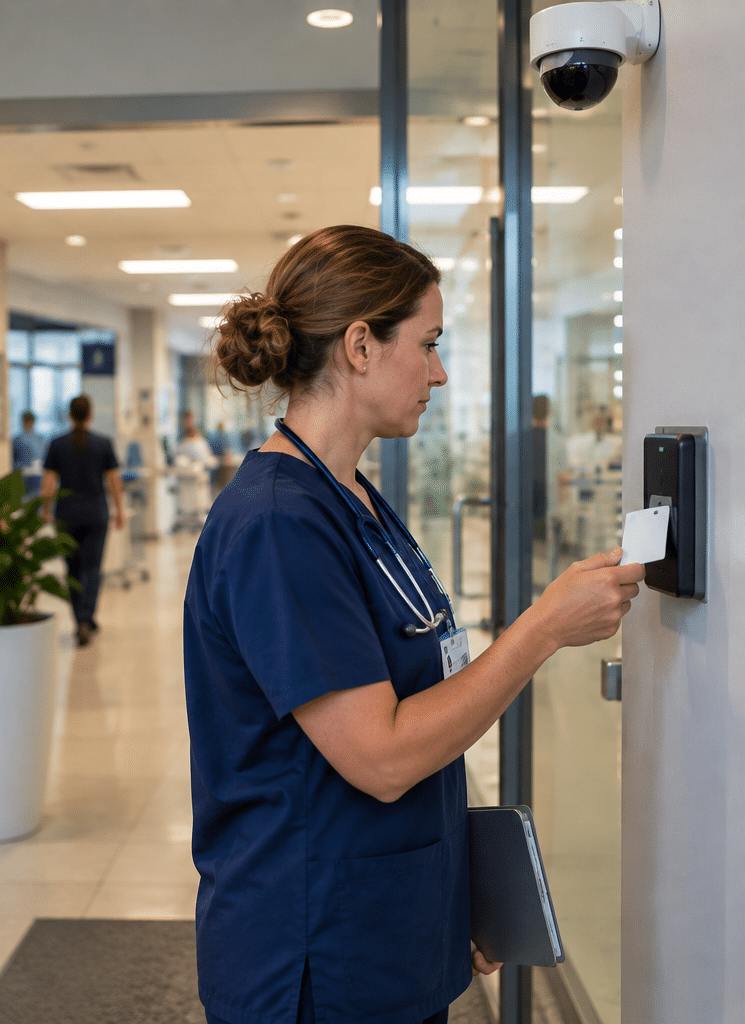
Table of Contents
- Why Healthcare Security Systems Matter in Australia
- The Main Risks Healthcare Facilities Need to Manage
- Core Components of Healthcare Security Systems
- CCTV for Hospitals, Clinics and Medical Centres
- Access Control for Healthcare Facilities
- Duress and Alarm Systems
- Intercoms and Controlled Entry
- Healthcare Security Systems and Workplace Violence
- Protecting Medicines, Records and Sensitive Areas
- Privacy and Healthcare Security Technology
- Cyber Security and Networked Physical Security
- Integrated vs Standalone Healthcare Security Systems
- Designing Security Around Healthcare Zones
- Healthcare Security System Implementation Checklist
- Common Security Mistakes
- Maintenance and Testing
- Choosing a Healthcare Security Provider
- People Also Ask
- Healthcare Security Q&A
- Conclusion
Why Healthcare Security Systems Matter in Australia
Healthcare environments bring together risks that would normally be managed separately in other industries.
For example, a typical commercial office may need to control employee access and deter theft. However, a medical centre may simultaneously need to manage:
- unrestricted public entry during consultation hours
- confidential patient conversations
- access to treatment rooms
- staff-only offices
- pharmaceutical storage
- patient records
- cash or payment areas
- vulnerable patients
- aggressive visitors
- contractors
- cleaners
- after-hours access
- emergency departures.
Hospitals add further complexity through emergency departments, wards, pharmacies, laboratories, loading areas, car parks, operating areas and clinical infrastructure.
Consequently, Healthcare Security Systems need to be designed around workflows rather than simply around doors and cameras.
Safe Work Australia identifies healthcare and social assistance among the industries at greater risk of workplace violence and aggression. Its healthcare guidance also states that healthcare workers may encounter aggressive behaviour from patients, clients, family members and members of the public.
Healthcare security therefore has both asset-protection and people-safety functions.
For further Australian guidance, see Safe Work Australia guidance on work-related violence and aggression.
What Risks Should Healthcare Security Systems Address?
Before selecting equipment, a healthcare organisation should identify what it is actually trying to protect.
The risk profile of a two-room allied health clinic will be very different from a hospital emergency department.
However, common risk categories include unauthorised access, theft, workplace aggression, drug diversion, vandalism, staff safety, privacy breaches, after-hours intrusion and unauthorised movement through restricted areas.
Security planning should therefore begin with questions such as:
Who can enter the building?
Which areas should patients be able to reach without assistance?
Which areas are staff-only?
Where are medications stored?
Where might a staff member be isolated?
Are employees working before opening or after closing?
Can reception staff summon assistance discreetly?
Who needs access after hours?
How quickly could security footage be retrieved following an incident?
What happens when an employee or contractor leaves?
These questions help determine where technology can reduce risk.
Importantly, they also stop organisations from buying equipment that does not address the real operational problem.
Core Components of Healthcare Security Systems
Most effective Healthcare Security Systems combine several technologies.
CCTV Surveillance
CCTV can help healthcare facilities monitor entrances, corridors, reception areas, car parks, loading areas and other suitable locations.
Its main functions can include:
- incident verification
- deterrence
- post-incident investigation
- monitoring high-risk areas
- supporting staff safety
- detecting unauthorised movement
- assisting with after-hours security.
However, placing more cameras throughout a facility does not automatically create better security.
Camera location, field of view, lighting, image quality, storage duration, privacy, network performance and retrieval procedures all influence whether footage will be useful.
Electronic Access Control
Access control determines who can enter particular areas and, depending on system design, when they may enter.
Credentials may include cards, fobs, PINs, mobile credentials or biometric technologies where appropriate.
Instead of issuing the same key to several employees, administrators can grant access according to role.
For example:
Reception employees may access the public entrance and administrative areas.
Clinical staff may access consultation and treatment spaces.
Pharmacy staff may receive additional permissions.
Facilities employees may access plant rooms.
Cleaning contractors may receive time-limited access.
This makes electronic access control particularly useful in healthcare environments with varied staff responsibilities.
Intrusion Alarm Systems
An intrusion alarm generally focuses on detecting unauthorised entry when an area should be secured.
Depending on the facility, sensors may protect:
- external doors
- windows
- pharmacies
- administration areas
- equipment rooms
- storage areas
- detached buildings.
When linked to appropriate monitoring arrangements, alarms can provide escalation when a facility is unoccupied.
Duress and Panic Alarms
Duress systems serve a different purpose.
Rather than detecting a break-in, they allow someone to signal that they need assistance.
They may be installed at reception desks, consultation spaces, pharmacies, treatment rooms or other areas identified through risk assessment.
Some systems can also use wireless or wearable devices where fixed buttons would not provide adequate coverage.
Intercom Systems
Video or audio intercoms can support controlled entry.
They are particularly useful for:
- after-hours entrances
- staff-only doors
- deliveries
- controlled clinical areas
- remote entrances
- facilities operating with limited reception staffing.
Intercoms can also be integrated with access control so authorised staff can assess a visitor before releasing a door.
CCTV in Healthcare Security Systems
Healthcare CCTV should be designed around clearly defined security objectives.
For instance, a camera providing a general overview of a reception area has a different purpose from one intended to help identify someone entering through a controlled doorway.
Therefore, one of the most important design questions is:
What must this camera allow staff to see?
That question should be answered before deciding where the camera will be installed.
High-Value CCTV Locations
Depending on the site and privacy considerations, suitable locations may include:
- main entrances
- reception approaches
- car parks
- external boundaries
- ambulance or service access points
- loading areas
- public corridors
- selected waiting areas
- pharmacy access points
- secure storage approaches
- building exits.
However, healthcare facilities must be especially careful around areas where patients reasonably expect a high degree of privacy.
CCTV should not be treated as a reason to monitor every available space.
Instead, the security benefit should be balanced against patient privacy, clinical requirements and applicable Australian privacy obligations.
Why Image Quality Matters
A camera specification can look impressive on paper while providing poor operational results.
For example, high resolution alone does not guarantee a useful image.
Other factors include:
- lighting
- viewing angle
- subject distance
- movement
- lens selection
- obstructions
- reflections
- night conditions
- compression
- recording settings.
Therefore, testing the actual recorded image is essential.
A practical commissioning test should ask whether staff can retrieve footage and clearly understand what occurred, not merely whether the camera displays an image.
Access Control for Healthcare Facilities
Access control is one of the most valuable parts of Healthcare Security Systems because healthcare buildings often contain several security zones under one roof.
A patient should be able to reach reception.
However, that does not mean the patient should be able to enter medication storage, records rooms, staff offices or clinical back-of-house areas.
Electronic access control creates boundaries between these zones.
Role-Based Access
A good access strategy follows the principle that people receive the access required for their work, rather than blanket access across the facility.
For example, an organisation might define:
Public zone: reception, approved waiting areas and public amenities.
Clinical zone: consultation rooms and treatment areas.
Staff zone: offices, staff rooms and internal administration.
Restricted zone: medicine storage, records, communications equipment and high-value assets.
Critical zone: areas requiring tightly controlled authorised access.
This approach also makes employee departures easier to manage.
If someone leaves the organisation, their digital credential can normally be removed rather than relying on the return of every physical key.
Access Events and Audit Trails
Electronic access control can also produce event records.
Depending on system capability, administrators may be able to determine when a credential was used and at which controlled door.
However, organisations should establish appropriate policies covering who can review this information and how long records are retained.
Security information should itself be protected.
Duress Systems: Protecting Frontline Healthcare Workers
Duress protection deserves particular attention because healthcare workers frequently interact directly with members of the public.
Safe Work Australia recommends measures for violence and aggression risks that include training, escalation procedures and ensuring isolated workers have communication methods that allow them to contact support.
Technology can support those procedures.
For example, a receptionist facing threatening behaviour may need a discreet way to signal for assistance without escalating the situation.
Likewise, a clinician working alone in a consultation room may need a different type of alerting method.
Fixed vs Mobile Duress
Fixed buttons can work well where employees remain in predictable positions.
Mobile duress devices may be more appropriate when people move between rooms or areas.
The correct choice depends on operational conditions.
More importantly, organisations should define what happens after activation.
Who receives the alert?
Can they identify where it originated?
What response is expected?
What happens if the first responder is unavailable?
Is the system tested regularly?
A duress device without a reliable response procedure is incomplete.
Healthcare Security Systems and Workplace Violence
Security technology cannot eliminate workplace violence.
However, it can form part of a broader risk-control strategy.
Safe Work Australia describes workplace violence and aggression as potential causes of both physical and psychological harm. It also notes that healthcare workers may interact with people who are injured, unwell, experiencing mental illness or dementia, or experiencing distressing circumstances.
Therefore, security should not be designed around the assumption that every aggressive incident is deliberate criminal behaviour.
Healthcare security requires a proportionate approach.
Possible controls can include:
- clear sightlines around reception
- controlled staff-only doors
- accessible escape routes
- duress alarms
- CCTV in suitable shared areas
- visitor management
- lighting
- communication procedures
- escalation protocols
- staff training.
Technology works best alongside organisational procedures and appropriate clinical responses.
Protecting Medicines, Records and Sensitive Areas
Australian healthcare security also needs to consider items that may be unusually attractive to offenders.
These include medicines, medical equipment, identity information and electronic devices containing sensitive records.
The current AS 4485.1:2021 Australian Standard on security for healthcare facilities addresses security arrangements intended to protect patients, workers, controlled substances, information and property. Its companion procedures guide, AS 4485.2:2021, provides guidance for implementing healthcare security arrangements.
These standards reinforce an important principle: healthcare security is broader than burglary prevention.
Layered Protection
A medicine storage area, for example, should not depend on a single building entrance for protection.
Depending on the risk, security layers might include:
building access → staff-only area → controlled room → secured medicine storage.
Likewise, an administrative server or communications room may sit behind several levels of access.
This layered approach makes it more difficult for one security failure to expose a critical asset.
Privacy and Healthcare Security Systems
Privacy must be considered when designing CCTV, access control and other systems that collect or record information.
The Office of the Australian Information Commissioner explains that health information is sensitive information and receives additional privacy protection.
In addition, Australian Privacy Principle 11 requires covered organisations to take reasonable steps to protect personal information from misuse, interference, loss and unauthorised access, modification or disclosure. The OAIC notes that these reasonable steps can include technical and organisational measures.
The OAIC’s current healthcare privacy guidance is available through the OAIC Guide to Health Privacy.
CCTV Data Is Still Data
Security teams sometimes focus on where cameras are installed but overlook how recordings are managed.
Yet security footage can contain identifiable personal information.
Healthcare organisations should therefore consider administrative questions such as:
Who can view recordings?
Can footage be exported?
Who can export it?
Are administrator accounts shared?
How is exported footage protected?
How long is footage retained?
What happens when recording equipment is replaced?
Are access logs available?
These matters should be addressed through the organisation’s privacy, security and records-management processes.
This information is general administrative guidance, not legal advice. Privacy requirements may vary depending on the organisation, jurisdiction and circumstances. Relevant obligations should be reviewed with appropriately qualified privacy or legal advisers.
Healthcare Security Systems and Cyber Security
Modern physical security increasingly depends on computer networks.
IP cameras, video management systems, access control servers, mobile applications and remote management platforms may all communicate digitally.
Therefore, poor cyber security can weaken physical security.
For example, organisations should carefully manage:
- administrator credentials
- password policies
- software and firmware updates
- remote access
- user permissions
- network segmentation
- vendor access
- backups
- security logging
- account removal.
The Australian Digital Health Agency states that healthcare organisations need to protect digital systems and patient information against cyber threats. Its guidance also emphasises cyber awareness, secure practices and organisational resilience.
Healthcare providers can review Australian Digital Health Agency cyber security guidance for healthcare providers for current government resources.
Physical and Cyber Security Should Meet
Consider an access control server.
Physically, it manages doors.
Digitally, however, it is a networked system containing credentials, user permissions and event history.
Therefore, the security installer and the organisation’s IT team should coordinate rather than treating these systems as completely separate projects.
The same applies to modern CCTV.
Good video security involves both correct camera placement and secure system administration.
Integrated vs Standalone Healthcare Security Systems
Healthcare organisations frequently need to decide whether separate technologies should operate independently or through an integrated security environment.
| Security Approach | Main Advantage | Main Limitation | Best Suited To |
| Standalone CCTV | Simple video monitoring | Limited interaction with other systems | Small clinics with straightforward requirements |
| Standalone access control | Strong control over selected doors | Operators may use separate interfaces | Small to medium healthcare sites |
| Standalone alarms | Straightforward intrusion detection | Limited context during an alert | Smaller premises |
| Partially integrated system | Better coordination between key technologies | Integration requires careful configuration | Medical centres and multi-zone clinics |
| Highly integrated platform | Centralised monitoring and richer event information | Greater design and administration complexity | Hospitals and larger healthcare facilities |
Integration should solve an operational problem rather than exist only because technology makes it possible.
For example, integration may allow an operator to receive an alarm associated with a specific door and quickly view the nearby camera.
That can reduce the time needed to understand what caused the alert.
However, highly integrated systems also require appropriate maintenance, permissions, cyber security and staff training.
Therefore, more integration is not automatically better.
Designing Healthcare Security Around Zones
A useful approach is to divide the healthcare facility into zones according to risk.
Zone 1: Public Areas
These may include reception areas, public entrances and waiting spaces.
Security priorities often include visibility, controlled movement and incident awareness.
Zone 2: Patient Care Areas
These areas require additional attention because patient dignity and clinical privacy are important.
Security should support care rather than interfere with it.
Zone 3: Staff-Only Areas
Staff rooms, administrative spaces and internal corridors may benefit from access control because members of the public generally do not require entry.
Zone 4: Restricted Areas
These may contain medicines, sensitive information, high-value equipment or communications infrastructure.
Stronger authentication and monitoring may be appropriate.
Zone 5: External Areas
Car parks, loading zones, side entrances and perimeter areas can become security weaknesses when planning focuses only on the building interior.
Lighting, CCTV, controlled doors and clear movement routes should therefore be considered together.
Healthcare Security System Implementation Checklist
A structured implementation process helps prevent gaps between the security design and daily operation.
- Map the facility. Identify entrances, exits, public spaces, clinical areas, staff zones, medicine storage, records, plant rooms and external areas.
- Identify credible risks. Review theft, aggression, unauthorised access, after-hours intrusion, drug security, staff isolation and information-security concerns.
- Review previous incidents. Look for repeated locations, times or circumstances rather than treating every event as unrelated.
- Classify security zones. Decide which areas are public, staff-only, restricted or critical.
- Define access permissions. Document which roles require access to each zone.
- Set CCTV objectives. Decide what each camera must achieve before selecting equipment or positions.
- Assess duress requirements. Identify workers who may face aggressive behaviour or work alone.
- Plan alarm escalation. Define who receives alerts and what actions should follow.
- Coordinate with IT. Review networks, remote access, administrator permissions, updates and backups for connected security devices.
- Review privacy requirements. Consider signage, information handling, recording access and retention arrangements with the appropriate privacy advisers.
- Install and commission the system. Test technology under realistic operating conditions rather than checking only that devices power on.
- Train employees. Staff should understand access credentials, alarms, duress procedures and incident reporting.
- Document administration. Establish procedures for adding and removing users, managing lost cards and reviewing administrator accounts.
- Schedule maintenance. Test equipment regularly and correct faults before they become critical.
- Review after incidents or operational changes. Security should evolve when services, building layouts, staffing patterns or risks change.
Common Healthcare Security Mistakes
Even expensive systems can perform poorly when basic planning is overlooked.
Giving Too Many People Full Access
Providing every employee with access to every controlled door may be convenient.
However, it removes much of the benefit of access control.
Permissions should reflect genuine operational requirements.
Forgetting Former Workers
Inactive credentials should be removed promptly when staff, contractors or service providers no longer require access.
Offboarding should therefore include physical security credentials as well as IT accounts.
Installing Cameras Without Clear Objectives
A camera should have an identified purpose.
Otherwise, organisations can end up with large quantities of footage that provide little useful information during an incident.
Ignoring Lighting
Cameras depend on usable lighting conditions.
A location that looks clear at midday may become difficult to monitor at night.
Testing should therefore include realistic after-hours conditions.
No Duress Response Procedure
The technology is only one part of the system.
Employees must know who responds and what they should do after activation.
Shared Administrator Accounts
Shared logins make it harder to control access and understand who changed system settings.
Named accounts with appropriate privileges are generally easier to manage securely.
Waiting for Failure Before Maintenance
Security equipment can degrade gradually.
Hard drives, batteries, door hardware, readers, cameras and communications systems should be inspected before failure creates an unnoticed security gap.
Maintaining Healthcare Security Systems
Maintenance is particularly important in healthcare because facilities may operate long hours and cannot always tolerate disruptive failures.
A maintenance program may include checking:
- camera focus and alignment
- image quality
- recording availability
- storage health
- door readers
- electric locking hardware
- door position monitoring
- alarm sensors
- duress devices
- intercom audio and video
- backup power
- user databases
- system time
- software versions
- event logs.
Testing should also consider real outcomes.
For example, activating a duress button and seeing an indicator illuminate does not prove the complete process works.
The test should verify whether the alert reaches the intended recipient and whether its location can be identified correctly.
Similarly, CCTV testing should include retrieving recorded video, not simply checking the live display.
How Often Should Healthcare Security Be Reviewed?
There is no universal review interval suitable for every facility.
Instead, the frequency should be based on risk, equipment type, manufacturer recommendations, organisational procedures and any applicable contractual or regulatory requirements.
However, additional reviews should occur when there is:
- a significant security incident
- building renovation
- relocation
- expansion
- a new clinical service
- changed operating hours
- new medicine storage
- increased staff working alone
- repeated aggression
- substantial staffing changes
- new security technology.
Security should therefore be treated as an ongoing operational program.
Choosing Healthcare Security Systems for Different Facilities
Different healthcare organisations require different levels of security.
GP and Specialist Clinics
A smaller clinic may prioritise:
- entrance CCTV
- reception duress
- staff-only access
- intrusion alarms
- intercom entry
- secure medicine storage.
Dental Practices
Dental practices may also need to protect expensive equipment, medication and administrative information.
After-hours intrusion protection and controlled internal access can therefore be important.
Pharmacies
Pharmacies can have additional medicine-security requirements and may benefit from layered access, CCTV, alarms and duress protection.
Allied Health Clinics
Many allied health facilities operate from smaller premises.
However, practitioners may work alone or conduct appointments behind closed doors.
Consequently, duress planning and reliable communication can remain important even when the site itself is small.
Hospitals
Hospitals require a much broader strategy.
Security may extend across public entrances, emergency areas, wards, pharmacies, loading areas, staff zones, car parks, plant rooms and communications infrastructure.
Integration, monitoring and clearly defined security responsibilities become increasingly important as facility complexity grows.
Aged-Care Environments
Residential aged care presents a different challenge because the facility is both a workplace and a living environment.
Security measures need to consider resident wellbeing, visitor access, staff safety and operational requirements without creating an unnecessarily institutional environment.
Choosing a Healthcare Security Provider
A healthcare security provider should begin by understanding the facility rather than immediately recommending a product list.
Useful questions to ask include:
Does the provider assess risk before proposing equipment?
Can the provider explain why each camera or controlled door is necessary?
Can access permissions be managed by role?
How will the system interact with the existing network?
Who controls administrator credentials?
What happens when an employee leaves?
How are faults reported?
What maintenance is recommended?
Can the provider explain how alarms and duress signals are escalated?
Will system documentation be supplied?
Can the solution expand if the healthcare facility grows?
Where regulated security work or licensing requirements apply, installation and related administrative tasks should be carried out or reviewed by appropriately licensed professionals in the relevant Australian jurisdiction.
People Also Ask About Healthcare Security Systems
What security systems do Australian healthcare facilities need?
Requirements depend on the facility’s risks, size, operating hours and services. However, Healthcare Security Systems commonly include CCTV, electronic access control, intrusion alarms, duress devices and intercoms supported by staff procedures and regular maintenance.
Why is access control important in healthcare?
Access control allows a healthcare organisation to keep public areas accessible while restricting sensitive zones. It can also provide different permissions for clinicians, reception staff, contractors, pharmacy staff and other users.
Should medical clinics have CCTV?
CCTV can be useful for entrances, reception approaches, external areas and other appropriate shared spaces. However, camera placement should have a clear security purpose and must take account of patient privacy and relevant Australian information-handling requirements.
What is a duress alarm in healthcare?
A duress alarm allows a worker to discreetly request assistance when they feel threatened or unsafe. Systems may use fixed buttons, wireless devices or other technologies depending on the facility and worker movements.
Can healthcare CCTV and access control be integrated?
Yes. Integration can allow security events to be associated with relevant video or other information. However, integration should have a clear operational purpose and requires appropriate permissions, cyber security and maintenance.
Healthcare Security Systems Q&A
1. Should every door in a medical centre have electronic access control?
Not necessarily. The objective is to control meaningful boundaries, not maximise the number of electronic locks.
Public reception areas may need easy access during business hours, while medicine storage, staff offices, records rooms or back-of-house clinical areas may require tighter control.
A risk-based zoning exercise usually produces a more practical result than applying the same security level everywhere.
2. What happens to healthcare security during a power outage?
The answer depends on system architecture.
Security designers need to consider backup power, door behaviour, alarm communications and essential operating requirements. Importantly, electronic locking arrangements must also align with relevant building, emergency and life-safety requirements.
These matters should be coordinated with appropriately qualified building, fire, electrical and security professionals rather than decided solely from a security perspective.
3. How should healthcare organisations manage lost access cards?
Lost credentials should be reported quickly and disabled according to documented procedures.
Because electronic access credentials can generally be removed from the system, organisations do not necessarily need to replace locks in the way they might after losing an uncontrolled mechanical key.
However, administrators should still confirm whether the lost credential was used unexpectedly.
4. Can security systems reduce false alarms in healthcare facilities?
Good design and maintenance can reduce avoidable alarms, although no system can guarantee that false alarms will never occur.
Correct sensor selection, appropriate user training, maintained equipment and well-defined arming procedures are particularly important.
Where repeated false alarms occur, organisations should investigate the cause rather than simply becoming accustomed to them.
5. How can a healthcare organisation tell whether its current security system is adequate?
Start with risk and operational outcomes rather than equipment age alone.
Review recent incidents, access permissions, CCTV coverage, duress response, alarm history, maintenance records and changes to the facility.
Then ask whether existing controls address today’s risks.
A five-year-old system that remains properly maintained and suitable for its purpose may still provide value. Conversely, a new system can be inadequate if it was poorly designed.
Conclusion: Build Healthcare Security Around Real Risks
Healthcare Security Systems should protect people first while also safeguarding medicines, information, property and healthcare operations.
For most Australian healthcare facilities, the strongest approach combines several layers. CCTV provides visibility and evidence. Access control restricts sensitive areas. Intrusion alarms protect unoccupied spaces. Duress systems give frontline workers a way to request assistance. Intercoms help manage controlled entrances. Meanwhile, secure administration, maintenance and cyber security keep those technologies dependable.
However, equipment alone does not create a secure healthcare environment.
The system must reflect how patients arrive, how staff move, where sensitive assets are located and how the organisation responds when something goes wrong.
Therefore, the starting point should always be a structured risk assessment and clearly defined security objectives.
If your medical centre, clinic, healthcare facility or aged-care organisation is reviewing CCTV, alarms or access control, explore integrated commercial security solutions for Australian organisations and discuss a security approach designed around your site’s actual risks rather than a generic equipment package.