


The Ultimate Guide to Fog Security in Australia: Protecting Your Assets in Seconds
Table of Contents
- Introduction
- What is Fog Security? (Featured Definition)
- The Rising Need for Active Deterrents in Australia
- How Fog Security Works: The Science of Invisibility
- Comparison: Fog Security vs. Traditional Alarms
- Is Fog Security Safe? Health, Electronics, and Residue
- Installation and Integration: A Step-by-Step Checklist
- Australian Compliance and Legal Considerations
- People Also Ask (PAA)
- Advanced Q&A: Expert Insights
- Conclusion
1. Introduction
In the current landscape of Australian property protection, traditional methods are often no longer enough to stop determined criminals. While CCTV and loud sirens are essential, they are passive measures; they record a crime happening or alert authorities, but they rarely physically stop the intruder at the moment of entry. This is where Fog Security has emerged as a game-changer for businesses across Melbourne, Sydney, and the broader Australian market.
From my experience in the security industry, the most critical window in a break-in is the first three to five minutes. Police response times in metropolitan Australia can vary, and sophisticated thieves know exactly how long they have before authorities arrive. Fog Security bridges this gap by instantly removing the intruder’s ability to see, thereby removing their ability to steal. This guide provides a comprehensive, fact-based look at how security fog works, its safety profile, and why it is becoming a standard requirement for high-risk Australian businesses.
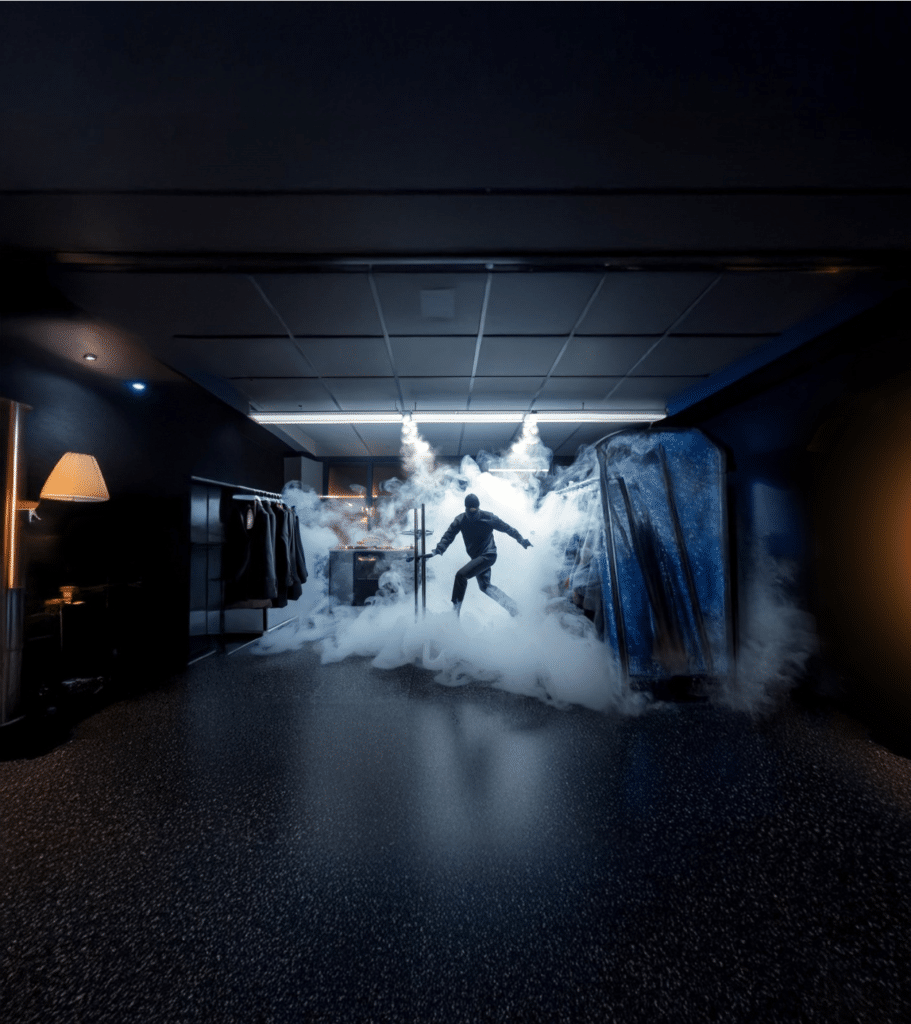
2. What is Fog Security?
Fog Security (also known as security smoke) is an active intrusion prevention system that fills a designated area with a dense, harmless vapour within seconds of a break-in detection. By reducing visibility to near zero (often less than 30cm), it disorients intruders and forces them to flee immediately, preventing theft before police arrive.
3. The Rising Need for Active Deterrents in Australia
Australia has seen a shift in the nature of commercial burglary over the last decade. The rise of “ram raids” and “smash and grab” attacks, particularly targeting retail outlets like tobacconists, jewelers, and electronics stores, has highlighted the limitations of standard alarm systems.
The “Three-Minute” Gap
According to various crime statistics, the average duration of a commercial break-in is often under four minutes. Conversely, the response time for security patrols or police can range from 10 to 20 minutes depending on the location and current demand.
In this scenario, a thief can enter, locate high-value stock, and exit long before anyone arrives to stop them. Passive security measures like cameras are reactive—they provide evidence after the loss has occurred. Fog Security is an active measure. It intervenes physically in the environment.
Industries Most at Risk
Based on current Australian market trends, the following sectors benefit most from fog deployment:
- High-End Retail: Jewelers and designer fashion outlets.
- Controlled Goods: Tobacconists and liquor stores (highly targeted for black market resale).
- Warehousing: Facilities storing high-value electronics or copper.
- Cash Handling: Petrol stations and gaming venues.
4. How Fog Security Works: The Science of Invisibility
Understanding the mechanics behind these systems helps dispel myths about “smoke” damage.
The Fluid (Glycol and Water)
The “fog” generated is not smoke (which is a product of combustion). It is a vapor created by heating a specific fluid mixture, usually comprising food-grade glycol and distilled water. This is the same basic chemistry used in theatrical fog machines but engineered for much higher density and persistence.
The Deployment Process
- Trigger: The system is connected to your intruder alarm. It usually requires a “double knock” verification (e.g., a door sensor and a motion sensor must both trip) to prevent false activations.
- Heating: The fluid is pumped through a high-efficiency heater block.
- Expansion: As the fluid hits the heat, it expands roughly 600 times its volume, turning into a dry, dense white cloud.
- Pressure: The vapor is ejected at high velocity, filling a standard retail shop or warehouse zone in under 10 seconds.
The “White-Out” Effect
The density of the fog is such that you cannot see your hand in front of your face. This induces a psychological “flight” response in the intruder. Without visual references, they lose their orientation. Their primary instinct shifts from “steal” to “escape.”
5. Comparison: Fog Security vs. Traditional Alarms
To understand the value proposition, it is helpful to compare active fog systems against the standard security setup found in most Australian businesses.
| Feature | Traditional Alarm System | Fog Security System |
| Primary Function | Alerting (Sound/Strobe) | Denying Access (Visual Barrier) |
| Action Taken | Notifies monitoring centre/owner | Physically blocks the intruder’s vision |
| Effect on Intruder | Increases urgency (rush to steal) | Causes disorientation & retreat |
| Response Time | Instant Alert (but wait for police) | Instant Action (stops crime in seconds) |
| Damage Prevention | Low (Loss usually occurs) | High (Prevents access to goods) |
| Deterrence Factor | Moderate | Extreme (Intruders avoid fog signage) |
As the table illustrates, while alarms are necessary for notification, only fog creates an immediate barrier to the actual act of theft.
6. Is Fog Security Safe? Health, Electronics, and Residue
One of the most common questions I encounter from business owners concerns safety. “Will it ruin my stock?” or “Is it toxic?” are valid concerns.
Human and Animal Safety
The fluid used in reputable Fog Security systems is typically composed of water and glycol.
- Non-Toxic: It is harmless to breathe for short periods.
- Non-Carcinogenic: It contains no burnt particles.
- Food Safe: Many systems are certified for use in food preparation areas, though covering open food is always recommended as best practice.
Electronics and Textiles
Because the fog is “dry,” it does not leave a damp residue that damages electronics. Computers, servers, and sensitive retail stock (like clothing) are generally safe. The fog settles as a fine dust that can be wiped away or simply evaporates, depending on the specific fluid formulation used.
Certification Matters
In Australia, it is vital to use equipment that meets international standards, such as the European Standard EN 50131-8, which governs the installation and operation of security fog devices. This standard ensures the fog density is safe and the ejection speed is controlled.
According to a report by the Security Industry Association (SIA), verifying that security devices meet recognized standards is the first line of defense against liability issues.
7. Installation and Integration: A Step-by-Step Checklist
Installing a fog cannon is not a DIY job. It involves high-pressure heating elements and integration with complex alarm wiring. However, understanding the process helps you manage the installation.
1. Site Assessment (The “Volume” Calculation)
The installer measures the cubic meters of the room. Fog cannons are rated by their output (e.g., 400 cubic meters in 30 seconds). Undersizing the unit means the fog won’t be dense enough; oversizing can be wasteful.
2. Placement Strategy
- Corner Mounting: Usually placed in a corner facing the likely entry point or high-value stock.
- Height: Mounted high on the wall or ceiling to prevent tampering.
- Hidden Installation: Some units can be installed above a false ceiling with only a nozzle visible, offering a discreet aesthetic.
3. Alarm Integration
The unit is hardwired into your existing alarm panel.
- Arming: The fog machine only activates when the alarm is fully armed (e.g., at night).
- Trigger Protocol: Configuring the “double knock” sensors to ensure a spider crawling on a lens doesn’t fill your shop with fog.
4. Signage
You must display warning stickers on entry points. This is a legal requirement in many jurisdictions and acts as a powerful deterrent.
5. Test Fire
A test fire is conducted to ensure the room fills correctly and to demonstrate the system to the staff.
For a detailed consultation on how this fits your specific premises, you can view our solutions for professional fog security installation.
8. Australian Compliance and Legal Considerations
While I am providing information based on industry standards, always consult with a licensed security advisor regarding your specific liabilities.
Fire Brigade Notification
This is the most critical administrative step. Because the fog looks like smoke, it can trigger optical smoke detectors.
- Registration: You generally need to register the system with your monitoring station.
- Isolation: Smoke detectors in the fog zone usually need to be replaced with heat detectors, or the alarm monitoring must be configured to distinguish between a fog activation and a fire alarm to prevent false dispatch of the Fire Brigade (which can incur heavy fines in states like Victoria and NSW).
Workplace Health and Safety (WHS)
Staff must be trained on what the system is. They need to know that if it accidentally triggers, they should not panic, stay low (visibility is better near the floor initially), and exit the building.
9. People Also Ask (PAA)
Here are the most common questions Australians search for regarding this technology:
Is security fog legal in Australia?
Yes, security fog is legal in Australia when installed by a licensed security professional. It must comply with Australian safety standards, and proper warning signage must be displayed at all entry points to inform anyone entering the premises.
Does fog security trigger fire alarms?
It can trigger standard optical smoke detectors because the particles mimic smoke density. To prevent this, professional installers usually replace standard smoke sensors with heat sensors in the fog zone or isolate the fire panel during the system’s armed hours.
How much does a fog cannon cost?
The cost varies based on the size of the room and the sophistication of the unit. In Australia, a small unit for a back office might start around $2,000, while large warehouse systems can cost significantly more. Installation and integration labor are additional.
What happens if the fog goes off accidentally?
If a false activation occurs, the room will fill with harmless vapor. You should open all windows and doors to vent the area. The fog typically dissipates completely within 45 to 60 minutes, leaving little to no residue.
10. Advanced Q&A: Expert Insights
For business owners looking for deeper technical details, here are five specific insights.
Q1: Can intruders simply wait for the fog to clear and then re-enter?
A: Most modern systems have a “pulse” or “maintenance” mode. Once the initial burst fills the room, the sensor monitors density. If the fog starts to settle while the alarm is still active, the machine fires short bursts to maintain zero visibility for up to an hour, by which time police will have arrived.
Q2: Does the fluid expire?
A: Yes, fluid containers usually have a shelf life (often 2-5 years). It is a simple maintenance task to swap out the fluid bag. Using expired fluid can result in thin fog or potential clogging of the heater block.
Q3: Will the fog affect my insurance premiums?
A: Often, yes—in a positive way. Many Australian insurers recognize Fog Security as a high-level risk mitigation tool. Installing one may reduce your premiums or deductible, particularly for high-risk businesses like jewelers. It is worth discussing this with your broker.
Q4: Can I use Fog Security in a server room?
A: Generally, yes, provided you use high-quality, certified fluid that produces a dry vapor. However, you must consult the hardware manufacturer’s warranty. The main concern in server rooms is usually the HVAC system sucking the fog out, so automatic shutdown of air conditioning is often integrated into the install.
Q5: How does the system handle power outages?
A: Security fog units have built-in backup batteries. They act like a UPS (Uninterruptible Power Supply). Even if a thief cuts the power to the building before breaking in, the unit remains hot and ready to fire for a specified period (usually 1-3 hours).
11. Conclusion
In the fight against property crime in Australia, speed is the only metric that matters. When a break-in occurs, the difference between a total loss and a failed attempt is often measured in seconds. Fog Security offers the unique ability to reclaim control of your premises immediately, physically stopping intruders without risking human safety.
By removing the thief’s ability to see, you remove their power. Whether you operate a retail store in a busy CBD or a warehouse in an industrial suburb, integrating fog into your security layering is one of the most effective investments you can make.
For trusted, effective protection, ensure you rely on verifiable data and experienced installers. To discuss how we can secure your business with these active deterrents, visit our dedicated page on professional fog security installation.
References: