


The Ultimate Guide to the Best Anti Fog Spray for Security Camera Maintenance in Australia
Table of Contents
- Introduction
- What is Anti-Fog Spray for Security Cameras? (Featured Definition)
- Why Do Security Cameras Fog Up? The Australian Climate Factor
- How Anti-Fog Solutions Work: Hydrophilic vs. Hydrophobic
- Identifying the Best Anti-Fog Spray for Security Camera Lenses
- Comparison: Anti-Fog Sprays vs. Hardware Heaters
- Step-by-Step Checklist: Applying Anti-Fog Treatments Correctly
- DIY Myths vs. Professional Solutions
- People Also Ask (PAA)
- Advanced Q&A: Expert Maintenance Insights
- Conclusion
1. Introduction
There is nothing more frustrating for a business owner or homeowner than reviewing CCTV footage after an incident, only to find the critical moment obscured by a cloudy white haze. Finding the best anti fog spray for security camera lenses is a common priority for Australians, particularly as we navigate the diverse climates from the humid summers of Queensland to the frosty winter mornings of Melbourne and Tasmania.
From my experience in the security industry, blurry lenses are rarely a fault of the camera’s resolution; they are a battle against physics. Condensation can render a 4K camera useless in seconds. While modern IP cameras come with weather ratings, the external lens glass is still susceptible to environmental moisture. This guide covers everything you need to know about keeping your vision clear, selecting the right chemical treatments, and understanding when a spray is enough—or when you need to upgrade your hardware.
2. What is Anti-Fog Spray for Security Cameras?
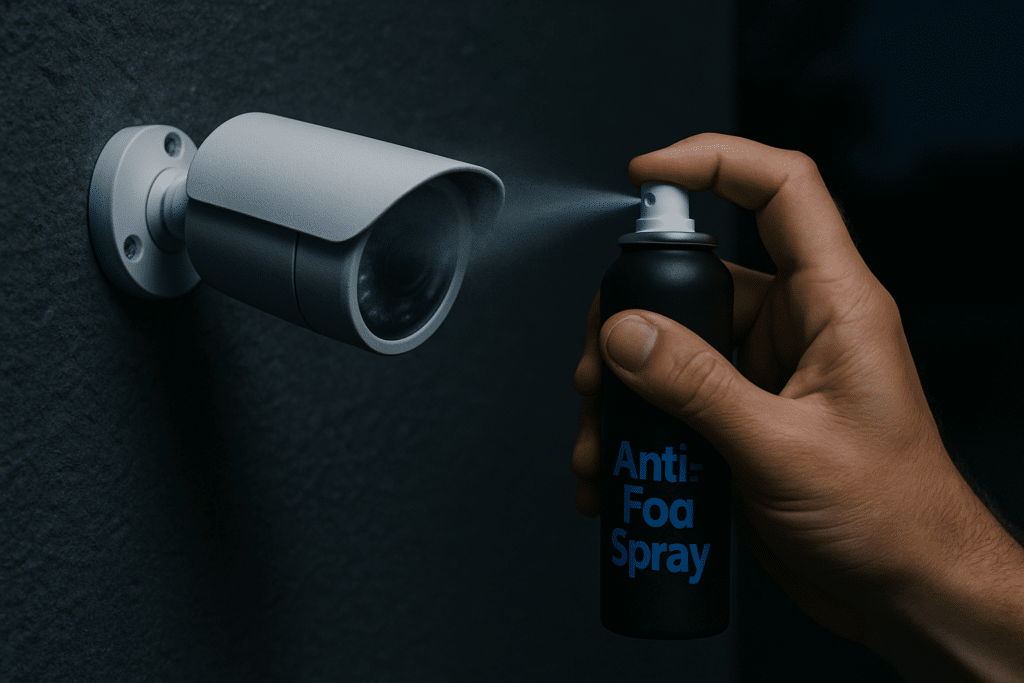
Anti-fog spray for security cameras is a specialized chemical treatment designed to lower the surface tension of water droplets on a glass or plastic lens. Instead of forming tiny, light-scattering beads (fog), the moisture spreads into a thin, transparent film, allowing the camera to maintain clear visibility during rapid temperature changes or high humidity.
3. Why Do Security Cameras Fog Up? The Australian Climate Factor
To solve the problem, we must first understand the cause. Fog on a security camera is simply condensation. It occurs when the temperature of the lens surface drops below the “dew point” of the surrounding air.
The Dew Point Dynamic
In Australia, we often experience drastic temperature shifts. For example, in Western Sydney or inland areas, the air can be warm and humid during the day. As night falls, the temperature plummets. The glass lens of your camera cools down faster than the air inside the housing or the ambient air outside. When warm, moist air hits that cold glass, it releases its water content as liquid droplets.
Internal vs. External Fogging
It is critical to distinguish between the two:
- External Fogging: This is on the outside of the glass. This is what best anti fog spray for security camera products are designed to fix. It happens during rain, mist, or morning dew.
- Internal Fogging: This occurs inside the lens housing. This usually indicates a failed seal or a compromised IP (Ingress Protection) rating. No spray will fix this; it requires a desiccant pack replacement or a new camera unit.
The Impact of Location
- Coastal Areas: Salt spray combined with humidity can accelerate fogging and create a sticky residue that attracts moisture.
- Industrial Zones: Dust particles settle on the lens, providing a surface for water to cling to, worsening the fog effect.
4. How Anti-Fog Solutions Work: Hydrophilic vs. Hydrophobic
When searching for the best anti fog spray for security camera maintenance, you will encounter two main scientific approaches. Understanding the difference ensures you buy the right product for your specific environment.
Hydrophilic Coatings (Water-Loving)
These sprays work by maximizing the surface energy of the glass.
- Mechanism: They attract water. When condensation forms, the coating forces the water to flatten out instantly into a non-scattering sheet.
- Result: The “fog” is technically still there (the water is present), but it is transparent so the camera looks right through it.
- Best For: Environments with constant high humidity (e.g., indoor pool areas, tropical North Queensland).
Hydrophobic Coatings (Water-Fearing)
These are often marketed as “rain repellents” (like Rain-X, though caution is advised with specific plastics).
- Mechanism: They lower the surface energy, causing water to bead up into perfect spheres and roll off.
- Result: Gravity does the work. As the beads get heavy, they drop off the lens, taking dirt and dust with them.
- Best For: Outdoor cameras exposed to direct rain or heavy splashing.
For standard morning fog (condensation), hydrophilic sprays are generally superior because they prevent the light-scattering droplets from forming in the first place.
5. Identifying the Best Anti-Fog Spray for Security Camera Lenses
Not all sprays are created equal. Using a product designed for a bathroom mirror or a car windshield might damage the delicate anti-glare coatings found on high-end CCTV lenses.
Key Criteria for Selection
- Lens Safety: Ensure the spray is safe for coated optics and polycarbonate (plastic) domes. Some automotive sprays contain aggressive solvents that can craze (crack) plastic over time.
- Longevity: A good security spray should last at least 2–4 weeks per application. You do not want to be climbing a ladder every morning.
- Clarity: It must dry completely clear. Some cheaper pastes leave a waxy haze that causes “blooming” when night vision (IR) lights turn on.
Recommended Types
While I cannot endorse specific third-party brands without testing your specific glass type, look for sprays labeled for:
- Scuba/Dive Masks: These are designed for high clarity and plastic safety.
- Sports Optics: Designed for rifle scopes or binoculars, these are excellent for CCTV.
- Nano-Tech Sprays: These newer solutions bond at a molecular level and tend to last longer than traditional surfactants.
According to a report by Corning Glass, optical coatings are sensitive to abrasion. Therefore, the method of application (discussed in Section 7) is just as important as the spray itself.
6. Comparison: Anti-Fog Sprays vs. Hardware Heaters
Is a spray actually the solution, or is it a band-aid? In professional security integration, we often rely on hardware solutions for critical infrastructure.
| Feature | Anti-Fog Spray | Internal Heater / Blower |
| Cost | Low ($10 – $30) | High (Requires specialized camera) |
| Mechanism | Chemical alteration of surface | Thermal regulation of glass |
| Maintenance | High (Reapply monthly) | Low (Automated) |
| Effectiveness | Moderate (Surface only) | High (Prevents condensation totally) |
| Power Usage | None | Requires additional POE/Power draw |
| Installation | DIY Friendly | Professional Install Required |
Verdict: For existing cameras that do not have built-in heaters, the best anti fog spray for security camera usage is the most cost-effective retrofit. However, for new installations in cold climates (like the Snowy Mountains or rural Victoria), we always recommend specifying cameras with built-in heaters.
7. Step-by-Step Checklist: Applying Anti-Fog Treatments Correctly
Improper application is the number one reason these products fail. If you apply spray over dust, you are creating mud.
The “Crystal Clear” Protocol:
- Safety First: Ensure your ladder is stable. Turn off the camera if possible to avoid triggering motion alerts constantly.
- Clean the Lens: Use a microfiber cloth and a mild lens cleaner (or isopropyl alcohol if safe for your specific housing) to remove all dirt, bird droppings, and spider webs. The glass must be pristine.
- Dry Completely: Moisture trapped under the anti-fog coating will ruin it.
- Apply the Product:
- Spray: Light misting. Do not soak it.
- Gel/Paste: Use a grain-of-rice sized amount.
- Distribute: Use a fresh section of your microfiber cloth to spread the fluid evenly across the dome or lens face.
- Buff (Don’t Wipe Off): Gently buff until the haze disappears and the glass looks clear. You are trying to leave a microscopic layer behind, not wipe it all away.
- Test: Breathe gently on the lens. If the fog vanishes instantly, the treatment is active.
8. DIY Myths vs. Professional Solutions
In the search for the best anti fog spray for security camera maintenance, many Australians turn to “life hacks.” From my experience, these often do more harm than good.
The Toothpaste Myth
- The Theory: The abrasive nature cleans the glass and leaves a film.
- The Reality: Toothpaste is an abrasive. It will create micro-scratches on your lens. Over time, these scratches will catch light from streetlamps or the camera’s own IR LEDs, causing a “starburst” effect that ruins night footage.
The Shaving Cream Hack
- The Theory: The glycerin in shaving cream acts as a surfactant.
- The Reality: It works—briefly. However, shaving cream is not designed for optical clarity. It often leaves a residue that attracts dust and dirt rapidly. In an outdoor environment, your lens will be dirty again within days.
The Potato Trick
- The Theory: Rubbing a raw potato leaves a starch film that repels water.
- The Reality: Starch is organic. It feeds bacteria and mold. In the humid Australian climate, a starchy lens is a recipe for fungal growth on the glass.
Stick to engineered optical chemicals. The cost of a proper bottle is negligible compared to the cost of replacing a scratched camera lens.
9. People Also Ask (PAA)
Can I use Rain-X on my security cameras?
You should be cautious. Rain-X is designed primarily for automotive glass. Many security camera domes are made of polycarbonate (plastic). Unless you buy the specific “Rain-X for Plastics” version, the standard formula can damage the protective coating or cause the plastic to become brittle and crack over time.
How often should I apply anti-fog spray to CCTV?
In outdoor Australian conditions, you should typically reapply the spray every 4 to 6 weeks. However, if you are in a high-rainfall area or a coastal zone with salt spray, you may need to clean and reapply every 2 weeks to maintain optimal clarity.
Does Vaseline stop camera fog?
No, Vaseline (petroleum jelly) is too thick and opaque. While it repels water, it will blur your image significantly and attract a massive amount of dust and insects. It is one of the worst things you can put on a camera lens.
Why does my camera fog up at night only?
This is due to the infrared (IR) LEDs. The LEDs generate heat, but the glass surface is exposed to cold night air. This temperature differential creates the dew point on the glass surface. Additionally, the IR light reflects off the tiny fog droplets, making the image look completely white or “washed out” (known as IR reflection).
10. Advanced Q&A: Expert Maintenance Insights
Q1: My camera is sealed (IP67), so why is there condensation inside the lens?
A: Even IP67 cameras are not hermetically sealed forever. Over time, the rubber gaskets degrade due to UV exposure from the Australian sun. When the seal fails, moist air enters during the day and condenses at night. The only reliable fix is to open the unit, dry it out with silica gel packets, and reseal it with silicone grease—or replace the unit entirely.
Q2: Will anti-fog spray affect the Night Vision (IR) range?
A: A high-quality spray applied correctly should not affect IR range. However, if you apply it too thickly or use a waxy product, it can cause “IR Bleed.” This happens when the infrared light catches the uneven texture of the coating and reflects back into the lens, causing a foggy halo effect in the footage.
Q3: Can I use anti-fog spray on the camera housing (sunshield)?
A: You can, but it is less critical. However, applying a hydrophobic (water-repelling) spray to the housing can help keep the camera clean by encouraging rain to wash away bird droppings and dust, which indirectly helps keep the lens area cleaner.
Q4: Is there a permanent coating solution?
A: There are “permanent” nano-coatings available (often ceramic-based), similar to those used in automotive detailing. These can last 6–12 months. However, they are expensive and difficult to remove if they start to peel or discolor. For most users, a monthly maintenance spray is safer and more manageable.
Q5: What if the fog is actually caused by the environment, not the lens?
A: Sometimes, the air itself is so thick with fog or smoke that the camera cannot see. No spray will fix this. In these scenarios, you need to rely on thermal cameras (which see heat, not light) or consider alternative security measures. This brings us to a crucial point: relying solely on visual confirmation has limitations.
Moving Beyond Clear Lenses
While keeping your cameras clear is vital for recording evidence, recording a crime is not the same as preventing it. Even with the best anti fog spray for security camera clarity, a camera is a passive observer.
If you are looking for a way to actively stop intruders when visibility is poor or when response times are slow, you might consider systems that create their own “fog” to defend your property. Unlike natural fog which hinders you, security fog hinders the criminal.
You can learn more about how active fog security solutions can protect your assets by physically blocking an intruder’s vision, rather than just trying to improve your own.
11. Conclusion
Maintaining your security infrastructure is just as important as installing it. In Australia, where environmental conditions can be harsh and unpredictable, ensuring your “eyes on the ground” are not blinded by simple condensation is a mandatory maintenance task.
By choosing the best anti fog spray for security camera lenses—specifically hydrophilic formulas safe for optics—and adhering to a regular cleaning schedule, you can ensure your footage remains admissible and clear. Remember to avoid household hacks like toothpaste or shaving cream, as the short-term gain is not worth the long-term damage to your equipment.
Whether you are managing a single front-door camera or a complex commercial perimeter, clear vision is the foundation of effective security. Keep your lenses clean, your seals tight, and your property protected.
References: