


Apartment intercom systems are now a core part of secure, convenient living in Australian apartment buildings, strata complexes, mixed-use developments, and gated residential communities. From my experience planning access solutions for multi-tenant properties, the best results come from matching the system to the building, not simply choosing the newest screen, app, or entry panel.
For residents, an intercom should feel simple. Someone calls from the entry, the resident verifies the visitor, and access is granted only when appropriate. However, behind that simple moment is a mix of cabling, networking, door hardware, privacy settings, lift integration, maintenance planning, and strata approval.
This guide explains what apartment intercom systems do, how they differ, what Australian buildings should consider, and how owners corporations, building managers, developers, and landlords can plan upgrades with fewer surprises.
Table of Contents
- What are apartment intercom systems?
- Why apartment buildings use intercoms
- How apartment intercom systems work
- Main types of apartment intercom systems
- Audio, video, IP, and mobile app options compared
- Australian building and strata considerations
- Cabling, networking, and installation planning
- Privacy, visitor data, and camera considerations
- Common features worth considering
- Upgrade checklist for Australian apartment buildings
- People Also Ask
- Expert Q&A
- Conclusion
What are apartment intercom systems?
Apartment intercom systems let residents speak with, see, and verify visitors before unlocking a shared entrance, gate, or lobby door. In Australia, they are commonly used in strata and multi-residential buildings to improve access control, reduce unauthorised entry, and make visitor management easier for residents and building managers.
Why Apartment Buildings Use Intercom Systems
Apartment buildings have a different access problem from standalone homes. One entrance may serve 10, 50, 100, or even 300 residences. Therefore, the system must balance resident convenience with building-wide security.
A good intercom helps answer three basic questions:
Who is at the door?
Which apartment are they visiting?
Should they be allowed in?
Without a reliable intercom, residents often prop doors open, share access codes, or let people “tailgate” into the building. As a result, the building’s main security layer becomes weaker over time.
Apartment intercom systems also support day-to-day operations. Couriers, trades, cleaners, carers, guests, property managers, and emergency contacts all need controlled access at different times. So, the system should reduce friction without turning the building into an open-access space.
For Australian apartment buildings, the most common reasons to install or upgrade include:
- Old handsets no longer working
- Poor audio quality at the front door
- Residents wanting video verification
- Strata committees replacing obsolete analogue hardware
- Building managers needing better access logs
- Lift access needing to connect with entry control
- Tenants expecting mobile app access
- Repeated issues with unauthorised visitors
In short, apartment intercom systems are not just doorbells. They are part of the wider access control strategy for the building.
How Apartment Intercom Systems Work
Most apartment intercom systems include four main parts.
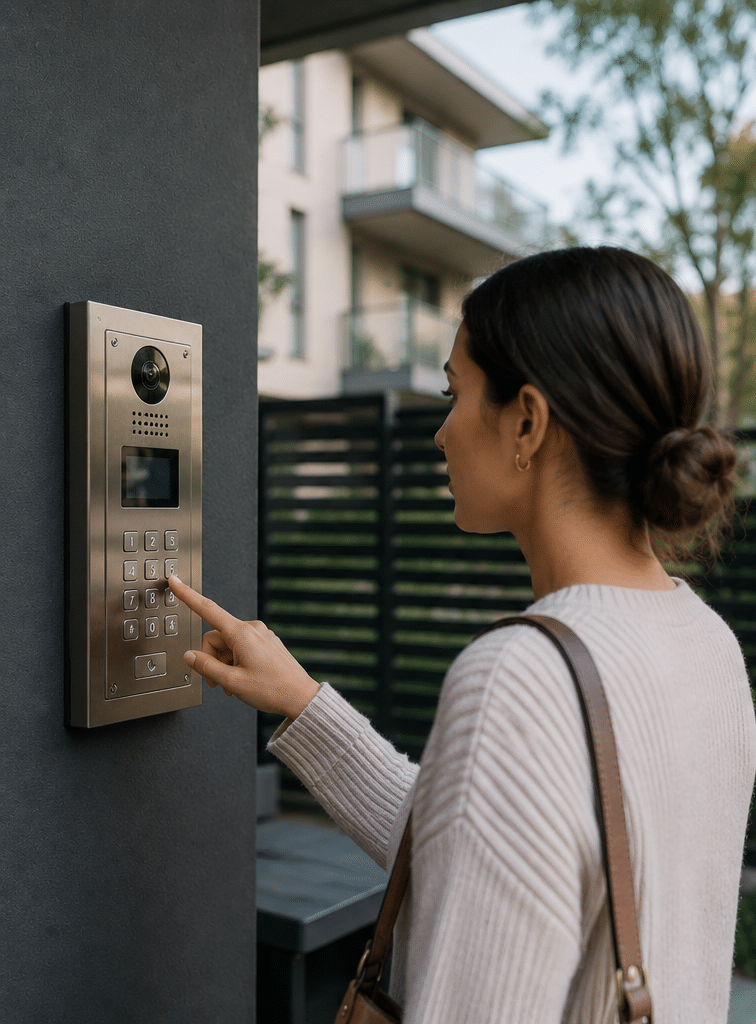
First, there is an entry station. This is the panel visitors use at the front gate, lobby, car park entrance, or loading dock. It may include call buttons, a directory, keypad, card reader, camera, microphone, and speaker.
Second, there is a resident answering point. This may be a wall-mounted handset, indoor video monitor, mobile app, or browser-based interface. Older buildings often use audio handsets. Newer buildings may use video monitors or smartphone apps.
Third, there is the door release. When a resident approves a visitor, the intercom triggers an electric strike, magnetic lock, gate motor, or access controller. This unlocks the entry point for a short period.
Fourth, there is the cabling or network layer. Traditional systems use dedicated cabling between entry panels and apartments. Modern IP systems often use network infrastructure. Because communications cabling has technical and safety requirements, ACMA advises that phone, internet, and alarm cabling in homes and workplaces should be handled by a registered cabler. See the ACMA guidance on registered cablers.
The exact design depends on the building. For example, a small block of eight apartments may only need one entry panel and eight handsets. However, a high-rise building may need multiple lobby panels, lift control, basement access, concierge integration, CCTV coordination, and remote management.
Main Types of Apartment Intercom Systems
Apartment intercom systems can be grouped into several practical categories. Each has benefits and limits.
Audio Apartment Intercom Systems
Audio systems allow visitors and residents to speak before access is granted. They are simple, familiar, and often cost-effective for smaller buildings.
However, audio-only systems rely on voice recognition. That can be a problem if residents cannot clearly hear the visitor, if the area is noisy, or if someone pretends to be a courier or contractor.
Audio systems may suit older buildings that need a like-for-like replacement. Still, many Australian strata committees now consider video when upgrading because visual confirmation can reduce uncertainty.
Video Apartment Intercom Systems
Video intercoms allow residents to see visitors before opening the door. This improves decision-making, especially in busy apartment foyers.
Video is helpful for deliveries, after-hours visitors, and buildings with vulnerable residents. However, it adds privacy and data management considerations. If footage can identify people, building operators should consider how it is collected, stored, accessed, and disclosed. The Office of the Australian Information Commissioner explains that organisations using surveillance devices such as security cameras generally need to consider privacy obligations. You can review the OAIC guidance on security cameras.
Video apartment intercom systems are now common in new developments and premium upgrades. Even so, they must be specified carefully. Camera angle, lighting, vandal resistance, network reliability, and screen placement all affect the result.
IP Apartment Intercom Systems
IP intercoms use network-based communication. They can support video, remote management, mobile apps, access control integration, and easier software updates.
The main advantage is flexibility. For example, a building manager may be able to update resident names, change permissions, or review system events from a secure management portal.
However, IP systems depend on network design. If the network is poorly segmented, underpowered, or unmanaged, the intercom may become unreliable. Therefore, network planning is just as important as the hardware.
Mobile App Apartment Intercom Systems
Some systems can call a resident’s mobile phone. This is convenient for residents who do not want a wall monitor or who are often away from home.
For rental buildings and build-to-rent properties, app-based access can also reduce hardware inside apartments. However, it depends on smartphone access, user onboarding, internet availability, and support for residents who prefer not to use apps.
A balanced approach often works best. For example, the building may provide indoor stations for some units and mobile app access for others, depending on resident needs and budget.
Apartment Intercom Systems Compared
| System type | Best suited to | Main benefit | Watch-out |
| Audio intercom | Small or older apartment buildings | Simple and cost-effective | No visual verification |
| Video intercom | Medium to large residential buildings | Residents can see visitors | Needs privacy and camera planning |
| IP intercom | New builds and major upgrades | Flexible and scalable | Requires sound network design |
| Mobile app intercom | Modern strata or build-to-rent sites | Convenient remote answering | Needs app support and resident onboarding |
| Integrated access system | Buildings with lifts, car parks, and multiple doors | Stronger whole-building control | Higher planning and coordination effort |
This comparison shows why there is no single “best” option. Instead, the right choice depends on building size, resident expectations, budget, cabling condition, and long-term maintenance plans.
Australian Building and Strata Considerations
In Australia, many apartment buildings are strata-titled. That means some areas are private lots, while others are common property. Intercom entry panels, lobby doors, risers, shared cabling pathways, and building entrances may fall under common property arrangements.
For example, NSW Government guidance explains that owners corporations are generally responsible for maintaining and repairing common property, while owners repair items within their own property. This type of guidance is useful for understanding the administrative side of repairs and upgrades, although each building should check its own strata plan, by-laws, and professional advice. See the NSW Government strata repairs and maintenance guidance.
This is not legal advice. However, from a project planning point of view, strata committees should clarify:
- Who owns the existing intercom hardware
- Whether cabling runs through common property
- Whether apartment entry devices are lot owner fixtures
- Whether by-laws mention security devices or alterations
- Who approves changes to lobby panels or door hardware
- Whether multiple quotes are required under the building’s rules
- How residents will be notified before works start
This administrative step matters. Even a technically simple upgrade can become difficult if approvals, notices, access to apartments, and resident expectations are not handled early.
Cabling, Networking, and Installation Planning
Cabling is one of the biggest practical issues in older apartment intercom systems. Many buildings still have legacy wiring that was installed decades ago. Sometimes it works. Sometimes it is brittle, undocumented, or unsuitable for video.
Before choosing hardware, a competent installer should assess:
- Existing cabling type and condition
- Riser access and cable pathways
- Distance from entry panel to apartments
- Power availability at entry points
- Door lock and gate hardware condition
- Network availability for IP systems
- Lift or access control integration needs
- Weather exposure and vandal risk
- Resident access requirements during installation
- Future expansion needs
This investigation helps avoid a common mistake: buying a system that looks good in a brochure but does not match the building’s infrastructure.
For example, a video intercom may need more bandwidth or different cabling than an old audio handset system. Similarly, a mobile-enabled system may need reliable internet connectivity and secure network configuration.
Therefore, the best project sequence is usually:
- Audit the existing system
- Confirm building requirements
- Inspect cabling and door hardware
- Compare suitable system types
- Prepare a clear scope of works
- Seek strata or owner approval
- Schedule resident communications
- Install and test entry points
- Configure apartments and users
- Train building managers and residents
This numbered checklist reduces missed steps and makes the upgrade easier to explain to committee members, landlords, and residents.
What to Look for in Apartment Intercom Systems
The right features depend on the building. However, several features are worth considering.
Clear Audio and Reliable Call Quality
Audio quality is still the foundation of every intercom. Even with video, residents need to hear the visitor clearly. Noise cancellation, quality speakers, and well-positioned microphones can make a major difference.
In my experience, poor audio often causes more complaints than missing advanced features. Residents will forgive a basic system if it works. They will not forgive a premium-looking system that fails during everyday use.
Video Verification
Video helps residents confirm who is at the door. It can also reduce accidental entry for strangers. However, camera placement matters. The camera should capture the visitor’s face without pointing unnecessarily into private areas.
Lighting is also important. A lobby camera that works during the day may perform poorly at night if the entrance has glare, shadows, or backlighting.
Door Release Control
The door release must be reliable and secure. Common options include electric strikes, magnetic locks, and gate relays. The installer should also consider fire egress requirements, fail-safe or fail-secure behaviour, and integration with existing access control.
These topics should be reviewed by qualified professionals. The goal is to keep the building secure while ensuring people can exit safely.
Resident Directory Management
Older systems often require manual label changes. Modern systems may allow digital directory updates. This is helpful in rental-heavy buildings where occupants change often.
However, directory privacy should be considered. Some residents may not want their full name displayed. As a result, many buildings use unit numbers, initials, or approved display names.
Access Logs and Admin Controls
Some apartment intercom systems record events such as calls, door releases, or access attempts. This can help investigate incidents. However, logs should not be treated casually.
Buildings should decide who can access logs, how long records are kept, and when information can be shared. Clear administrative rules reduce disputes later.
Vandal Resistance and Weather Rating
External entry panels in Australia may face heat, rain, salt air, dust, vandalism, and heavy use. Therefore, panel durability matters.
For coastal buildings, corrosion resistance is especially important. For busy city buildings, impact resistance and secure mounting may matter more.
Integration with Access Control and CCTV
Many apartment buildings use intercoms alongside fobs, swipe cards, lift control, CCTV, garage remotes, and visitor access systems. Integration can improve security and reduce duplicated administration.
However, integration also increases complexity. If one system fails, it can affect several parts of the building. Therefore, design, documentation, and support arrangements are important.
New Installation vs Upgrade: Which Is Better?
Some buildings can reuse existing cabling and replace only entry panels and apartment stations. Others need a full redesign.
A simple replacement may be suitable when:
- Existing cabling is healthy
- The building only needs audio
- Apartment handsets are easy to access
- Door hardware is already reliable
- The owners corporation wants a lower-cost upgrade
A full upgrade may be better when:
- The system is obsolete
- Parts are no longer available
- Residents want video or app access
- Cabling is damaged or unsuitable
- The building has multiple entrances
- Lift or access control integration is required
- Ongoing maintenance costs are increasing
Although a full upgrade may cost more upfront, it can reduce future frustration. Conversely, a simple replacement can be sensible when the building has modest needs and reliable infrastructure.
Common Mistakes to Avoid
Many intercom projects run into problems because the planning is too narrow. The following issues are common.
First, some buildings choose hardware before inspecting cabling. This can lead to variation costs later.
Second, committees may focus only on the entry panel and forget apartment devices. Resident access for installation can become the hardest part of the project.
Third, privacy settings may be ignored until after installation. Video, logs, and app accounts should be planned from the start.
Fourth, buildings may fail to document administrator access. When committee members change, nobody knows who controls the system.
Finally, some projects do not include training. Residents then use the system incorrectly, and managers receive avoidable support requests.
A better approach is to treat apartment intercom systems as shared building infrastructure. That means planning for installation, use, maintenance, privacy, and future changes.
Cost Factors for Apartment Intercom Systems in Australia
Costs vary widely, so any figure without a site inspection is only an estimate. The main cost drivers include:
- Number of apartments
- Number of entry panels
- Audio vs video requirements
- Existing cabling condition
- Need for new riser cabling
- Door hardware upgrades
- Lift integration
- Mobile app licensing
- Network equipment
- Programming and commissioning
- Resident training and support
- After-hours work requirements
For example, a small walk-up apartment block may need a relatively simple system. By contrast, a high-rise building with basement parking, multiple lifts, concierge access, and hundreds of residents will require a more detailed design.
Therefore, the most useful quote is not always the cheapest. A good quote should explain the scope, assumptions, exclusions, hardware, cabling approach, warranty, and support process.
Privacy and Compliance: Practical Administration, Not Legal Advice
Apartment intercom systems may involve names, apartment numbers, call records, access events, images, and sometimes video recordings. Therefore, privacy should be handled carefully.
This does not mean every building needs a complex legal framework. However, it does mean committees and managers should make sensible administrative decisions.
For example:
- Display only necessary resident information
- Limit administrator access
- Use strong passwords and role-based permissions
- Decide how long logs are retained
- Avoid recording audio unless properly assessed
- Place cameras to support entry verification, not unnecessary monitoring
- Notify residents about major changes
- Keep supplier and warranty documents organised
Because privacy and surveillance rules can vary by context, buildings should seek qualified advice where needed. The key point is simple: collect only what is useful, protect it properly, and explain the system clearly to residents.
On-Premise vs Cloud-Managed Apartment Intercom Systems
| Option | Advantages | Limitations | Good fit |
| On-premise system | More local control, less reliance on external cloud services | May need more site-based maintenance | Buildings wanting local management |
| Cloud-managed system | Easier remote updates and app features | Depends on internet, vendor platform, and account management | Buildings wanting mobile and remote administration |
| Hybrid system | Balances local access with remote features | Needs careful configuration | Larger buildings with mixed needs |
Cloud-managed systems can be convenient. However, committees should ask about data hosting, account ownership, subscription fees, and what happens if the building changes providers.
On-premise systems may appeal to buildings that prefer local control. However, they still need maintenance and secure configuration.
People Also Ask
Are apartment intercom systems worth it?
Yes, apartment intercom systems are usually worth it for buildings with shared entrances. They help residents verify visitors, reduce unauthorised access, and improve daily convenience for deliveries and guests.
Can an old apartment intercom be upgraded to video?
Often, yes, but it depends on cabling, distance, power, and the existing system design. A site inspection is needed because some older audio cabling may not support modern video systems without changes.
Do apartment intercom systems need internet?
Not always. Traditional audio and some video systems can work without internet. However, IP and mobile app systems usually need reliable network or internet connectivity.
Who pays for apartment intercom repairs in strata?
In many strata buildings, shared entry equipment and common property infrastructure are managed by the owners corporation. However, responsibilities can depend on the strata plan, by-laws, and where the fault is located.
Can tenants use mobile app intercom access?
Yes, many modern systems support tenant app access. Still, the building manager or authorised administrator should have a clear process for adding and removing users when tenancies change.
Expert Q&A: Apartment Intercom Systems
1. What is the best apartment intercom system for a small Australian block?
For a small block, the best option is often a reliable audio or video system with simple administration. If the building has fewer than 20 apartments, avoid overcomplicating the setup unless residents need app access, multiple entrances, or access logs.
2. How long do apartment intercom systems last?
Many systems last 10 years or more, but lifespan depends on hardware quality, weather exposure, usage, cabling condition, and parts availability. Older systems may still work but become expensive to repair when replacement handsets or panels are no longer available.
3. Should an apartment intercom connect to access control?
Yes, when the building has multiple secure areas such as lifts, garages, plant rooms, or resident-only zones. Integration can improve security and administration, but it should be planned carefully so one fault does not disrupt the whole building.
4. What should strata committees ask before approving a quote?
Committees should ask what is included, what is excluded, whether cabling has been inspected, how residents will be onboarded, who will administer the system, and what support is provided after installation. They should also ask whether the installer is appropriately qualified for communications cabling and door hardware work.
5. Can apartment intercom systems help with deliveries?
Yes, but they should be configured thoughtfully. Some buildings use concierge calling, temporary access rules, parcel room access, or resident app calling. However, unrestricted courier access can create security risks, so delivery convenience should be balanced with entry control.
Conclusion
Apartment intercom systems are a practical investment for Australian residential buildings that need safer, easier visitor access. The right system can improve resident confidence, reduce entry confusion, support deliveries, and make building administration smoother.
However, the best outcome depends on planning. Before choosing hardware, check the building layout, cabling, door hardware, privacy needs, resident expectations, and strata approval process. Also, think beyond installation. A good system should be easy to manage, maintain, and update as residents change.
For tailored advice on secure intercoms, access control, and integrated building security, speak with Australian security system specialists for apartments and commercial properties.