


Alarm maintenance is one of the easiest security tasks to delay, yet it is also one of the most important for keeping a property protected. From my experience working with Australian security content and service-led businesses, many alarm issues are not caused by “bad systems”. Instead, they often come from flat backup batteries, dusty sensors, outdated user codes, poor testing habits, or missed service visits.
For Australian homes, shops, warehouses, schools, medical centres and offices, a security alarm is only useful when it works at the right time. Therefore, this guide explains what alarm maintenance involves, why it matters, how often to do it, and what to ask a technician before booking a service.
What Is Alarm Maintenance?
Alarm maintenance is the routine inspection, testing, cleaning and servicing of a security alarm system to confirm it can detect, report and respond to threats properly. It usually includes checking sensors, sirens, keypads, batteries, communication paths, user codes, event logs and monitoring signals.
Table of Contents
- Why alarm maintenance matters in Australia
- How alarm systems work in simple terms
- What is included in professional alarm maintenance?
- How often should alarms be maintained?
- Planned vs reactive alarm servicing
- Alarm maintenance checklist for Australian properties
- Common alarm faults and what they mean
- False alarms: why prevention matters
- Home alarm maintenance vs business alarm maintenance
- Monitored alarm maintenance
- Wireless alarm maintenance
- Compliance and admin considerations
- Choosing an alarm maintenance provider
- People Also Ask
- Expert Q&A
- Conclusion
Why Alarm Maintenance Matters in Australia
A modern alarm system has several jobs. First, it must detect unusual activity. Next, it must alert the right people. Finally, it must help you respond quickly. However, every one of those steps depends on working parts.
For example, a door reed switch may fail if it is loose. A motion sensor may become unreliable if it is aimed at a heater, window or moving display. A siren may stop sounding if the battery is weak. In addition, a monitored alarm may not send signals properly if the communication path is down.
In Australia, alarm systems are also affected by everyday local conditions. Heat, dust, humidity, pests, storms and renovations can all affect performance. Because of this, alarm maintenance should be treated as a normal property management task, not an emergency job.
According to ASIAL, Australian electronic security standards include alarm systems, monitoring centres, CCTV and cabling rules, which shows that alarm servicing sits within a broader security quality framework. ASIAL also lists AS/NZS 2201.1:2007 for intruder alarm systems, covering client premises design, installation, commissioning and maintenance. You can view the reference list through ASIAL Electronic Security Standards.
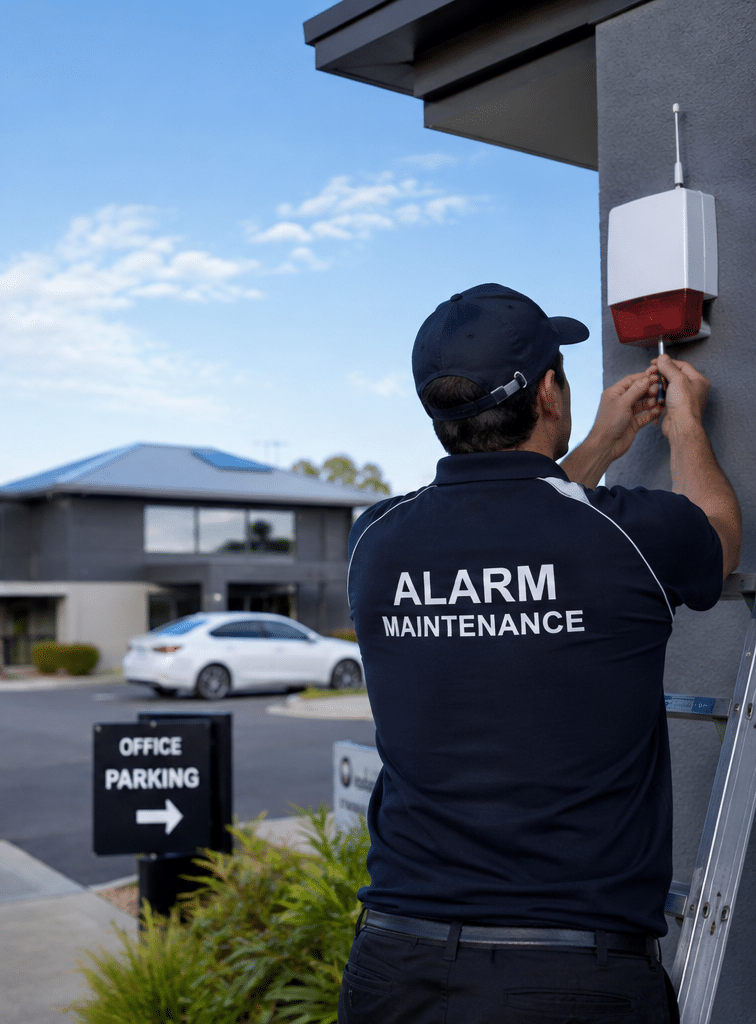
How Alarm Systems Work in Simple Terms
Before looking at alarm maintenance, it helps to understand the core parts of a typical system.
Most alarm systems include:
- A control panel, which is the system’s brain
- A keypad or touchscreen, used to arm and disarm the alarm
- Motion sensors, often called PIR detectors
- Door and window contacts, also called reed switches
- Internal and external sirens
- Backup batteries
- Remote controls, tags or mobile app access
- Communication modules, such as 4G, IP or dialler pathways
- Monitoring centre connections, where applicable
When the alarm is armed, the system watches selected zones. If a sensor detects activity, the control panel decides whether that activity should trigger an alarm event. Then, depending on the setup, the system may sound a siren, send an app alert, notify a monitoring centre, or trigger another response.
Therefore, alarm maintenance is not just “pressing the test button”. A proper service checks the full chain from detection to notification.
What Is Included in Professional Alarm Maintenance?
Professional alarm maintenance should be practical, documented and matched to the property risk. Although every site is different, a service visit often includes the following tasks.
1. Control Panel Inspection
The technician checks the alarm panel for faults, tamper alerts, power issues and error codes. They may also review the event history to identify repeated alarms, communication failures or zones that have been bypassed too often.
This matters because the panel can reveal problems that users miss. For instance, a zone that keeps triggering at night may point to a sensor alignment issue, not a real intrusion.
2. Battery Testing and Replacement Advice
Backup batteries are critical because they keep the system running during a power outage. Over time, batteries lose capacity. As a result, the alarm may fail during a blackout or display low battery faults.
During alarm maintenance, the technician should test battery health and recommend replacement when needed. For many Australian homes and businesses, backup battery checks are one of the most valuable parts of routine servicing.
3. Sensor Cleaning and Testing
Dust, insects, cobwebs, airflow, sunlight and changed room layouts can affect sensors. Therefore, a technician will test each detection device and check whether it is still suitable for the area.
For example, a PIR sensor in a warehouse may need adjustment if storage racks have moved. Similarly, a pet-friendly home may need sensor settings reviewed if the pet’s movement patterns have changed.
4. Siren and Strobe Testing
Sirens and strobes provide a visible and audible warning. However, they can degrade over time, especially in exposed outdoor locations. Alarm maintenance should confirm that sirens work, covers are secure, and tamper switches operate correctly.
Because sirens can disturb neighbours, testing should be controlled and brief. If the system is monitored, the monitoring centre should be notified before testing.
5. Communication Path Testing
A monitored alarm needs a reliable path to send signals. This may be 4G, IP, radio or another approved pathway. If communication fails, the alarm may still sound locally but not alert the monitoring centre.
Queensland Police advises that when testing an electronic security alarm system, the monitoring centre should be advised. That is a simple but important step because it helps prevent unnecessary responses during service activity.
6. User Code and Access Review
Many alarm systems keep old user codes for years. However, staff, cleaners, tenants and contractors change. Therefore, alarm maintenance should include a basic access review.
Remove codes for people who no longer need access. Update duress codes if used. Also, check whether users understand entry and exit delays. This helps reduce false alarms and improves accountability.
7. Documentation and Service Report
A good maintenance visit should end with a report. This may include tested devices, faults found, parts replaced, recommended upgrades and any user actions required.
This documentation is useful for businesses, property managers, insurance discussions and internal security reviews. However, it should be treated as administrative support, not legal advice.
How Often Should Alarm Maintenance Be Done?
For many Australian properties, alarm maintenance is commonly scheduled at least once a year. However, higher-risk or high-traffic sites may need more frequent servicing.
A small home may only need annual servicing if the system is simple and lightly used. In contrast, a retail shop, warehouse, childcare centre, medical practice or commercial office may benefit from six-monthly checks. Meanwhile, sites with monitored alarms, multiple users or repeated false alarms should review service frequency more carefully.
The best schedule depends on:
- Property type
- Insurance requirements
- Monitoring requirements
- Number of users
- System age
- Exposure to dust, heat, pests or humidity
- Previous false alarm history
- Business operating hours
- Whether the alarm is integrated with CCTV or access control
AS/NZS 2201.1:2007 is described as covering design, installation, commissioning and maintenance for intruder alarm systems at client premises. This supports the idea that maintenance is part of the system lifecycle, not an optional extra.
Planned vs Reactive Alarm Servicing
| Factor | Planned Alarm Maintenance | Reactive Alarm Repair |
| Purpose | Prevent faults before they become urgent | Fix a fault after it appears |
| Timing | Scheduled in advance | Usually booked after an issue |
| Cost control | Easier to budget | Can be harder to predict |
| Disruption | Usually lower | May interrupt business or routines |
| False alarm prevention | Stronger, because issues are found early | Weaker, because the issue may already be active |
| Best for | Homes, businesses, monitored sites, property managers | Sudden faults, damaged parts, urgent failures |
Planned alarm maintenance is usually the better long-term approach. It helps detect weak batteries, communication faults and sensor issues before they cause a real security gap.
However, reactive repair is still important. If your alarm shows a fault, makes random noises, fails to arm, or triggers without a clear reason, you should book a service rather than ignoring it.
Alarm Maintenance Checklist for Australian Properties
Use this numbered checklist as a practical guide before, during and after a service visit.
- Check the keypad for warning lights or fault messages.
Write down anything unusual before the technician arrives. - Review recent alarm events.
Note any false alarms, after-hours triggers, low battery warnings or zones that were bypassed. - Confirm who has alarm codes.
Remove codes for former staff, tenants, cleaners or contractors. - Test entry and exit routines.
Make sure users know how long they have to enter, exit and disarm the system. - Inspect visible sensors.
Look for dust, insects, damage, loose covers or blocked detection areas. - Check doors and windows.
Ensure alarmed entry points close properly and are not misaligned. - Tell the monitoring centre before testing.
This is especially important for monitored alarm maintenance. - Ask for battery testing.
Do not wait until the system fails during a power outage. - Request a communication test.
Confirm that alarm signals are reaching the correct destination. - Keep a service report.
Store it with your property, maintenance or compliance documents.
Common Alarm Faults and What They Mean
Alarm faults can look confusing, but many have simple causes.
Low Battery Warning
This usually means the backup battery, sensor battery or remote battery is weak. It should not be ignored because battery failure can stop part of the system from working.
Zone Fault
A zone fault may mean a door is open, a sensor is damaged, a cable is loose, or a wireless device is not communicating. Therefore, the specific zone should be tested.
Tamper Fault
A tamper fault means a cover may be open, a device may be loose, or the system has detected interference. Sometimes pests, vibration or renovations can trigger this.
Communication Failure
This may mean the system cannot reach the monitoring centre or app platform. Causes can include network outages, SIM issues, router changes or module faults.
Repeated False Alarms
Repeated alarms often point to environmental or user issues. For example, moving signs, insects, pets, heaters, air conditioning, loose doors and poor user training can all create problems.
Why Prevention Matters
False alarms waste time, create stress and can weaken trust in the alarm system. For businesses, they may also lead to callout costs, staff disruption and customer inconvenience.
In some Australian jurisdictions, false alarm charges may apply in certain circumstances. For example, NSW legislation states that if police respond more than once within 28 days to false alarms from the same security device installed in a non-dwelling building, a charge may be payable for each occasion except the first. This is a legal reference for awareness, not legal advice.
Fire Rescue Victoria also advises that owners and representatives must manage fire alarm systems and sites effectively to reduce preventable false alarms. Although fire alarms are different from intruder alarms, the lesson is similar: regular assessment, maintenance and site management reduce avoidable activations.
For intruder alarms, the NSW EPA notes that building intruder alarms should be installed according to the relevant Australian Standard and refers to AS2201.1:2007. It also advises checking that the installer has a security licence for the type of system involved. You can read the public guidance on managing noise from intruder alarms.
Home Alarm Maintenance
Home alarm maintenance is usually focused on reliability, ease of use and avoiding nuisance alarms.
A home service may include:
- Checking motion sensors in living areas, hallways and garages
- Testing door and window contacts
- Reviewing pet-friendly settings
- Testing remotes, tags and mobile app functions
- Replacing weak batteries
- Checking sirens
- Updating user codes
- Explaining arming modes, such as stay mode and away mode
From my experience, many home alarm problems come from changed routines. For example, a family may add a pet, renovate a room, change internet providers or stop using the alarm regularly. Each change can affect how the alarm performs.
Therefore, homeowners should not wait until the alarm becomes annoying. A short maintenance visit can make the system easier to use and more dependable.
Business Alarm Maintenance
Business alarm maintenance is usually more detailed because commercial sites have more users, more doors and more operational changes.
A business may need to check:
- Staff access codes
- Cleaner and contractor access
- Opening and closing procedures
- Alarm schedules
- Monitored response instructions
- Duress buttons
- Back-to-base signals
- Sensor coverage in stockrooms, offices and reception areas
- Alarm integration with CCTV or access control
- Service records for administration
For Australian businesses, alarm maintenance is also part of risk management. It helps owners and managers show that security systems are being checked and maintained in a reasonable way. However, compliance requirements can vary by industry, location, insurance policy and building type, so any formal requirement should be reviewed with the relevant licensed adviser, insurer or authority.
Monitored Alarm Maintenance
A monitored alarm sends signals to a monitoring centre. This can improve response management because the event is not only local to the site.
However, monitoring depends on accurate information. During alarm maintenance, the technician or account manager should help review:
- Site address
- Keyholder contacts
- After-hours instructions
- Opening and closing schedules
- Duress procedures
- Zone descriptions
- Communication test results
- Recent alarm history
If this information is outdated, the monitoring centre may call the wrong person or misunderstand the event. Therefore, contact details should be reviewed whenever staff or tenants change.
Wireless Alarm Maintenance
Wireless alarms are common in homes, rentals, small businesses and retrofit installations. They are flexible because they require less cabling. However, they still need regular servicing.
Wireless alarm maintenance should include:
- Testing signal strength
- Replacing sensor batteries
- Checking device tamper switches
- Confirming receiver communication
- Inspecting sensor mounting
- Looking for interference risks
- Testing remotes and panic buttons
Wireless sensors can be affected by distance, building materials, battery condition and interference. Because of this, a system that worked well two years ago may need review after renovations or layout changes.
Compliance and Admin Considerations
Alarm maintenance can support compliance, insurance and operational documentation, but it should not be treated as legal advice.
Administrative tasks may include:
- Keeping service reports
- Recording battery replacements
- Maintaining a log of false alarms
- Updating keyholder lists
- Reviewing user access
- Keeping monitoring instructions current
- Recording technician recommendations
- Confirming licence details where relevant
For example, the Queensland Police Service describes electronic security alarm systems as a business safety tool that can alert people in the area, a monitoring company and relevant authorities about possible suspicious activity. You can review their general public guidance on electronic security alarm systems.
Choosing an Alarm Maintenance Provider
The right provider should be practical, licensed where required, and familiar with Australian alarm conditions. Also, they should be able to explain faults clearly without pushing unnecessary upgrades.
When comparing providers, ask:
- Do you service my alarm brand?
- Are your technicians experienced with residential and commercial systems?
- Can you test monitoring signals?
- Will I receive a written service report?
- Do you check batteries, sirens, sensors and communication paths?
- Can you update user codes and keyholder details?
- Do you provide advice on false alarm prevention?
- Can you maintain related systems such as CCTV, access control or intercoms?
A provider that understands the full security environment can often give better advice. For example, a repeated alarm at a rear door may be easier to investigate if CCTV footage and access logs are also reviewed.
For tailored support with alarms, CCTV, access control and intercoms, explore professional security system maintenance for Australian properties.
Practical Signs Your Alarm Needs Maintenance Now
You should book alarm maintenance if you notice any of these signs:
- The keypad shows a fault
- The alarm beeps for no clear reason
- You have had a recent false alarm
- The system will not arm
- A sensor has been hit, moved or painted over
- You changed internet providers
- You changed business hours
- Staff or tenants have changed
- You cannot remember who has alarm codes
- The system has not been serviced in more than 12 months
- The siren sounds weak
- You see low battery warnings
- A monitored alarm has communication faults
In many cases, a small issue can be fixed quickly. However, if ignored, it can become a bigger security risk.
People Also Ask About Alarm Maintenance
How often should alarm maintenance be done in Australia?
Most homes and small businesses should consider alarm maintenance at least once a year. However, busy commercial sites, monitored alarms and older systems may need six-monthly servicing, especially if false alarms or fault messages have occurred.
What does an alarm technician check during maintenance?
A technician usually checks the control panel, sensors, batteries, sirens, keypad, communication pathway, user codes and event history. They should also test signals carefully and provide a service report.
Can I maintain my alarm system myself?
You can do basic checks, such as looking for fault messages, keeping sensors clear and updating user lists. However, professional alarm maintenance is recommended for battery testing, communication testing, sensor diagnostics and technical faults.
Why does my alarm keep going off for no reason?
Common causes include insects, pets, low batteries, loose doors, dust, sensor placement, airflow, user error or communication faults. A technician can review the event log and test the affected zone to identify the likely cause.
Should I tell my monitoring centre before testing my alarm?
Yes. If your system is monitored, advise the monitoring centre before testing. This helps prevent unnecessary escalation and ensures test signals are handled correctly.
Expert Q&A: Alarm Maintenance for Australian Properties
1. What is the difference between alarm maintenance and alarm repair?
Alarm maintenance is planned work that checks system health before a serious issue appears. Alarm repair is reactive work that fixes a known fault, such as a failed sensor, damaged keypad or communication failure.
2. Do alarm batteries need replacing even if the system still works?
Yes, batteries can weaken before the system fully fails. A battery may still power the system briefly but fail during a longer outage. Therefore, battery testing is a key part of alarm maintenance.
3. Can renovations affect alarm performance?
Yes. Renovations can move doors, block sensors, damage cables, create dust or change room layouts. After renovations, an alarm maintenance visit can confirm that sensors still cover the right areas.
4. Is alarm maintenance useful for insurance?
It can be useful for documentation, especially if your insurer asks about security systems. However, insurance requirements vary, so you should check your policy and keep service records as administrative evidence.
5. What should a business include in an alarm maintenance record?
A business should keep the service date, technician details, tested devices, faults found, batteries replaced, communication test results and recommendations. It should also record updates to keyholders, user codes and monitoring instructions.
Conclusion
Alarm maintenance helps keep your security system reliable, practical and ready when it matters. It reduces the risk of false alarms, weak batteries, communication failures and user access problems. More importantly, it turns your alarm from a forgotten device on the wall into an active part of your property’s protection plan.
For Australian homes and businesses, the best approach is simple: schedule regular servicing, keep user details current, document each visit and act quickly when faults appear. That way, your alarm system can continue doing the job it was installed to do.