


A vape alarm system is becoming a practical option for Australian schools, commercial buildings, hospitality venues, public bathrooms and workplaces that need a safer way to detect vaping in areas where cameras are unsuitable. From my experience reviewing security and detection projects, the best outcomes come when the technology is treated as part of a clear response process, not as a stand-alone “quick fix”.
Vaping is now a real facilities management issue. It affects toilets, change rooms, classrooms, corridors, stairwells, staff areas and other shared spaces. Therefore, decision-makers need to understand how vape detection works, what it can and cannot prove, and how to introduce it fairly.
This guide explains how a vape alarm system works in Australia, where it fits, what to check before installation, and how to create a response plan that supports safety, privacy and good governance.
Table of Contents
- What is a vape alarm system?
- Why vape alarm systems are being considered in Australia
- How a vape alarm system works
- Where vape alarm systems are commonly installed
- Vape alarm system vs smoke detector vs CCTV
- Key features to look for in a vape alarm system
- Australia compliance and administration considerations
- Step-by-step checklist for rollout
- Common mistakes to avoid
- People Also Ask
- Expert Q&A
- Conclusion
What Is a Vape Alarm System?
A vape alarm system is a sensor-based detection setup that identifies airborne particles, chemicals or environmental changes linked to vaping. It sends real-time alerts to nominated staff, helping schools, workplaces and venues respond quickly in private spaces such as toilets where cameras are not appropriate.
Why Vape Alarm Systems Are Being Considered in Australia
Vaping has changed the way many Australian organisations think about indoor safety. Unlike traditional smoking, vaping can be discreet. Devices are small, vapour can clear quickly, and incidents often happen in private or semi-private areas.
As a result, schools and facility managers may struggle to confirm where and when vaping occurs. Staff may notice odours, complaints, damaged sensors, blocked toilets or groups gathering in bathrooms. However, without a detection process, responses can become inconsistent.
According to the Australian Government Department of Health and Aged Care, Australian vaping laws changed in 2024 so that vapes and vaping products can only be sold through pharmacies for the purpose of quitting smoking or managing nicotine dependence. This matters because schools, workplaces and public venues are now dealing with a behaviour that is not just a nuisance. It also sits within a broader public health and regulatory environment.
The Australian Institute of Health and Welfare reports that e-cigarette use in Australia increased substantially in recent years, with younger age groups a key concern. Therefore, a vape alarm system is often considered by principals, business owners, property managers and safety teams who want to reduce repeat incidents and create a clearer response trail.
However, technology should not replace education, supervision or fair policy. Instead, it should support them. From my experience, the most effective vape alarm system projects combine four things:
- Clear detection goals.
- Suitable sensor placement.
- A documented response plan.
- Respectful communication with staff, students or occupants.
In other words, a vape alarm system works best when everyone knows what happens after an alert.
How a Vape Alarm System Works
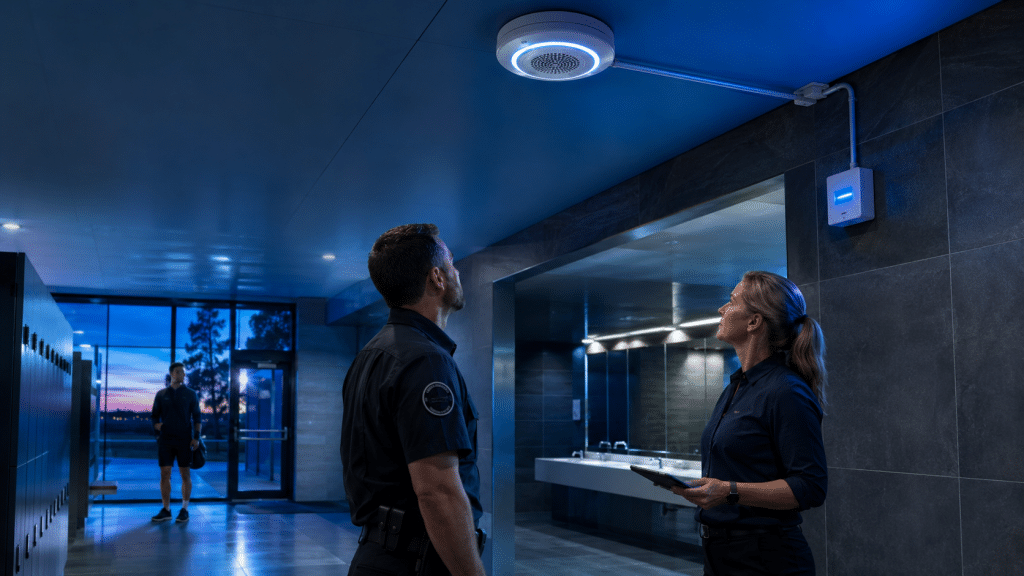
A vape alarm system usually uses sensors installed in areas where vaping is suspected. These sensors monitor the air and detect changes that may indicate vaping activity.
Depending on the product, a sensor may monitor:
- Fine airborne particles.
- Volatile organic compounds.
- Changes in air quality.
- Humidity shifts.
- Temperature changes.
- Noise events, such as tampering or aggression.
- Device interference or masking attempts.
When the sensor detects a reading above a configured threshold, it sends an alert. This alert may go to a dashboard, mobile app, email, SMS, security platform or building management system.
For example, a school may receive an alert that “Sensor 04 – Senior Boys Bathroom” detected a vape event at 11:17 am. Staff can then follow the school’s agreed response procedure.
A vape alarm system does not usually identify the individual who vaped. Also, it should not be presented as absolute proof by itself. Instead, it provides a time, location and environmental signal that staff can investigate.
This distinction is important. A vape alarm system helps detect likely incidents. It does not replace human judgment.
Why Vape Sensors Are Different from Normal Smoke Alarms
Traditional smoke alarms are designed for fire safety. They detect smoke patterns associated with combustion. Vape aerosol is different. It may disperse faster and may not trigger a standard smoke detector reliably.
A vape alarm system is designed for the vaping problem specifically. Therefore, it is usually more suitable for toilets, change rooms and enclosed indoor areas where vaping is likely but fire smoke may not be present.
However, it should not replace fire detection. Fire alarms and vape alarm systems have different jobs.
What Happens After an Alert?
The alert workflow matters as much as the sensor itself. A typical response may include:
- A sensor detects a possible vape event.
- A notification is sent to authorised staff.
- Staff attend the area using a respectful and safe process.
- The incident is recorded.
- Repeat patterns are reviewed.
- Policy, education or supervision is adjusted if needed.
This process is especially important in schools. Staff should avoid jumping to conclusions. Instead, they should use alerts as part of a broader student wellbeing and behaviour management framework.
Where Vape Alarm Systems Are Commonly Installed
A vape alarm system is most useful in spaces where vaping is hard to supervise directly. In Australia, common locations include:
School Toilets and Change Rooms
Schools are one of the most common environments for vape detection. Toilets and change rooms are difficult to monitor because privacy must be respected. Therefore, camera-based surveillance is not appropriate in these areas.
A vape alarm system can help staff identify when and where incidents occur. It can also support better supervision during known problem times, such as recess, lunch, class changes and after-school periods.
Commercial Buildings
Office buildings may use vape detection in bathrooms, end-of-trip facilities, stairwells or shared amenities. This can help facility managers address complaints from tenants and maintain indoor air quality expectations.
Hospitality and Entertainment Venues
Pubs, clubs, event spaces and entertainment venues may face vaping in bathrooms or restricted areas. In these settings, alerts can help security teams respond more quickly and reduce conflict.
Public Facilities
Councils, libraries, aquatic centres, transport facilities and community buildings may consider vape detection where repeated indoor vaping has become a maintenance or safety concern.
Workplaces and Industrial Sites
Some workplaces have strict safety rules because of chemicals, equipment, clean rooms or sensitive environments. In these cases, vaping may create risk beyond odour or nuisance.
Vape Alarm System vs Smoke Detector vs CCTV
A vape alarm system should be selected for the right reason. The table below compares common options.
| Option | Best Used For | Strengths | Limitations |
| Vape alarm system | Detecting likely vaping in toilets, change rooms and private indoor spaces | Real-time alerts, privacy-friendly compared with cameras, useful for trend data | Does not identify a person by itself and needs a response plan |
| Smoke detector | Fire and life safety detection | Essential for fire safety and building compliance | Not designed specifically for vape aerosol |
| CCTV | Monitoring public or permitted areas | Strong visual record where lawful and appropriate | Not suitable for bathrooms, toilets or private change areas |
| Staff patrols | Supervision and visible deterrence | Human judgment and relationship-based response | Time-consuming and may miss short incidents |
| Education program | Prevention and behaviour change | Supports long-term culture and health awareness | Does not provide real-time detection |
The key point is simple: these tools are not interchangeable. A vape alarm system fills a specific gap where privacy-sensitive detection is needed.
Key Features to Look for in a Vape Alarm System
Not every vape alarm system is the same. Before choosing one, compare both the sensor hardware and the management process around it.
1. Real-Time Alerts
Fast alerts are important. If the system only provides reports after the fact, staff may miss the opportunity to respond. Look for alerts through practical channels such as email, SMS, app notifications or integration with a security system.
2. Reliable Sensor Technology
A good vape alarm system should detect likely vape events while reducing false alerts. False alerts can occur due to aerosols, cleaning products, deodorants, humidity changes or poor placement. Therefore, calibration and site testing matter.
3. Location-Based Reporting
Clear location labels help staff respond quickly. For instance, “Ground Floor Female Amenities” is more useful than “Sensor 7”.
4. Tamper Detection
Some users may try to cover, damage or disable sensors. Tamper alerts can help staff respond before the system becomes unreliable.
5. Privacy-Aware Design
A vape alarm system should not record video in private areas. In sensitive locations, make sure staff understand what is detected, what is not detected, and how data is stored.
6. Easy Administration
The system should be manageable by real staff with limited time. Dashboards, reporting, alert routing and permissions should be simple.
7. Integration Options
For larger sites, integration with access control, alarms, security monitoring or building systems may be useful. However, integration should be purposeful. More complexity is not always better.
8. Good Support and Maintenance
Sensors need testing, firmware updates and occasional recalibration. Therefore, choose a supplier that can support installation, handover and ongoing maintenance.
For Australian organisations that want guidance on detection options, installation planning and practical security integration, explore Eclipse Security’s security system solutions for Australian sites.
Australia Compliance and Administration Considerations
This section is general information, not legal advice. Schools, employers and facility managers should review their own policies and seek appropriate professional advice where needed.
In Australia, vaping policy is shaped by federal, state and territory rules, workplace obligations, school policies, privacy expectations and health guidance. The Therapeutic Goods Administration explains that reforms from 2024 and 2025 changed how vaping products can be imported, manufactured, supplied and advertised.
For a vape alarm system project, compliance is usually an administrative and governance task. It may involve:
- Updating a school or workplace policy.
- Explaining where sensors are installed.
- Limiting who receives alerts.
- Setting data retention rules.
- Training staff on fair response procedures.
- Recording incidents consistently.
- Reviewing signs and communication.
- Considering state or territory requirements.
- Checking child safety or workplace safety processes.
The goal is not to create fear. Instead, the goal is to create a transparent process.
Privacy Considerations
Privacy is one reason organisations consider vape sensors instead of cameras. However, privacy still matters. A vape alarm system may collect event data, such as time, location and sensor readings.
Therefore, staff should know:
- What data is collected.
- Who can access it.
- How long it is kept.
- How alerts are used.
- How disputes are handled.
In schools, communication with parents and students can also reduce misunderstanding. For workplaces, staff consultation may be appropriate before rollout.
Signage and Communication
Signage can act as a deterrent. However, it should be clear and calm. For example:
“This area is fitted with environmental sensors that may detect vaping, tampering and air quality changes. No cameras or audio recording are used in this private space.”
Use plain language. Also, avoid overstating what the system can prove.
Step-by-Step Checklist for Vape Alarm System Rollout
Use this numbered checklist before installing a vape alarm system.
- Define the problem.
Identify where incidents happen, how often they occur and who is affected. - Map high-risk locations.
Review toilets, change rooms, stairwells, staff areas and shared amenities. - Check privacy-sensitive areas.
Confirm that camera surveillance is not appropriate and that sensors are a better fit. - Review policies.
Update school, workplace or facility rules so the response process is clear. - Choose suitable sensor locations.
Avoid poor airflow positions, direct vents, wet zones or areas where cleaning sprays may trigger false alerts. - Set alert recipients.
Decide who receives notifications and who is responsible for attending. - Create an incident response script.
Staff should know what to say, what to record and when to escalate. - Test before full rollout.
Run a pilot in one or two areas and adjust thresholds if needed. - Communicate the change.
Tell staff, students, tenants or occupants what the system does and why it is being used. - Review monthly.
Look for trends, repeat locations and false alerts. Then improve supervision, education or maintenance.
Practical Example: School Vape Alarm System Rollout
Imagine an Australian secondary school has repeated vaping complaints in two toilet blocks. Staff find discarded vape devices, students report feeling unsafe, and cleaners notice odours.
A practical rollout may look like this:
First, the school records incident times for four weeks. Next, it installs sensors in the two highest-risk toilet blocks. Then, alerts are sent to nominated wellbeing and leadership staff rather than every teacher. The school updates its behaviour policy and tells parents that sensors detect environmental changes, not video.
After installation, the school reviews alert patterns. If alerts peak at lunch, supervision changes. If one sensor creates false alerts after cleaning, the threshold or placement is adjusted.
This approach is balanced because it combines technology, communication and behaviour support.
Practical Example: Commercial Building Vape Alarm System Rollout
Now consider a commercial office building where tenants complain about vaping in end-of-trip facilities. The property manager wants a response that avoids conflict but protects shared amenity standards.
A measured approach may include installing sensors in bathrooms and bike facility change areas, adding polite signage, and routing alerts to the building concierge or security team. The building rules are updated, and incident reports are reviewed monthly.
Over time, the property manager can see whether vaping is isolated or recurring. As a result, responses become evidence-informed rather than complaint-driven.
Benefits of a Vape Alarm System
A vape alarm system can support safer, cleaner and more manageable indoor spaces. However, benefits depend on planning and follow-through.
Faster Response
Real-time alerts allow staff to respond while the incident is still current. This can reduce repeat behaviour and help staff understand patterns.
Better Visibility in Private Areas
Bathrooms and change rooms cannot be monitored by cameras. Therefore, vape sensors offer a privacy-aware option for detecting likely incidents.
Stronger Incident Records
A dashboard or alert log can show dates, times and locations. This helps schools and facility managers identify trends and review interventions.
Deterrence
When people know sensors are installed, some may avoid vaping in that area. However, deterrence should not be promised as guaranteed.
Cleaner Facilities
Repeated vaping can create odour complaints and maintenance concerns. Detection may help reduce misuse of shared spaces.
Support for Education and Policy
In schools, alerts can support broader wellbeing and health messaging. In workplaces, they can support smoke-free and vape-free policies.
Limitations of Vape Alarm Systems
Balanced content matters. A vape alarm system is useful, but it is not magic.
It May Not Identify the Person
Most systems detect an event, not a person. Staff may still need to investigate.
False Alerts Can Occur
Cleaning sprays, aerosols, humidity and poor placement may cause alerts. Therefore, testing and calibration are important.
It Requires Staff Capacity
An alert is only useful if someone can respond. If no one owns the process, the system may become ignored.
It Should Not Replace Education
Vaping is also a health, wellbeing and behaviour issue. Technology can support prevention, but it should not be the only response.
It Needs Maintenance
Sensors should be checked, cleaned and updated. Otherwise, reliability can decline.
How to Choose the Right Vape Alarm System in Australia
Before buying a vape alarm system, ask practical questions.
What Problem Are We Solving?
Do you need detection, deterrence, reporting, policy enforcement or all of these? Clear goals help avoid overbuying.
Which Areas Need Coverage?
Start with known problem locations. You do not always need sensors everywhere.
Who Will Receive Alerts?
Choose staff who can respond calmly and consistently. Too many recipients can create confusion.
How Will Incidents Be Recorded?
A simple incident log may be enough. Larger sites may need dashboard exports or integration with security reporting.
What Is the Maintenance Plan?
Ask how sensors are tested, cleaned, updated and supported.
How Will We Communicate the Rollout?
Good communication reduces resistance. Explain the purpose, the limits and the privacy safeguards.
Installation Considerations
Sensor placement affects performance. A vape alarm system should be installed where air from likely vaping activity can reach the sensor without being blocked.
Avoid placing sensors:
- Too close to strong vents.
- Directly above wet areas.
- Where cleaning chemicals are sprayed frequently.
- Behind obstructions.
- Where tampering is easy.
- In areas with poor Wi-Fi or network coverage, if the device depends on it.
In many projects, a site walk-through is valuable. The installer can assess airflow, power, network access, ceiling height and maintenance access.
Vape Alarm System Costs: What Affects Price?
Costs vary, so any estimate should be treated as general. Pricing may depend on:
- Number of sensors.
- Sensor quality and detection range.
- Alert platform fees.
- Installation complexity.
- Cabling or network requirements.
- Integration with other systems.
- Ongoing support and maintenance.
- Reporting needs.
- Site location and access hours.
The cheapest vape alarm system is not always the best choice. A poor system that creates false alerts or fails to notify staff can waste time and reduce trust.
Instead, compare total value. Consider reliability, support, ease of use and fit for your site.
Onsite Monitoring vs Remote Alerting
Some organisations manage alerts internally. Others want alerts integrated with broader security processes.
| Approach | How It Works | Best For | Watch-Outs |
| Onsite staff alerts | Notifications go to school leaders, managers or security staff | Schools, small venues and workplaces with staff present | Staff must be trained and available |
| Security team integration | Alerts go to a security desk or control room | Larger buildings, venues and campuses | Needs clear escalation rules |
| Remote reporting dashboard | Managers review trends and incident history | Multi-site organisations | Not a substitute for immediate response |
| Hybrid model | Alerts go onsite, reports are reviewed centrally | Schools groups, councils and property portfolios | Requires consistent naming and reporting |
A hybrid model often works well. It allows quick local response while giving management better trend visibility.
Building a Fair Response Policy
A vape alarm system should be supported by a fair policy. This protects both the organisation and the people using the space.
A good policy should explain:
- Why sensors are installed.
- Where they are located.
- What they detect.
- What they do not detect.
- Who receives alerts.
- How incidents are investigated.
- What support or consequences may apply.
- How records are kept.
- Who reviews the system.
In schools, the response may include wellbeing support, parent communication and education. In workplaces, the response may sit within smoke-free policy, work health and safety processes, or site rules.
The tone should be firm but fair.
Common Mistakes to Avoid
Mistake 1: Installing Sensors Without a Plan
Buying sensors without a response plan often leads to confusion. Decide first who acts on alerts and how incidents are recorded.
Mistake 2: Overclaiming What the System Proves
A vape alarm system detects likely environmental signals. It should not be described as perfect evidence of individual behaviour.
Mistake 3: Ignoring Privacy Communication
People may assume sensors record video or audio. Explain clearly if they do not.
Mistake 4: Poor Sensor Placement
Bad placement can increase false alerts or missed events. A site assessment reduces this risk.
Mistake 5: No Maintenance Schedule
Sensors need attention. Plan maintenance from the beginning.
Mistake 6: Treating Vaping Only as a Discipline Issue
Especially in schools, vaping may involve peer pressure, nicotine dependence and wellbeing concerns. A balanced response is more effective.
People Also Ask
What is a vape alarm system used for in Australia?
A vape alarm system is used to detect likely vaping events in indoor areas such as toilets, change rooms, stairwells and shared amenities. In Australia, it is commonly considered by schools, workplaces, venues and public facilities that need a privacy-aware way to respond to vaping.
Can a vape alarm system be installed in school toilets?
Yes, vape sensors are often installed in school toilets because cameras are not appropriate in private areas. The school should still communicate clearly, use signage where suitable and follow a fair response process.
Does a vape alarm system record video or audio?
Most vape alarm systems are designed to detect environmental changes, not record video. Some advanced devices may include noise or tamper detection, so administrators should confirm exactly what the chosen product collects before installation.
Are vape alarm systems accurate?
A good vape alarm system can be effective when properly placed, calibrated and maintained. However, false alerts can occur from aerosols, cleaning products or humidity, so alerts should be investigated rather than treated as automatic proof.
Is a vape alarm system legal in Australia?
Vape sensors can be used in Australia, but organisations should consider privacy, workplace, school and state or territory requirements. This is an administrative governance task, not legal advice, and organisations should seek professional advice if unsure.
Expert Q&A
1. How many sensors does a site need?
The number depends on room size, airflow, ceiling layout and risk areas. A small toilet block may need one sensor, while a larger amenity area may need several. A site inspection is the best way to avoid gaps.
2. Can a vape alarm system detect THC or nicotine specifically?
Some systems focus on vape aerosol indicators rather than identifying the exact substance. If substance-specific detection is important, ask the supplier for technical documentation and be careful not to overstate the system’s capability.
3. Will students or occupants try to tamper with vape sensors?
Tampering can happen. Therefore, choose devices with tamper alerts, install them in sensible locations and include tampering in the site’s behaviour or facility policy.
4. Should vape alarm alerts go to security or management?
It depends on the site. Schools may send alerts to leadership or wellbeing staff, while venues may send alerts to security. The best recipient is the person who can respond quickly, calmly and consistently.
5. How often should a vape alarm system be reviewed?
Review alert data at least monthly during the first stage. After that, review trends regularly and after any major incident, false alert pattern or site layout change.
Conclusion
A vape alarm system can help Australian schools, workplaces, venues and public facilities respond to vaping in private indoor areas where cameras are not suitable. However, the technology works best when it is part of a broader plan.
Start with the problem. Then choose suitable sensor locations, create a fair response process, communicate clearly and review the data over time. This balanced approach helps reduce guesswork and supports safer shared spaces.
For practical support with detection, alarms and security planning, speak with Eclipse Security about building a safer, more responsive system for your Australian site.