


Anti vaping sensors are becoming a practical security and wellbeing tool for Australian schools, toilets, changerooms, offices, shopping centres and public facilities. From my experience in security planning, the best results come when these devices are treated as part of a wider prevention strategy, not as a standalone “catch-all” gadget. They help staff identify likely vaping activity in areas where cameras are not suitable, while still respecting privacy.
Vaping is a sensitive issue in Australia. It involves student wellbeing, workplace safety, building management, supervision, privacy expectations and policy enforcement. Therefore, buyers need clear information before installing sensors. The goal is not to over-police people. Instead, the aim is to detect risk early, respond fairly, and create safer shared spaces.
This guide explains how anti vaping sensors work, where they are useful, what Australian organisations should consider, and how to choose a system that suits real sites.
What Are Anti Vaping Sensors?
Anti vaping sensors are electronic detection devices that monitor air quality for particles, chemicals or patterns linked to vape aerosol. They are often installed in toilets, changerooms and other camera-free areas. When vaping is suspected, they send alerts so authorised staff can respond quickly and follow site procedures.
Table of Contents
- Why anti vaping sensors matter in Australia
- How anti vaping sensors work
- Where anti vaping sensors are commonly installed
- Anti vaping sensors versus smoke alarms and CCTV
- Australian compliance and admin considerations
- Comparison table: sensor options and deployment models
- What to check before buying anti vaping sensors
- Numbered checklist for a smooth installation
- Common mistakes to avoid
- People Also Ask
- Expert Q&A
- Conclusion
Why Anti Vaping Sensors Matter in Australia
Vaping has become a real operational issue for many Australian schools and organisations. According to the Therapeutic Goods Administration vaping reforms, Australia introduced major changes from 2024 to regulate the importation, supply, manufacture and advertising of vaping goods. These reforms show that vaping is not just a school discipline issue. It is also a public health and governance issue.
In addition, the Australian Institute of Health and Welfare reports that e-cigarette use increased substantially in Australia in recent years. This is especially relevant for schools, universities, youth facilities, hospitality venues and workplaces where staff may be responsible for maintaining a safe environment.
However, the challenge is practical. Vaping often happens in places where camera surveillance is not appropriate. Toilets are the most common example. Changerooms, shower areas and quiet corridors can also become problem zones. Because staff cannot monitor these spaces directly, incidents can go unnoticed until they become frequent.
Anti vaping sensors help close that gap. They detect air changes associated with vaping and notify the right people. As a result, staff can respond closer to the time of the incident. This makes conversations more specific, reduces guesswork and supports a more consistent response.
Still, sensors should not be seen as a punishment-first solution. From my experience, the best outcomes happen when schools and organisations combine detection with education, clear policy, support pathways and fair incident handling.
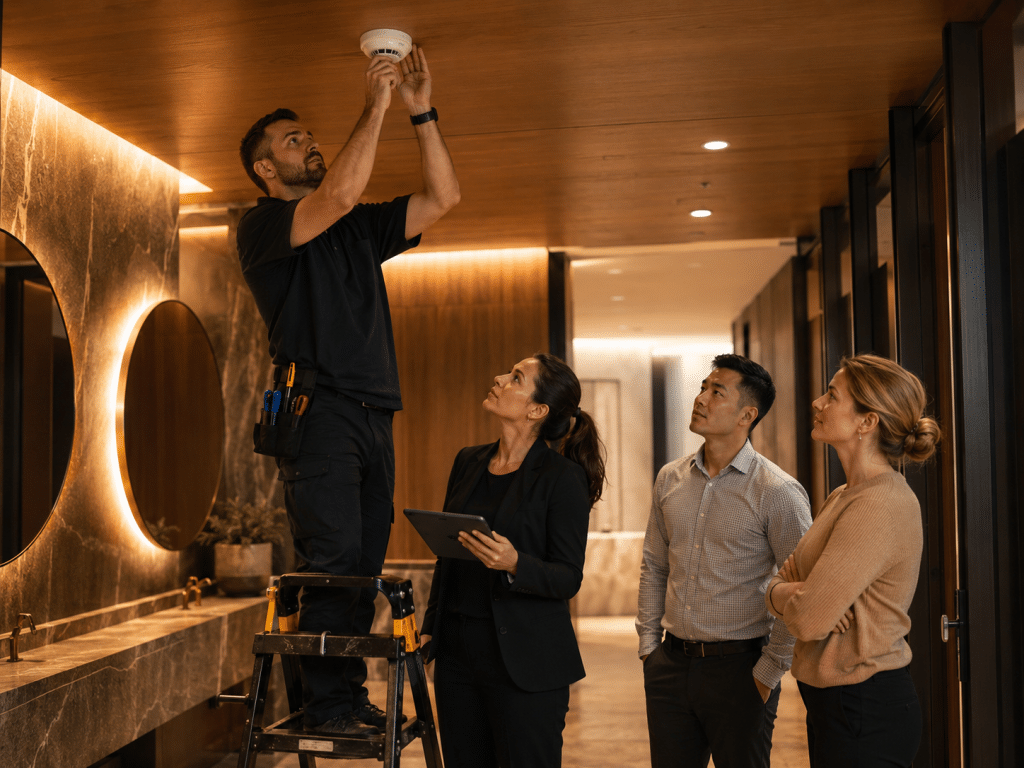
How Anti Vaping Sensors Work
Anti vaping sensors usually monitor the air for fine particles, volatile compounds or air quality changes linked to vape aerosol. Vapes can create a visible or invisible mist made up of tiny particles. Depending on the device, sensors may detect particulate matter, chemical signatures, humidity shifts, temperature changes or unusual air patterns.
Most modern sensors connect to a cloud dashboard, local network or alerting system. When the device identifies a likely vaping event, it can send an alert by email, app notification, SMS, dashboard event or integration with another security platform.
Some models also include extra environmental monitoring. For example, they may detect noise anomalies, tampering, poor air quality or occupancy-related changes. This can be useful in toilets or shared facilities where vandalism, bullying or overcrowding may also be concerns.
The important point is that anti vaping sensors do not “see” people. They are not cameras. They do not need to record private areas. Instead, they detect air conditions. This is why they are often considered for spaces where CCTV would be inappropriate or unacceptable.
However, no sensor is perfect. Aerosol sprays, cleaning chemicals, heavy steam, dust or poor ventilation can affect readings. Therefore, calibration, correct placement and good response procedures matter. A sensor should trigger a review, not an automatic accusation.
What Do Anti Vaping Sensors Detect?
Different products use different sensor combinations. In general, anti vaping sensors may detect:
- Fine particles associated with vape aerosol
- Volatile organic compounds, often called VOCs
- Changes in air quality
- Humidity and temperature changes
- Tamper events, such as someone covering the device
- Sound level changes, depending on the model
- Environmental trends over time
Because each site is different, it is worth discussing the detection environment before installation. A toilet near a cleaning storeroom may need different settings from a school changeroom. Likewise, a busy public facility may need different alert thresholds from a small office bathroom.
This is why a professional site assessment is useful. It helps match device type, placement and alert settings to the building.
Where Anti Vaping Sensors Are Commonly Installed
Anti vaping sensors are most useful in areas where vaping is likely and camera monitoring is not suitable. In Australia, common locations include school toilets, university amenities, TAFE campuses, workplace bathrooms, shopping centre toilets, leisure centres, libraries, transport facilities and staff-only amenities.
School Toilets and Student Amenities
Schools are one of the strongest use cases. The Victorian Department of Education smoking and vaping ban policy states that smoking and vaping are prohibited on school premises and within 4 metres of pedestrian access points to school premises in Victoria. Other states and territories also have their own school policies and tobacco control rules.
For school leaders, the practical problem is supervision. Toilets are private spaces, yet they can become high-risk areas for vaping, peer pressure or property damage. Anti vaping sensors help staff identify when and where a suspected event has occurred. Then, staff can respond through the school’s behaviour, wellbeing and parent communication procedures.
From my experience, schools should avoid presenting sensors as a “gotcha” tool. Instead, they should explain that the system supports a healthier learning environment, protects students from exposure, and helps staff respond consistently.
Public Toilets and Community Facilities
Councils, shopping centres and community venues may also consider anti vaping sensors. Public toilets can be difficult to supervise. In addition, vaping can create complaints from other users, especially families, older people and people with respiratory concerns.
In these environments, alerts may go to security staff, cleaners, facility managers or a monitoring centre. The response might be a welfare check, a patrol, cleaning follow-up or incident report.
Workplaces and Commercial Buildings
Workplaces may use anti vaping sensors in staff toilets, warehouses, loading areas or restricted spaces. However, workplace use needs careful communication. Staff should know what is being monitored, why it is being monitored, who receives alerts and how incidents are handled.
This is an administrative and HR governance issue, not legal advice. Policies should be reviewed by appropriate managers, HR advisers or legal professionals where needed.
Hospitality and Accommodation Venues
Hotels, clubs, venues and accommodation providers may use sensors to reduce vaping in rooms, toilets or restricted areas. In these settings, sensors can support cleaning standards, guest comfort and fire safety procedures. However, policies should clearly explain any consequences, such as cleaning fees or room checks.
Anti Vaping Sensors Versus Smoke Alarms and CCTV
Anti vaping sensors are not the same as smoke alarms. They are also not a replacement for CCTV, access control or staff supervision. Each tool has a different role.
Smoke alarms are primarily designed for fire detection and life safety. They may not reliably detect vaping, especially if the aerosol is light, brief or dispersed. CCTV can help monitor corridors and entrances, but it should not be used inside toilets or private changerooms. Anti vaping sensors fill a different gap by monitoring air quality in private areas without video recording.
This distinction matters for Australian buyers. A school or facility manager should not assume an existing smoke alarm system will solve vaping incidents. Likewise, adding more cameras outside toilet entrances may not identify what happened inside. Anti vaping sensors provide a more targeted option.
Comparison Table: Detection and Response Options
| Option | Best Use | Strengths | Limitations | Privacy Fit |
| Anti vaping sensors | Toilets, changerooms, camera-free areas | Detect likely vaping events and send alerts | May need calibration; possible false triggers | Strong fit because there is no video |
| Smoke alarms | Fire and smoke safety | Essential life safety system | Not designed mainly for vape detection | Good, but not targeted |
| CCTV outside amenities | Corridors, entrances, public areas | Helps confirm movement patterns | Cannot monitor private spaces | Must be carefully positioned |
| Staff patrols | Schools, venues, workplaces | Human judgement and immediate response | Time-consuming and inconsistent | Depends on procedure |
| Education programs | Schools and youth settings | Addresses behaviour and prevention | Does not provide real-time alerts | Strong fit |
| Policy-only approach | Smaller sites | Low cost and easy to start | Hard to enforce without evidence | Strong, but limited |
The best approach usually combines several controls. For example, a school may use anti vaping sensors inside toilets, CCTV in nearby corridors, clear student policy, parent communication and wellbeing support. Together, these measures create a more balanced system.
Australian Compliance and Admin Considerations
Anti vaping sensors involve several administrative considerations. These are not a substitute for legal advice, but they help guide planning.
First, organisations should document why the sensors are being installed. Common reasons include student safety, workplace health, asset protection, incident response and policy enforcement.
Second, signage and communication should be clear. People should understand that air quality sensors are installed in certain amenities. The wording should avoid scare tactics. It should explain that the system supports a safe and healthy environment.
Third, access to alerts should be limited. Not every staff member needs to receive notifications. Usually, alerts should go to authorised people such as school leadership, security, facilities management or designated wellbeing staff.
Fourth, incident records should be handled carefully. A sensor alert is an indicator, not proof by itself. Therefore, the response should consider context, staff observations, student welfare and any relevant policy.
Finally, state and territory rules may differ. For example, schools may follow department policies, Catholic or independent school governance, workplace policies, or building management procedures. Therefore, organisations should review relevant internal policies before rollout.
Benefits of Anti Vaping Sensors
Anti vaping sensors can offer several practical benefits when installed and managed well.
They create faster awareness. Instead of discovering vaping through complaints or damage, staff can receive near real-time alerts.
They support privacy. Because sensors monitor air rather than video, they suit toilets and changerooms better than cameras.
They improve consistency. Alerts can be logged, reviewed and used to identify patterns. For example, a school may notice repeated incidents at the same time each day.
They reduce reliance on rumours. Staff can respond to a specific alert rather than acting on hearsay.
They can support prevention. When students, staff or visitors know that vaping is likely to be detected, some may be less likely to vape in shared facilities.
However, the benefits depend on planning. A poorly placed device, unclear policy or heavy-handed response can reduce trust. Therefore, anti vaping sensors should be part of a measured and transparent plan.
Limitations to Understand Before Installation
It is important to be realistic. Anti vaping sensors are helpful, but they are not magic.
False alerts can happen. Aerosol deodorants, cleaning products, steam or dust may trigger some sensors. This is why site testing and threshold adjustment matter.
They do not identify a person by themselves. A sensor can show that vaping may have occurred in a location at a time. It cannot confirm who was responsible unless paired with other information, such as staff observation or corridor movement.
They need maintenance. Sensors may require firmware updates, cleaning, connectivity checks and periodic calibration.
They need clear response procedures. Without a response plan, alerts become noise. Staff may ignore them, or responses may become inconsistent.
They can affect trust if introduced poorly. For that reason, communication should be open, factual and respectful.
What to Check Before Buying Anti Vaping Sensors
Before choosing a product, focus on practical fit rather than marketing claims. The best anti vaping sensors for one site may not be the best for another.
Start with the building. How many toilets or amenities need coverage? Are ceilings high or low? Is ventilation strong? Are there cleaning chemicals nearby? Is Wi-Fi reliable? Are there power points or network cabling?
Next, review alerts. Who should receive them? Do you need app alerts, email, SMS or integration with security software? Is after-hours monitoring required?
Then, check reporting. Can the system show trends by location and time? Can reports be exported? Are logs easy to understand?
Also, consider privacy and data handling. What information is stored? Where is it stored? Who can access it? How long are logs retained?
Finally, consider support. A local installer can help with placement, testing, user training and ongoing maintenance. This is especially useful for schools and multi-site organisations.
For professional advice on detection, alarms and integrated security planning, Eclipse Security can help Australian organisations assess options through its security system design and installation expertise.
Numbered Checklist: How to Plan an Anti Vaping Sensor Rollout
- Identify the problem areas
List the toilets, changerooms or shared spaces where vaping complaints, damage or supervision issues occur. - Define the goal
Decide whether the main aim is student wellbeing, workplace safety, facility management, incident response or all of these. - Review internal policies
Check school rules, workplace procedures, facility terms of use and relevant state or territory guidance. - Assess the site conditions
Review ceiling height, airflow, cleaning routines, power, network access and likely sources of false alerts. - Choose alert recipients
Limit alerts to authorised staff who can respond calmly and consistently. - Create a response procedure
Decide what happens after an alert. Include welfare checks, documentation, escalation and communication steps. - Plan communication and signage
Explain why sensors are installed and what they monitor. Keep the language clear and factual. - Install and test devices
Test each sensor under real conditions. Adjust thresholds where needed. - Train staff
Show staff how to read alerts, respond to incidents and avoid treating alerts as automatic proof. - Review trends after rollout
After several weeks, review alert patterns. Then adjust placement, settings or procedures if needed.
Common Mistakes to Avoid
One common mistake is installing sensors without a response plan. Alerts are only useful when staff know what to do next. Therefore, procedures should be written before the system goes live.
Another mistake is placing sensors without considering airflow. If a device is too close to an exhaust fan, doorway or cleaning chemical source, results may be less reliable.
A third mistake is overpromising results. Anti vaping sensors can reduce blind spots, but they cannot guarantee vaping will stop. It is better to communicate realistic goals.
Also, some organisations forget staff training. This can lead to confusion, delayed responses or inconsistent documentation.
Finally, avoid treating every alert as misconduct. A sensor alert should prompt investigation. It should not automatically lead to punishment without context.
How Anti Vaping Sensors Support Schools
Schools often need a balanced response to vaping. On one hand, leaders must maintain safe learning environments. On the other hand, students may need education, support and guidance.
Anti vaping sensors can help by making incidents visible. If alerts show repeated events in one toilet block during lunch, the school can adjust supervision around that area. If alerts reduce after education sessions, leaders can see that prevention efforts may be working.
However, schools should still use a wellbeing lens. Some students may be dealing with nicotine dependence, peer pressure or stress. Therefore, detection should be linked with support pathways, not only discipline.
This approach also helps with parent communication. Instead of vague claims, schools can explain that there was an alert at a certain time and that staff followed a documented procedure.
How Anti Vaping Sensors Support Facility Managers
Facility managers care about safety, complaints, cleaning costs, asset protection and user experience. Vaping can affect all of these.
For example, repeated vaping in toilets may lead to odour complaints, residue, damaged fittings or misuse of spaces. In public venues, it may also affect families and customers who expect clean amenities.
Anti vaping sensors give facility managers better visibility. Over time, reports can show whether certain amenities need more patrols, better signage, improved ventilation or design changes.
In addition, sensors can help prioritise cleaning and security responses. If an alert occurs in a remote toilet block, staff can check it sooner rather than waiting for the next scheduled inspection.
Choosing Between Standalone and Integrated Systems
Some anti vaping sensors operate as standalone devices with their own dashboard. Others integrate with alarms, access control, CCTV management platforms or building systems.
Standalone systems can suit smaller sites. They may be easier to deploy and manage. However, they can create another dashboard for staff to check.
Integrated systems can suit larger organisations. For example, a school or commercial building may want vape alerts to appear alongside access control or security events. This can improve response workflows.
However, integration may increase planning time and cost. It may require network configuration, permissions, software compatibility and user training.
The right choice depends on site size, internal capability and response needs.
Cost Factors in Australia
Costs vary widely, so any figure should be treated as an estimate until a site is assessed. Price depends on the number of sensors, device features, installation complexity, network requirements, software licensing and monitoring needs.
A small workplace bathroom may need a simple setup. A large school may need multiple sensors across several blocks, dashboard access for key staff, reporting, training and maintenance.
When comparing quotes, do not look only at device price. Also compare installation, configuration, support, warranty, software fees and future expansion. A cheaper device may cost more later if it lacks reporting, support or reliable alerts.
People Also Ask: Anti Vaping Sensors in Australia
1. Are anti vaping sensors legal in Australian schools?
Anti vaping sensors can be used in schools when they are installed and managed under appropriate school policies, privacy expectations and administrative procedures. Schools should explain what is monitored, limit access to alerts and treat sensor events as prompts for review rather than automatic proof.
2. Do anti vaping sensors work in toilets?
Yes, anti vaping sensors are commonly used in toilets because they monitor air quality rather than video. However, placement, airflow, cleaning products and threshold settings can affect performance, so professional installation and testing are important.
3. Can anti vaping sensors detect nicotine?
Some sensors detect particles or chemical patterns associated with vape aerosol, while others monitor broader air quality changes. Not all devices directly identify nicotine, so buyers should check the detection method and limitations before purchasing.
4. Do anti vaping sensors record sound or video?
Anti vaping sensors generally do not record video. Some models may include noise anomaly detection, but this is different from recording conversations. Organisations should review product features carefully and communicate clearly with users.
5. What happens when an anti vaping sensor sends an alert?
The device usually sends a notification to authorised staff through an app, email, SMS or dashboard. Staff should then follow a documented response procedure, such as checking the area, recording the incident and taking appropriate welfare or policy steps.
Practical Response Workflow After an Alert
A clear workflow prevents confusion. When an alert comes through, the first step is to check the location and time. Then, authorised staff should attend the area where appropriate, following safeguarding and workplace procedures.
Next, staff should document what they observed. For example, was there a smell, visible haze, students nearby, damage, or another possible cause such as cleaning spray?
After that, the response should follow policy. In a school, this may involve a wellbeing conversation, parent contact or behaviour process. In a workplace, it may involve HR or facilities procedures.
Finally, the organisation should review patterns. A single alert may be isolated. Repeated alerts in the same place may suggest a supervision, ventilation or behaviour issue that needs broader action.
Privacy-Friendly Deployment Tips
Privacy is one of the main reasons organisations choose anti vaping sensors over cameras in sensitive areas. However, privacy-friendly deployment still needs planning.
Use clear signage. Tell users that air quality sensors are operating in the area.
Avoid unnecessary data collection. Collect only what is needed for safety and policy response.
Limit access. Alerts and reports should be available only to authorised personnel.
Keep records proportionate. Do not store incident data longer than necessary under your internal policy.
Be transparent. Explain that sensors detect environmental changes, not personal images.
These steps help build trust and reduce misunderstandings.
Maintenance and Long-Term Management
After installation, anti vaping sensors need ongoing management. Staff should check that devices remain online, alerts are reaching the right people and dashboards are being reviewed.
Firmware updates may improve performance or security. Physical inspections can confirm that devices have not been covered, damaged or moved. In addition, cleaning schedules should avoid spraying chemicals directly near sensors.
It is also useful to review alert data monthly or each school term. Trends can show whether the system is helping, whether thresholds need adjustment, or whether certain areas need extra attention.
Long-term success depends on ownership. Someone should be responsible for the system, reports and follow-up.
Expert Q&A: Advanced Questions About Anti Vaping Sensors
1. Can anti vaping sensors reduce vaping incidents by themselves?
They can help reduce opportunities and improve response times, but they work best as part of a wider strategy. Education, policy, supervision, wellbeing support and clear communication are still needed.
2. How many anti vaping sensors does a school need?
It depends on the layout. A small toilet block may need one sensor, while larger amenities or multi-level campuses may need several. A site assessment should consider airflow, cubicle layout, ceiling height and high-risk times.
3. Can sensors be connected to an existing security system?
Many systems can be integrated with dashboards, alerts or broader security workflows. Compatibility depends on the sensor model, network, alarm platform and monitoring requirements.
4. What should schools tell parents about anti vaping sensors?
Schools should explain that sensors are used to support student safety and privacy in areas where cameras are unsuitable. It is also helpful to explain how alerts are handled and how wellbeing support is offered.
5. What is the biggest buying mistake with anti vaping sensors?
The biggest mistake is buying devices without planning the response process. A good system needs correct placement, clear alert ownership, staff training and fair procedures.
Conclusion: Are Anti Vaping Sensors Worth Considering?
Anti vaping sensors are worth considering for Australian schools, workplaces and facilities that need a privacy-conscious way to detect likely vaping in toilets, changerooms and other sensitive spaces. They are not a complete solution by themselves. However, when combined with policy, education, supervision and careful response procedures, they can make incidents easier to identify and manage.
The best results come from realistic planning. Start with the problem areas, choose suitable devices, communicate clearly, train staff and review data over time. In addition, treat every alert as a prompt for careful follow-up, not automatic proof.
For Australian organisations that want practical guidance on security technology, detection systems and site-ready installation, speak with Eclipse Security about designing a safer, more manageable environment.