

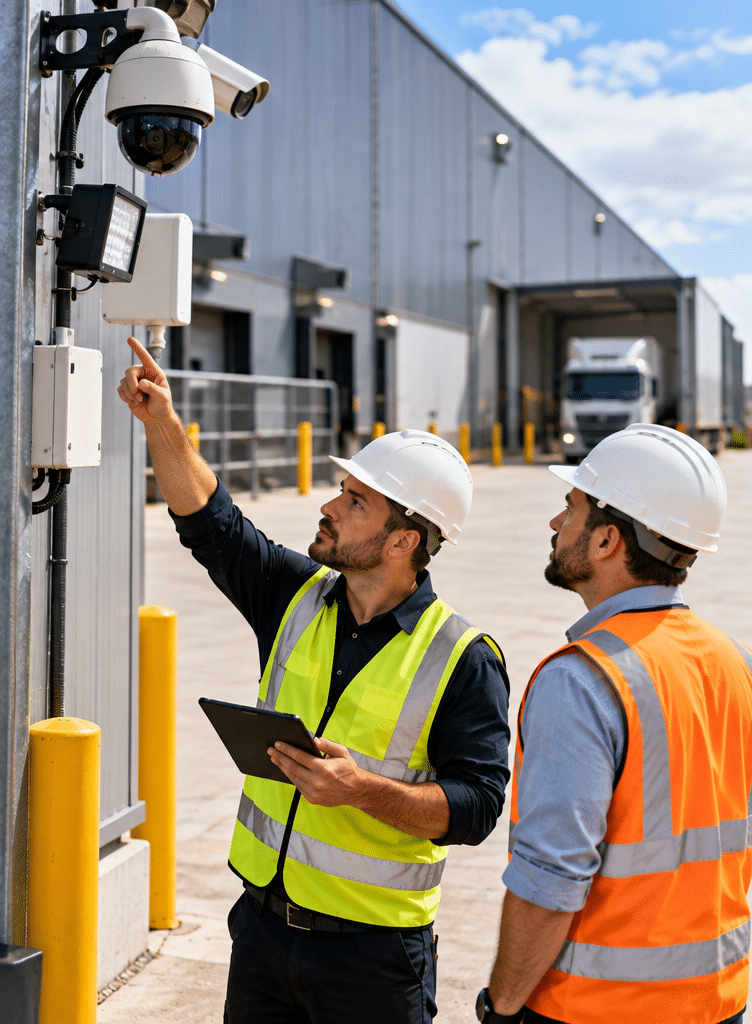
Industrial Security Systems play an important role in protecting Australian factories, warehouses, manufacturing plants, distribution centres and industrial facilities. These sites often contain valuable machinery, expensive inventory, sensitive business information and equipment that must remain operational. However, protecting an industrial property involves more than installing security cameras or locking the main entrance.
A modern industrial facility may have several entry points, large storage areas, delivery vehicles, contractors and employees working across different shifts. As a result, security risks can change throughout the day. A system that works well during normal business hours may not provide adequate protection overnight or during shutdown periods.
From a practical security planning perspective, the most effective approach begins with understanding how a facility operates. Camera placement, access permissions, alarm detection and monitoring procedures should support everyday operations rather than create unnecessary restrictions.
For Australian businesses, the goal is to build a coordinated security solution that protects people, property and operational continuity.
This guide explains the main technologies, installation considerations, Australian compliance requirements, costs and practical steps involved in choosing suitable industrial security solutions.
What Are Industrial Security Systems?
Industrial Security Systems are coordinated technologies and procedures that protect factories, warehouses, depots and industrial facilities against unauthorised access, theft, vandalism and other security threats. They typically combine CCTV surveillance, access control, intrusion alarms, perimeter detection and monitoring. Effective systems also consider workplace safety, privacy, cyber security and daily operations.

Table of Contents
- Why Industrial Security Systems Matter in Australia
- Common Security Risks at Industrial Facilities
- Essential Components of Industrial Security Systems
- How Industrial Security Systems Work Together
- Industrial CCTV Camera Placement
- Access Control for Employees and Contractors
- Perimeter Protection and Alarm Monitoring
- Designing Security for Harsh Industrial Environments
- Integrated vs Standalone Security Systems
- Cyber Security and Operational Technology
- Australian Privacy, Licensing and Compliance
- Industrial Security System Installation Costs
- Security Solutions for Different Industrial Sectors
- Industrial Security Installation Checklist
- Maintenance and System Reliability
- Choosing an Industrial Security Provider
- Common Security Planning Mistakes
- People Also Ask
- Expert Questions and Answers
- Conclusion
1. Why Industrial Security Systems Matter in Australia
Australian industrial facilities operate in environments where security, safety and business continuity are closely connected.
Manufacturing businesses depend on expensive machinery, specialist tools and raw materials. Warehouses handle large amounts of inventory, while transport depots manage vehicles, goods and delivery schedules.
A security incident can therefore create more than a direct financial loss.
For example, stolen electrical equipment may interrupt production. Unauthorised entry into a restricted storage area may create safety concerns. Likewise, damage to a warehouse roller door can delay deliveries and affect customers.
Consequently, Industrial Security Systems should address several business objectives.
Protecting valuable industrial assets
Machinery, vehicles, equipment and stored products can represent a significant business investment.
Depending on the facility, valuable assets may include:
- Manufacturing machinery and production tools
- Forklifts and material-handling equipment
- Commercial vehicles and trailers
- Electrical and mechanical equipment
- Raw materials and finished products
- Computers, servers and control equipment
- Specialist parts and maintenance supplies
A suitable security design identifies which assets require stronger protection.
For example, a high-value tool storage room may need electronic access control and CCTV. Meanwhile, a large outdoor equipment yard may benefit from perimeter detection and vehicle-entry monitoring.
Supporting safer workplaces
Security technology can help staff identify unexpected movement, investigate incidents and control access to restricted areas.
However, security equipment is not a substitute for workplace safety controls.
Emergency exits, machine guarding, traffic management and safe work procedures remain separate responsibilities.
Therefore, industrial security design should be reviewed alongside relevant workplace safety arrangements.
Improving business continuity
Industrial operations often depend on strict schedules.
Even a short interruption can affect production, dispatch or customer commitments.
A coordinated security system can improve incident awareness and support a planned response. Nevertheless, no system can eliminate every threat or guarantee uninterrupted operations.
2. Common Security Risks at Industrial Facilities
Every industrial site has a different risk profile.
A small fabrication workshop in Melbourne may face different challenges from a large distribution centre in Western Sydney or a regional equipment depot in Queensland.
Therefore, a site assessment should identify actual vulnerabilities before equipment is selected.
Unauthorised access
Industrial properties frequently have multiple doors, gates and delivery entrances.
Without clear access arrangements, visitors or former employees may enter areas they are no longer authorised to access.
Electronic access control can help reduce this risk by assigning permissions to individual users.
Theft of stock and equipment
Warehouses and manufacturing facilities may store goods that are attractive targets for theft.
Furthermore, some sites have periods when few employees are present.
CCTV, intrusion detection and secure storage arrangements can help businesses identify suspicious activity and review incidents.
Perimeter intrusion
Large industrial properties can be difficult to observe from one location.
External yards, fencing, rear access roads and poorly lit areas may require additional protection.
However, installing cameras around the entire boundary does not automatically provide reliable detection. A complete design must consider lighting, distance, obstacles and monitoring arrangements.
Internal security incidents
Not every incident involves an external intruder.
Incorrect access permissions, misplaced equipment and failures in visitor procedures can also expose a business to risk.
Therefore, appropriate access records, defined responsibilities and consistent security processes matter.
Unreliable security equipment
Industrial environments can expose equipment to dust, moisture, vibration and temperature changes.
As a result, poorly selected or maintained devices may fail when they are needed.
Regular testing and suitable equipment specifications are essential parts of long-term protection.
3. Essential Components of Industrial Security Systems
Effective Industrial Security Systems usually combine several technologies.
Each component has a different purpose. Understanding these differences helps businesses avoid spending money on equipment that does not address a meaningful risk.
CCTV surveillance cameras
Closed-circuit television, commonly called CCTV, provides visual information about activity around a property.
Industrial CCTV can help monitor:
- Factory entrances
- Warehouse aisles
- Loading docks
- Vehicle gates
- External storage yards
- Dispatch areas
- Restricted access points
- Car parks and building perimeters
Modern network cameras may offer high-resolution recording, remote viewing and motion-based alerts.
However, image quality depends on much more than camera resolution.
Lighting, lens selection, installation height and viewing angle also influence whether recorded footage is useful.
Electronic access control systems
Access control determines who can enter a particular area and when.
Instead of relying only on traditional keys, businesses can use electronic credentials such as access cards, fobs or mobile credentials.
For example, warehouse staff may need access to storage areas while maintenance contractors only require access to approved plant rooms.
This approach helps businesses manage permissions without distributing large numbers of physical keys.
In addition, lost credentials can generally be disabled without replacing every lock.
Intrusion alarm systems
Intrusion alarms detect events that may indicate unauthorised entry.
Common devices include door contacts, motion detectors and other approved intrusion sensors.
For example, a roller door sensor may detect opening outside approved operating hours.
However, an alarm is only useful when someone knows how to respond.
Therefore, businesses should define who receives notifications and what happens after an alert.
Perimeter security systems
Perimeter protection focuses on property boundaries and external entry points.
Depending on the site, solutions may include:
- External security cameras
- Gate access control
- Perimeter intrusion sensors
- Security lighting
- Fence-line monitoring
- Controlled vehicle entry
A layered approach is often more useful than relying on one device.
For example, a gate camera provides visual context, while access control manages approved entry.
Intercom and visitor management systems
Industrial facilities receive deliveries, contractors and other visitors.
An intercom allows staff to communicate with visitors before granting access.
Video intercoms can also provide visual confirmation.
For busy sites, these systems may support a structured process for vehicle arrivals and visitor entry.
Security monitoring
Monitoring connects detection technology with an agreed response process.
Depending on the service, alarm events may be reviewed by an authorised monitoring centre or sent directly to designated staff.
It is important to distinguish monitored alarms from continuously watched CCTV.
A monitored alarm does not necessarily mean every camera is being observed in real time.
Businesses should confirm exactly what the monitoring service includes.
4. How Industrial Security Systems Work Together
One of the main advantages of integrated Industrial Security Systems is the ability to connect information from different security devices.
Consider a manufacturing facility operating two shifts.
At the end of the evening shift, employees leave through an approved exit. The building then enters its after-hours security mode.
Later, a protected external door opens unexpectedly.
In a coordinated setup, several actions may occur:
- The door sensor detects the event.
- The intrusion alarm records the activation.
- A nearby CCTV camera provides visual information.
- The event is sent to an authorised person or monitoring service.
- The agreed response procedure is followed.
- Relevant records are retained according to company policy.
This example shows why integration can be valuable.
A camera provides visual evidence, but it may not alert anyone by itself. An alarm can detect an event, but it may not explain what happened.
When both systems are coordinated, staff can receive more useful information.
However, integration also creates technical dependencies.
If several functions rely on one server, network connection or software platform, a failure may affect multiple devices.
Therefore, reliability planning should include suitable backup arrangements, clear system ownership and recovery procedures.
5. Industrial CCTV Security Systems: Camera Placement
Camera placement is one of the most important parts of industrial CCTV design.
A high-quality camera installed in the wrong location may provide limited value.
For example, a camera mounted very high above a loading dock may show vehicle movement but fail to capture useful details at the entry point.
Consequently, installers should define what each camera must achieve.
Entrance and exit coverage
Entrances are important because they connect activity inside the facility with people and vehicles entering the property.
Cameras should provide suitable views of important access points.
However, overly wide viewing angles can reduce the detail available for identifying events.
Loading dock surveillance
Loading areas present several challenges.
Vehicles move frequently, large doors open and close, and lighting conditions can change throughout the day.
For example, sunlight entering through an open roller door may cause strong contrast.
Cameras with suitable wide dynamic range capabilities can help manage challenging lighting conditions.
Warehouse aisle monitoring
Warehouses contain shelving, racking and moving equipment.
Therefore, camera positions should account for changing stock heights and possible obstructions.
A camera that provides good coverage when a warehouse is empty may become less useful after new racking or storage units are installed.
Outdoor industrial surveillance
Outdoor cameras need suitable protection against environmental exposure.
Installation specifications may include weather resistance, operating temperature ranges and protection against physical damage.
Furthermore, night-time coverage should be tested under real lighting conditions.
A camera that produces a clear daytime image may perform differently when the yard is dark.
Recording and storage requirements
Businesses should decide how long footage is needed before selecting recording equipment.
Storage requirements depend on factors such as camera count, resolution, recording rate, compression and retention period.
For example, continuous recording from several high-resolution cameras can require substantially more storage than scheduled or event-based recording.
However, retention decisions must also consider applicable privacy obligations.
6. Industrial Access Control Systems for Employees and Contractors
Access control becomes increasingly important as industrial facilities grow.
Traditional keys are simple, but they can be difficult to manage when many employees and contractors require different permissions.
Electronic access control provides a more flexible approach.
Role-based access permissions
Role-based access means permissions are assigned according to a person’s responsibilities.
For example:
- Warehouse employees access approved storage areas.
- Production staff access designated manufacturing zones.
- Maintenance teams access relevant service rooms.
- Office staff access administrative areas.
- Contractors receive access limited to their approved work.
This reduces unnecessary access to sensitive locations.
Time-based access
Some facilities require access only during specific shifts.
Therefore, access permissions can be configured around approved working hours where the selected system supports that feature.
For example, a contractor may receive temporary entry during scheduled maintenance.
Once the work is complete, the credential should be reviewed and disabled.
Employee departures
A common administrative weakness is failing to remove access when someone leaves the organisation.
A clear offboarding procedure should cover physical credentials, digital accounts, alarm codes and remote access.
Additionally, access records should be reviewed when responsibilities change.
Emergency exit considerations
Electronic access control must not compromise safe evacuation.
Door hardware, fire systems and emergency release arrangements require appropriate professional design and review.
In particular, the correct locking behaviour during a power failure or fire event depends on the location and applicable safety requirements.
Security convenience must never take priority over safe egress.
7. Industrial Security Systems for Perimeter Protection
Perimeter security is especially relevant to sites with outdoor equipment, vehicle yards and multiple access points.
However, every movement near a boundary does not represent an intrusion.
Wind, vegetation, animals, weather and normal vehicle activity can cause unwanted alerts.
Therefore, careful configuration is essential.
Layered perimeter protection
A practical design might use three levels of protection.
First layer: Boundary awareness
External cameras and suitable sensors help detect or observe activity near the property boundary.
Second layer: Controlled entry
Gates, pedestrian entrances and vehicle access points manage authorised movement.
Third layer: Building protection
Door contacts, internal alarms and restricted-area controls add protection if someone crosses the external boundary.
This arrangement can reduce dependence on a single security measure.
Reducing nuisance alarms
Excessive false alarms can make employees less responsive to genuine incidents.
For example, a poorly configured outdoor detector may activate repeatedly when trees move in strong wind.
A better design considers the environment and tests detection settings under realistic conditions.
Furthermore, site managers should review recurring alarm patterns rather than simply ignoring them.
Planning the response
Before commissioning perimeter detection, businesses should answer several questions.
Who receives alerts? Who is authorised to attend the site? When should emergency services be contacted?
Clear answers improve consistency and reduce confusion during unexpected events.
8. Designing Industrial Security Systems for Harsh Environments
Industrial properties place demands on security equipment that may not exist in a typical office.
Therefore, environmental suitability should be assessed before installation.
Dust and airborne particles
Manufacturing workshops, warehouses and some processing facilities produce dust.
Over time, dust can reduce image clarity or affect unsuitable equipment.
Appropriate housings, installation locations and maintenance schedules can help.
Moisture and washdown areas
Some facilities contain wet environments or areas that require regular cleaning.
Equipment selected for these locations should have an appropriate ingress protection rating.
An IP rating describes protection against certain solid particles and water exposure.
However, a rating should be matched to actual site conditions rather than assumed to cover every cleaning method.
Heat and temperature changes
Equipment installed near machinery, roofs or exposed external walls may experience elevated temperatures.
Therefore, operating temperature specifications and ventilation should be considered.
Vibration and physical impact
Forklifts, machinery and vehicle movements can create vibration or impact risks.
Mounting positions should be selected to reduce accidental damage and maintain stable camera views.
Hazardous industrial areas
Sites containing flammable gases, combustible dust or other hazardous substances may require specialised engineering controls and equipment.
Ordinary security devices should not be assumed suitable for classified hazardous areas.
Qualified specialists must review these environments before installation.
9. Integrated vs Standalone Industrial Security Systems
Australian businesses often compare standalone security equipment with an integrated platform.
Both approaches can be appropriate, depending on the facility.
| Feature | Standalone security systems | Integrated security systems |
| CCTV management | Managed separately | May connect with other security events |
| Access control | Independent user management | May support centralised administration |
| Alarm detection | Separate alerts | Can support coordinated alerts |
| Installation | Often simpler for small sites | Requires more system planning |
| Initial investment | May be lower for a limited scope | Can be higher due to integration work |
| Maintenance | Several interfaces or service arrangements | More centralised, but integration must be maintained |
| Expansion | Compatibility may become an issue | Can be easier when supported by the chosen platform |
| Main limitation | Information may remain disconnected | Shared technical dependencies can increase complexity |
When standalone systems make sense
A small workshop with one entrance and a limited number of cameras may not need a complex integrated platform.
Standalone devices can be suitable when they address clear risks and remain easy to maintain.
When integration becomes valuable
Larger facilities may benefit from combining security events.
For example, a distribution centre with several vehicle gates, restricted storage rooms and different shifts may need centralised visibility.
However, integration should be tested before purchase.
Not every device supports every advertised integration, and some functions may require additional licences or software.
10. Cyber Security for Connected Industrial Security Systems
Many modern Industrial Security Systems operate through computer networks.
CCTV cameras, access controllers, recording servers and monitoring platforms may all exchange information electronically.
This creates useful capabilities such as remote management and centralised event reporting.
However, connected devices can also introduce cyber security risks.
Why network security matters
A poorly secured camera or recorder may provide an unwanted entry point into a business network.
Therefore, physical security and cyber security should be planned together.
Important controls include:
- Unique, strong administrator credentials
- Multi-factor authentication where supported
- Restricted remote access
- Supported firmware and software updates
- Network segmentation
- User permission reviews
- Secure configuration backups
- Logging and incident response procedures
Protecting operational technology
Operational technology, or OT, refers to systems that monitor or control physical industrial processes.
Examples include industrial controllers, automation systems and certain production equipment.
These systems often have different reliability and safety requirements from ordinary office computers.
According to the Australian Signals Directorate’s principles of operational technology cyber security, organisations should prioritise safety, understand critical systems and separate OT networks from less trusted networks.
For an industrial facility, this means new CCTV or access control equipment should not automatically be connected to production control networks.
Instead, the site’s IT and OT specialists should review the architecture.
Secure remote access
Remote viewing can help managers check security events without visiting the site.
However, convenience should not weaken protection.
Businesses should avoid unnecessary direct internet exposure of security devices.
Where remote access is needed, it should use an appropriately secured and supported method.
Furthermore, former employees and contractors should not retain remote access after their responsibilities end.
11. Australian Industrial Security Compliance and Privacy
Industrial security planning in Australia involves several legal, regulatory and administrative considerations.
Requirements depend on the state or territory, the type of facility and how equipment is used.
The following points provide general information, not legal advice.
CCTV privacy obligations
Security cameras may collect personal information when people can be identified from recordings.
The Office of the Australian Information Commissioner (OAIC) explains that organisations covered by the Privacy Act 1988 must comply with the Australian Privacy Principles when collecting personal information through surveillance devices.
The OAIC also explains that state and territory surveillance laws may apply.
Therefore, a business should review matters such as:
- CCTV notification and signage
- The purpose of recording
- Camera locations
- Access to recorded footage
- Secure storage
- Footage retention and deletion
- Requests for access or disclosure
- Applicable employee monitoring requirements
Importantly, there is no single footage retention period that is suitable or legally required for every Australian industrial site.
Retention should reflect applicable obligations, operational needs and documented policy.
Audio recording and biometric identification require particular care because additional restrictions or privacy considerations may arise.
Security installer licensing in Victoria
Eclipse Security Systems operates from Melbourne, so Victorian requirements are especially relevant.
As of October 2026, Victoria Police identifies security equipment installation and security advice as regulated private security activities.
Its private security licensing guidance describes relevant licence activities and explains how businesses can verify authorisations through the public register.
Consequently, Victorian businesses should confirm that their selected provider and relevant personnel hold the appropriate authorisations for the work.
Requirements in other Australian states and territories may differ.
Workplace safety coordination
Industrial security installation should also be coordinated with site safety procedures.
This may involve induction requirements, electrical safety, elevated work arrangements and working near moving machinery.
For example, installation work near an active loading dock may need scheduling and traffic controls.
Similarly, security locks and electronic doors should be reviewed against fire safety and emergency exit arrangements.
Record keeping and administrative support
Businesses can support their compliance processes by maintaining:
- Installer and contractor details
- Relevant licence verification records
- System drawings and asset registers
- Camera location schedules
- Access permission records
- Maintenance reports
- Alarm response instructions
- Privacy and footage management procedures
These are useful administrative practices. A suitably qualified professional should review legal and regulatory obligations for the specific site.
12. Industrial Security Systems Installation Costs in Australia
The cost of Industrial Security Systems depends on the property, security requirements and selected technology.
There is no reliable single price for every industrial facility.
For example, a small warehouse needing several cameras and basic alarm protection will have different requirements from a large manufacturing site with several buildings.
Main factors affecting installation costs
Property size
Larger sites may require additional cameras, cabling, network equipment and installation labour.
Number of entry points
Multiple gates, doors and restricted areas can increase access control requirements.
Environmental conditions
Specialised housings and suitable equipment may be needed in harsh industrial environments.
Network infrastructure
Existing cabling, switches and recording equipment can affect the total project cost.
Integration requirements
Connecting CCTV, alarms, access control and monitoring platforms may involve additional configuration and testing.
Monitoring arrangements
Professional monitoring can involve recurring charges, depending on the service agreement.
Maintenance and licensing
Ongoing costs may include servicing, software licences, equipment replacement and technical support.
Understanding the full project cost
A practical budget should consider more than the initial equipment price.
Businesses should ask for a written breakdown covering design, hardware, installation, commissioning, training and ongoing support.
In addition, quotes should clearly identify exclusions.
For example, electrical work, access equipment, civil works or new network infrastructure may not be included in every proposal.
No price estimate should be treated as a confirmed quotation without a site assessment.
How to prioritise a limited budget
When funding is limited, begin with high-risk areas.
An initial stage might focus on building entrances, valuable stock rooms and critical external access points.
Later stages can extend coverage to other parts of the property.
However, the first-stage design should consider future expansion so that equipment does not need to be replaced unnecessarily.
13. Industrial Security Solutions for Different Australian Sectors
Different industrial sectors have different security priorities.
Therefore, Industrial Security Systems should be designed around business activities rather than supplied as identical packages.
Manufacturing facilities
Manufacturing businesses often need to protect machinery, raw materials, production areas and maintenance rooms.
For example, a facility in Dandenong South may have employees working different shifts and delivery vehicles entering throughout the day.
A suitable system could combine:
- CCTV at important entrances and loading areas
- Electronic access control for restricted rooms
- Intrusion detection after operating hours
- Perimeter monitoring
- Secure access to security management systems
Importantly, camera installation and access controls should not interfere with production safety.
Warehouses and distribution centres
Distribution centres often have large internal spaces, several loading docks and frequent vehicle movements.
Facilities in logistics areas such as Truganina or Western Sydney may need different security rules for staff, contractors and delivery drivers.
For these locations, vehicle-entry procedures and loading dock visibility are often important.
However, a security system should complement warehouse traffic management, not replace it.
Transport and logistics depots
Transport depots may store vehicles, trailers, fuel-related equipment and goods awaiting delivery.
Security priorities can include entry gates, vehicle parking areas and after-hours access.
For example, licence plate recognition may be useful at certain controlled vehicle entrances.
Nevertheless, recognition accuracy depends on camera placement, vehicle movement, lighting and image quality.
Food production facilities
Food processing sites may require restricted access to production and storage areas.
Furthermore, hygiene requirements can influence where security equipment is installed.
Equipment should not create cleaning difficulties or introduce contamination risks.
Industrial workshops
Smaller workshops may not require a large integrated platform.
However, tools, equipment and unattended premises can still benefit from appropriate protection.
A practical solution may begin with entry cameras, monitored alarms and controlled access to valuable storage areas.
Regional industrial properties
Regional depots and remote facilities may have limited network connectivity or longer response distances.
Therefore, communication reliability, backup power and realistic response arrangements deserve particular attention.
A monitoring service may detect an event, but the business must still understand what response is available at that location.
14. Industrial Security Systems Installation Checklist
A structured installation process helps businesses avoid unnecessary equipment, hidden costs and incomplete coverage.
The following checklist can support project planning.
10-Step Industrial Security Installation Checklist
- Define your main security objectives. Identify whether the priority is theft prevention, restricted access, incident visibility, after-hours protection or several of these outcomes.
- Complete a site risk assessment. Review doors, gates, perimeter boundaries, loading areas, storage rooms and other important locations.
- Identify valuable and critical assets. Consider machinery, equipment, stock, vehicles, records and systems needed for continued operations.
- Map staff and vehicle movement. Understand shift changes, delivery patterns, contractor access and normal operating hours.
- Review existing equipment. Document current cameras, alarms, cabling, access devices and recording systems. Identify items that may be suitable for reuse.
- Develop a suitable security design. Select camera positions, alarm zones, access permissions, monitoring arrangements and backup requirements.
- Check licensing, privacy and safety requirements. Confirm relevant installer authorisations and coordinate work with responsible site personnel.
- Install and configure the equipment. Use appropriately authorised personnel and follow product specifications and approved site procedures.
- Test the complete system. Confirm camera views, recording, alarms, controlled doors, alerts, backup functions and agreed integrations under realistic conditions.
- Complete handover and staff training. Receive system documentation, administrator access arrangements, operating instructions, maintenance details and support contacts.
A checklist is most useful when every step has an assigned owner.
For example, the security provider may manage installation testing, while the business appoints someone to approve access permissions and maintain staff records.
Furthermore, project acceptance should depend on demonstrated operation rather than equipment simply being powered on.
15. Industrial Security Systems Maintenance and Reliability
Installation is only the beginning of a security system’s lifecycle.
Over time, equipment can be affected by weather, dust, building alterations and changes to business operations.
Therefore, planned maintenance is important.
Camera maintenance
Industrial camera checks may include image clarity, alignment, physical condition and recording performance.
For example, a camera near a dusty workshop may require more frequent cleaning than a camera inside a climate-controlled office.
Alarm testing
Alarm sensors, communication pathways and backup arrangements should be tested according to their specifications and site risk.
Additionally, recurring nuisance alarms should be investigated.
Repeated unwanted alerts may indicate poor configuration, unsuitable equipment or environmental changes.
Access control reviews
Businesses should review user permissions, inactive credentials and system events.
Employee departures and contractor access changes should trigger updates.
Software and cyber maintenance
Network-connected systems require ongoing attention to supported firmware, secure configuration and administrative accounts.
However, updates should be planned carefully where system availability is important.
Backups and recovery arrangements should also be reviewed.
Maintenance schedules
There is no universal servicing interval appropriate for every device and industrial property.
A maintenance plan should reflect manufacturer requirements, environmental conditions, contractual arrangements and the site’s risk profile.
For higher-risk facilities, additional inspections or checks may be sensible.
16. How to Choose an Industrial Security Systems Provider
Selecting a provider is about more than comparing equipment prices.
A suitable provider should understand the facility and explain why each proposed component is needed.
Look for relevant industrial experience
Ask whether the provider has experience with manufacturing sites, warehouses, logistics facilities or similar environments.
Industrial projects may require different installation methods from standard office security.
For example, working around forklifts, machinery and large external yards requires careful site planning.
Evaluate the proposed design
A good proposal should identify the risks being addressed.
It should explain camera locations, access control requirements, alarm zones and any planned integrations.
In addition, the business should understand what happens when power, connectivity or monitoring communications fail.
Confirm licensing and insurance
Verify the relevant security authorisations and appropriate insurance arrangements.
For Victorian work, check the applicable private security requirements.
Also, ensure any electrical or specialised work is undertaken by properly authorised personnel.
Ask about ongoing support
Security equipment requires maintenance and occasional repairs.
Therefore, ask about response arrangements, warranties, service contracts and technical support.
Consider scalability
A business may expand its warehouse, add another building or change working hours.
Choosing an appropriately scalable system can reduce future disruption.
However, suppliers should explain actual compatibility and expansion limits rather than making broad promises.
17. Common Industrial Security Planning Mistakes
Even expensive security technology can provide limited value when planning is poor.
The following mistakes are worth avoiding.
Buying cameras before assessing risks
More cameras do not necessarily mean better security.
For example, several cameras may cover the same low-risk area while leaving a vehicle entrance poorly observed.
Instead, define the purpose of each camera before installation.
Ignoring after-hours response procedures
An alarm may activate correctly, but the event can still go unresolved if nobody receives or acts on the notification.
Therefore, contact details and escalation procedures should remain current.
Failing to remove old access credentials
Inactive employees and former contractors may retain unnecessary permissions.
Regular access reviews help prevent this problem.
Overlooking cyber security
Network cameras and security servers should not be treated as isolated devices simply because they serve a physical security function.
Secure passwords, controlled connections and software maintenance remain important.
Underestimating environmental conditions
Equipment suited to an office may not perform reliably in a dusty, wet or high-temperature industrial location.
Specifications should reflect the installation environment.
Treating maintenance as optional
A camera can appear operational while recording poor-quality footage.
Likewise, a failed backup battery may remain unnoticed until a power interruption.
Consequently, routine testing and maintenance should be included in the operating budget.
Overlooking staff training
Complex technology can create confusion when employees do not understand basic procedures.
Staff should know how to report faults, respond to alarms and manage authorised access.
18. People Also Ask: Industrial Security Systems in Australia
1. What is the best security system for an industrial building?
The best system depends on the building’s risks, size and operating hours. Many industrial buildings benefit from a combination of CCTV, access control, intrusion alarms and a clear incident response plan rather than relying on one security product.
2. Do Australian factories need CCTV cameras?
There is no universal rule requiring every Australian factory to install CCTV. However, cameras can support asset protection and incident investigation, provided their use follows applicable privacy, surveillance and workplace requirements.
3. Can industrial security systems be monitored remotely?
Yes. Many modern systems support remote alerts, secure camera access and professional alarm monitoring, depending on their configuration. Businesses should confirm who responds to alerts and whether CCTV footage is actively monitored or simply recorded.
4. How long does industrial security installation take?
Installation time depends on property size, cabling, equipment availability and integration requirements. A small installation may be simpler than a multi-building project, but only a site assessment can support a reliable schedule.
5. Are industrial security systems suitable for small warehouses?
Yes. Smaller warehouses can use carefully selected cameras, alarms and access controls without purchasing a large enterprise platform. The priority should be addressing identified risks with equipment that can be maintained and expanded if necessary.
19. Industrial Security Systems: Expert Questions and Answers
Q1. How can an industrial business check whether its CCTV storage is sufficient?
Start by defining the recording quality and retention period required for each camera.
Then assess the number of cameras, frame rate, resolution, compression and recording schedule.
For example, a camera recording continuously usually requires more storage than one recording only during selected events, assuming other settings are comparable.
However, event-based recording may miss important context if detection fails.
Therefore, businesses should test the selected configuration using realistic activity and confirm that footage can be retrieved when needed.
Storage planning should also consider privacy policies, secure access and equipment failure.
Q2. What should happen to an industrial security system during a power outage?
The expected behaviour should be agreed during system design.
Certain components may use batteries or an uninterruptible power supply, commonly called a UPS, to maintain operation for a limited period.
However, backup duration depends on the equipment load and available capacity.
A facility should identify which functions need continued power.
These may include essential recording equipment, alarm communications or other critical security functions.
Most importantly, power failures must not compromise emergency exits or other life-safety arrangements.
Qualified specialists should determine the appropriate design.
Q3. Can industrial CCTV integrate with existing warehouse management software?
Some security platforms support integration through compatible software interfaces or approved third-party systems.
For example, an integration may associate a security event with a time, location or authorised operational record.
However, compatibility is not automatic.
The business should confirm technical support, cyber security requirements and the data that will be exchanged.
Privacy and access permissions also need review.
In many cases, a simpler arrangement that keeps security and warehouse management systems separate may be more appropriate.
Q4. How should a business measure the performance of its industrial security system?
Security performance should be measured using practical operational indicators.
Useful measures may include equipment availability, unresolved faults, alarm response times, nuisance alarm trends and whether important footage can be retrieved successfully.
Access control records can also show whether inactive credentials are being removed on time.
However, incident counts alone are not a complete measure of effectiveness.
A low number of detected incidents could reflect a low-risk period, successful deterrence or poor detection.
Therefore, businesses should combine technical testing with periodic risk reviews.
Q5. What information should an industrial facility receive after installation?
A complete handover should provide enough information for the business to operate and maintain the installed system.
Depending on the project, this may include:
- An installed equipment register
- Updated camera and device locations
- System configuration information
- Administrator account handover arrangements
- User and access permission procedures
- Alarm zone descriptions
- Monitoring and escalation instructions
- Warranty and support information
- Maintenance recommendations
- Testing and commissioning records
Sensitive credentials should be transferred securely rather than included in widely distributed documents.
Additionally, the business should identify who owns the system’s administration after handover.
This helps prevent long-term dependence on one employee or contractor.
20. Conclusion: Building Reliable Industrial Security Systems in Australia
Industrial Security Systems are an important part of protecting Australian factories, warehouses, distribution centres and other industrial facilities.
However, effective protection depends on more than purchasing advanced cameras, alarms or access control equipment.
The strongest approach begins with understanding the property, identifying meaningful risks and selecting technologies that support real operational needs.
CCTV can provide valuable visual information. Access control can manage authorised movement. Intrusion alarms can detect unexpected activity. Meanwhile, monitoring and response procedures help turn security events into practical action.
Just as importantly, businesses should consider cyber security, privacy, workplace safety, maintenance and future expansion.
A smaller, well-planned solution can be more useful than an expensive system with unnecessary features.
For Australian industrial businesses, the next step is to review existing arrangements, identify security gaps and develop a practical improvement plan.
Protect Your Industrial Facility with Eclipse Security Systems
Eclipse Security Systems provides security solutions for Australian commercial and industrial environments, including CCTV, access control, alarm systems, monitoring, installation and maintenance.
Whether you are improving security at a manufacturing facility, warehouse or industrial property, a professional site assessment can help identify suitable options.
Explore industrial and commercial security solutions from Eclipse Security Systems to discuss your facility’s requirements and request a security assessment.
A reliable industrial security strategy starts with the right assessment, suitable technology and a response plan that works for your business.